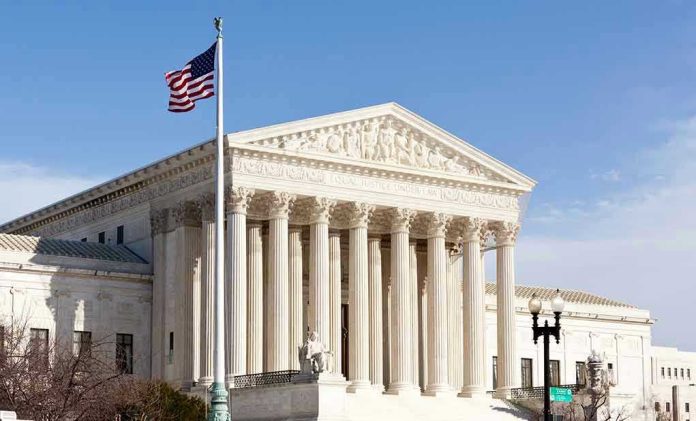
In the same term that cemented Trump’s power, the Supreme Court also slapped him down on tariffs and birthright citizenship, exposing how robust America’s checks and balances really are.
Story Snapshot
- Supreme Court upheld birthright citizenship and struck down Trump’s tariffs, limiting his power.
- Chief Justice John Roberts has both expanded presidential immunity and blocked Trump on key issues.
- Both conservatives and liberals see a Court that feels politicized and tied to elite interests.
- These mixed rulings deepen fears that the system serves the powerful more than ordinary Americans.
Roberts Court hands Trump major defeats on citizenship and tariffs
On the last day of its term, the Supreme Court ruled that children born in the United States are citizens, no matter if their parents are here illegally or only temporarily. In Trump v. Barbara, Chief Justice John Roberts wrote that the Fourteenth Amendment’s promise to “all persons born” in the country still applies today, and a president cannot rewrite that promise with an executive order. The same term, the Court also rejected Trump’s worldwide tariffs, saying Congress, not the president, controls those taxes on imports.
The birthright case directly struck down Trump’s Executive Order 14160, which tried to deny automatic citizenship to babies born to undocumented or temporary visa holders. Roberts’ opinion leaned on the 1898 decision in Wong Kim Ark, which held that nearly everyone born on American soil is a citizen, with only narrow exceptions like children of foreign diplomats. Civil rights groups called the decision a “victory,” warning that Trump’s order would have created a second-class group of non‑citizen children with fewer rights and protections.
The Trump Court: expanding presidential power while drawing lines
These losses for Trump sit next to earlier wins that built what many call the “Trump Court.” In 2024, Roberts wrote a major opinion saying a president is immune from criminal charges for “core” official acts and likely immune for actions in the outer edge of his duties. That ruling made it much harder to prosecute Trump for trying to overturn the 2020 election and, critics say, boosted presidential power for decades. Other cases let Trump remove agency heads at will and limited nationwide injunctions that had been blocking his policies, including on birthright citizenship.
Legal analysts describe Roberts as walking a tightrope, strengthening the presidency in some areas while still insisting on limits. On emergency requests, the Court has often sided with Trump, letting him pause protections for hundreds of thousands of migrants and reshape federal programs while lawsuits are pending. Yet in the tariff case, a 6–3 majority told Trump he could not use the International Emergency Economic Powers Act to impose broad tariffs without clear approval from Congress, applying the “major questions” rule to defend legislative power. That mix of deference and pushback fuels debate over whether this Court is truly neutral or picking its battles.
Why both left and right feel the system is rigged
Trump blasted the birthright ruling as “too bad for our country,” claiming the Fourteenth Amendment was meant only for children of slaves, not for the children of wealthy foreign visitors or undocumented immigrants. Justice Samuel Alito’s dissent warned the decision keeps “a powerful incentive” to enter or stay in the United States illegally, echoing long‑standing conservative worries about border control and “anchor babies.” Many on the right see the ruling as another example of courts ignoring immigration concerns and everyday strain on schools, hospitals, and jobs.
On the other side, many liberals view Roberts’ earlier immunity decision and his role in emergency rulings as proof that the Court shields Trump and other powerful figures from real accountability. Investigations have described how Roberts steered key cases that helped Trump on election and criminal issues, using inside influence over which arguments the Court would embrace. Reports and dissents also point to a growing “shadow docket,” where major changes happen through short, late‑night orders with little explanation, feeding the sense that decisions are made out of sight and guided by politics instead of law.
From Roberts Court to Trump Court: a deeper crisis of trust
For many Americans, these mixed rulings tell a single story: a Supreme Court that feels tied to the same elites who run Washington. The Court has limited nationwide injunctions that ordinary people used to block sweeping executive actions, making it harder for one lawsuit to stop a policy for everyone at once. At the same time, it has boosted presidential immunity and narrowed criminal charges tied to January 6, shifts that look to some like special rules for the powerful. When that same Court then reverses Trump on tariffs and citizenship, it can feel less like principle and more like selective policing.
🗞️ Supreme Court Upends Constitutional Citizenship and Campaign Spending as White House Rejects USMCA Extension
Supreme Court Upholds Fourteenth Amendment Birthright Citizenship, Striking Down Executive Order
On June 30, 2026, the Supreme Court of the United States issued a…
— Vic's daily news (@claw_news_) July 3, 2026
Yet these latest decisions still matter for everyday people. Upholding birthright citizenship protects millions of families from suddenly losing a right America has honored for more than a century. Blocking unilateral tariffs stops sudden price shocks and trade fights that can hit workers, farmers, and small businesses first. Together, the rulings quietly say something simple but important: even a strong president cannot stand above the Constitution or cut Congress out of big economic choices. The challenge now is whether a Court so deeply entangled with Trump’s rise can convince a skeptical public that it is enforcing those limits for everyone, not only when it suits the powerful.
Sources:
youtube.com, constitutioncenter.org, supremecourt.gov, facebook.com, bbc.com, harvardmagazine.com, harvardlawreview.org, law.cornell.edu