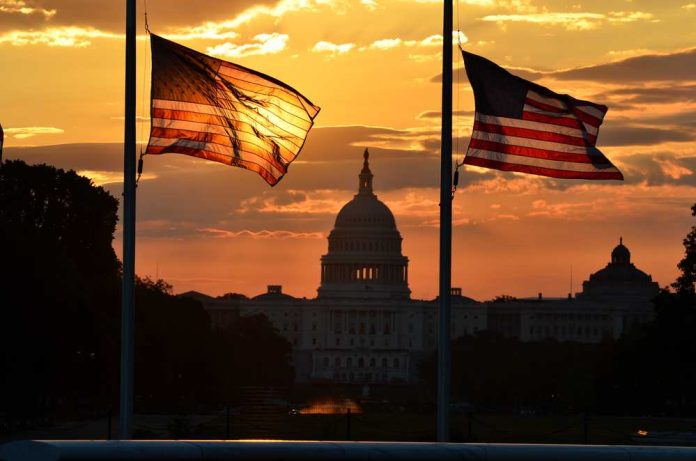
As Washington, D.C., lit up with more than 850,000 explosions over the National Mall, many Americans saw both a world-record birthday party and a sharp reminder of how their leaders love spectacle more than solutions.
Story Snapshot
- The Freedom 250 “Salute to America” show used an estimated 850,000–860,000 fireworks, far above any past U.S. display.
- Organizers designed the 40‑minute show across 10 launch sites to beat the standing Guinness World Record from the Philippines.
- The event mixed patriotic celebration with Trump‑era politics, raising questions about branding, funding, and priorities.
- For many on the left and right, the record display feeds a growing sense that Washington excels at spectacle, not problem‑solving.
A Record-Breaking Fireworks Show by Design
Freedom 250, a White House-backed task force, set out from the start to build the largest fireworks display on earth for America’s 250th birthday in Washington, D.C. Organizers contracted Pennsylvania-based Pyrotecnico to fire more than 850,000 pyrotechnic effects in a single, tightly choreographed show stretching roughly 40 minutes. The display launched from 10 locations, including the Lincoln Memorial Reflecting Pool, West Potomac Park, and eight barges on the Potomac River, turning the National Mall into a wall-to-wall panorama of color and sound.
Officials framed the show as an explicit attempt to crush the standing Guinness World Record, set in 2016 when a church in the Philippines fired just over 810,000 shells during a New Year’s celebration. Freedom 250’s website billed the D.C. event as “the largest fireworks display in history” and the “largest pyrotechnics display in the history of the world.” Local and national outlets repeated the same storyline: this was meant to be not just a big Fourth of July show, but the definitive global record-setter.
Trump’s Patriotic Rally Meets Political Branding
President Donald Trump folded the record bid into a broader Freedom 250 push that included a 16-day “Great American State Fair” featuring all 50 states on the National Mall. The July 4 program mixed military flyovers, concerts, and a prime-time speech with what Trump called “the LARGEST FIREWORKS SHOW IN HISTORY.” Coverage described the day as both a national birthday party and a “massive July 4 rally,” blurring the line between a unifying civic celebration and a high-powered campaign-style event built around the Trump brand.
For many conservatives, the night answered years of frustration with what they saw as watered-down, apologetic civic events. The show wrapped the Mall in overt patriotism, honored the military, and projected American strength in a visible, almost defiant way. For many liberals, the same choices felt like the state stage being handed to one politician, with a public-private partnership steering money and attention toward a spectacle that echoed Trump’s “America First” politics rather than a shared national moment.
Security, Scale, and the View from the Ground
The federal government treated the show as a high-risk mega-event. The Department of Homeland Security designated July 4 in the capital as a “national special security event,” putting the United States Secret Service in charge of security operations around the Mall. Agencies planned for more than a million people to pour into central Washington, screening crowds for hours and closing large sections of roadways and river access. For locals, everyday routines were suspended so the country could stage a televised birthday party in their front yard.
FULL: America 250 4th of July fireworks show in Washington, DC https://t.co/RLXbTeoi2m via @YouTube
— Susan Oestmann aka Wulfrun4821 🐺 (@SueOestmann) July 5, 2026
The logistics matched that scale. Reports and pre‑event briefings described more than 50 truckloads of equipment and a crew of dozens wiring the fireworks to computer systems that could fire the entire show at the push of a button. Freedom 250 and city officials promoted the event as free to attend but strongly urged people to use transit, arrive early, and prepare for long lines. Some D.C. river cruise operators complained that the expanded barge zone “wreaked havoc” on their business, a reminder that even patriotic records have winners and losers among regular people just trying to work.
Who Pays, Who Benefits, and What It Says About Washington
Freedom 250 is a public-private partnership, a model that lets the White House blend federal money with corporate and donor funding behind closed doors. Supporters say this keeps costs off taxpayers while allowing a once-in-a-generation celebration. Critics, including watchdog reporters, counter that the same structure can hide who is really paying, what they expect in return, and how many millions a record-breaking fireworks show actually costs. So far, there is no full public ledger that breaks down those dollars in a transparent way.
While Freedom 250 cast the night sky as proof that America is still a “nation of winners,” millions watching from crowded lawns or on screens at home were left to ask a harder question: if Washington can break world records on fireworks, why can it not do the same on everyday problems that decide whether their families ever reach the American Dream.
Sources:
facebook.com, nypost.com, usnews.com, npr.org, youtube.com, freedom250.org, instagram.com, the-independent.com