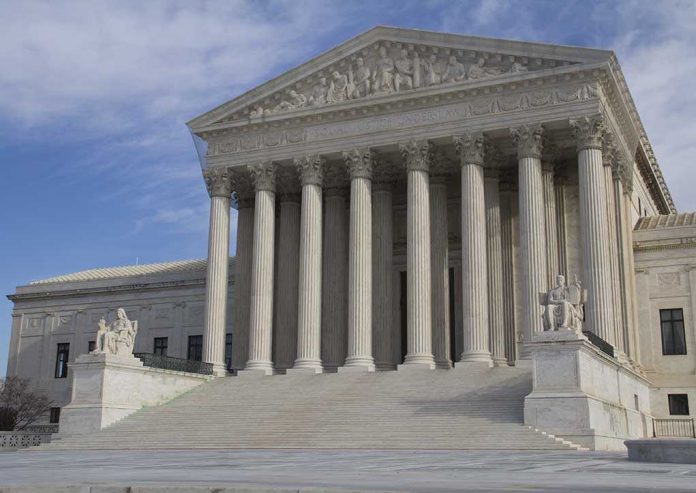
The Supreme Court’s narrow birthright citizenship ruling is already inspiring new citizenship scams that exploit legal gray areas and deepen public distrust in the system.
Story Snapshot
- Supreme Court struck down President Trump’s Executive Order 14160 but limited how judges can block policies.
- The ruling confirms almost all babies born on United States soil are citizens, yet leaves room for confusion.
- Advocates warn that bad actors are using this confusion to sell fake “citizenship fixes” and risky schemes.
- Both conservatives and liberals see the case as proof that leaders play politics while ordinary families pay the price.
What Executive Order 14160 Tried To Do
On January 20, 2025, President Donald Trump signed Executive Order 14160, called “Protecting the Meaning and Value of American Citizenship.” The order said many children born in the United States would no longer be citizens if their mothers were in the country illegally or only here for a short time, and if their fathers were not citizens or permanent residents. The policy was set to apply only to babies born 30 days after the order, starting in February 2025. Trump argued that the Fourteenth Amendment’s phrase “subject to the jurisdiction thereof” does not cover these children, claiming true citizenship requires a deeper allegiance to the country.
Legal groups and civil rights advocates quickly sued, saying the order clearly violated the Fourteenth Amendment’s Citizenship Clause. That clause says all persons born or naturalized in the United States and subject to its jurisdiction are citizens, and courts have long read it to include children of immigrants regardless of legal status. Multiple federal judges issued nationwide injunctions, temporarily blocking the order everywhere and keeping birthright citizenship in place while the cases moved forward. These fast court actions showed how serious the threat looked to many families and lawyers.
The Supreme Court’s Two-Step Involvement
In June 2025, the Supreme Court ruled that district courts should rarely issue nationwide injunctions, saying judges should normally protect only the people who sue, not everyone in the country. That decision did not decide whether Trump’s order was constitutional, but it narrowed earlier injunctions and allowed the government to enforce the policy against people who were not covered by the lawsuits. One year later, in Trump v. Barbara, the Court faced the core question: can the president end birthright citizenship for children of undocumented or temporary-status parents using an executive order alone?
On June 30, 2026, the Supreme Court ruled 6–3 against Trump, voiding Executive Order 14160. The majority held that children born in the United States to parents unlawfully or temporarily present are “subject to the jurisdiction” of the United States and are citizens at birth under the Fourteenth Amendment. The decision relied on the 1898 case United States v. Wong Kim Ark, which said the Citizenship Clause follows old English common law: almost every baby born on United States soil is a citizen, no matter the parents’ status. The Court reaffirmed that this has been the rule for more than a century.
How The Ruling Fuels Confusion And Scams
Even though the Court struck down Trump’s order, the earlier limit on nationwide injunctions left many people unsure about their rights during the legal battle. While lawsuits moved through the system, some families heard that birthright citizenship might not apply to their newborns, depending on where they lived or whether their state joined a case. That patchwork message created space for dishonest actors to sell fake “citizenship protection” services, promising special paperwork or secret legal tricks that do not exist in United States law.
Advocacy groups report that some parents were told they needed to pay for help to “lock in” their baby’s citizenship before courts changed the rules. Others were pushed into risky travel plans or sham relationships, based on false claims that the Court might soon narrow birthright citizenship again. These scams prey on fear and confusion that many working families already feel about immigration and government power. They also deepen a wider belief, shared by many conservatives and liberals, that the system is rigged for those with money and connections, while regular citizens are left guessing.
What Both Sides Agree And Disagree On
Many conservatives see Trump’s order as part of a broader push to tighten immigration and protect national identity, but the Court’s decision confirms that ending birthright citizenship cannot be done by executive order alone. Changing the Citizenship Clause would require a constitutional amendment, which means two-thirds of Congress and three-quarters of states would have to agree. That high bar reflects how strongly the country once valued clear, automatic citizenship for children born here, including those of poor or marginalized parents.
Many liberals focus on the harm the order would have caused, arguing it would have made some babies effectively stateless and turned hospital maternity wards into immigration checkpoints. Yet both sides share a growing anger that leaders use complex legal fights to score points, not to bring stability. The Supreme Court’s rejection of the order protects birthright citizenship, but the long, confusing path to that result shows how easily families can be caught between executive power, court limits, and political games — and how quickly scammers move in when trust in government breaks down.
Sources:
pjmedia.com, asianlawcaucus.org, naacpldf.org, aclu-nj.org, brennancenter.org, aila.org, youtube.com, ogletree.com, latino.ucla.edu