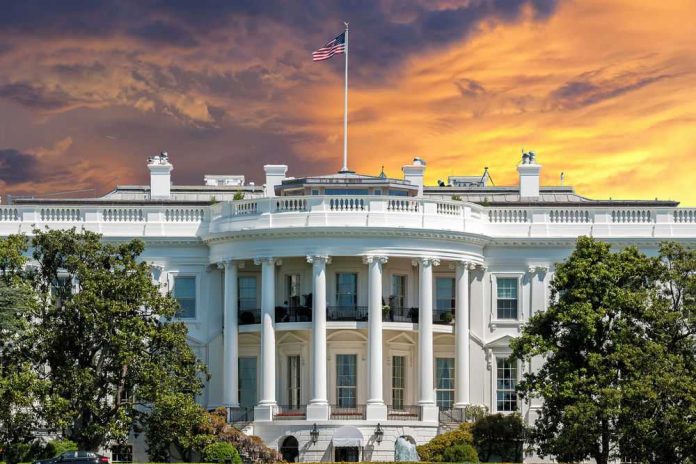
A new granite helipad on the White House lawn, funded by a major defense contractor, is turning a routine presidential helicopter landing into a fresh test of how much private money and corporate influence now shape America’s most symbolic home.
Story Snapshot
- Trump says a granite helipad on the South Lawn is needed because new Marine One helicopters are burning the grass.
- Defense giant Lockheed Martin, through Sikorsky Aircraft, is reportedly covering the $5–$6 million cost, not taxpayers.
- Construction has already started, but key documents about funding, design, and oversight have not been made public.
- The project fits a pattern of Trump-era “privately funded” White House upgrades that later raised conflict-of-interest and transparency questions.
Trump’s Helipad Plan: What He Says Is Happening
President Donald Trump has announced that a new **granite helipad** is being built on the White House South Lawn for Marine One, the presidential helicopter. He says the landing pad is needed because the latest VH-92A “Patriot” helicopters are more powerful and their exhaust has been scorching the grass during landings and takeoffs. Reports from major outlets describe construction crews already working on the site, with access to parts of the lawn restricted while the project moves forward.
Trump and news reports say the project will cost around **$5–$6 million**, and he has claimed that Sikorsky Aircraft, owned by defense contractor Lockheed Martin, will pay the bill. One report quotes a company official saying Lockheed Martin agreed to donate about $5 million for the helipad. Other stories echo Trump’s line that this means “no taxpayer dime” for the pad itself, even as details about related security or maintenance costs are still unclear. The pad is also supposed to feature the White House seal carved directly into the granite.
Funding, Documents, and the Deep-State-Style Transparency Gap
So far, no official White House contract, memo, or engineering plan has been released to confirm how the money flows or who oversees the work. Several stories mention “private donors” alongside Sikorsky, but do not name those donors or explain how their gifts connect to Lockheed Martin’s pledge. That lack of paperwork and clear answers feeds the growing belief on both the right and left that big projects in Washington are arranged behind closed doors, with ordinary citizens kept outside the loop while politically connected companies get special access.
This helipad story also echoes Trump’s earlier White House ballroom project, where he repeatedly promised taxpayers would not pay “a dime,” yet later documents showed federal agencies could cover as much as half of the inflated $600 million price tag. Watchdog groups found that many donors to the ballroom had large government contracts and lobbying interests. Critics argued that giving to the Trust for the National Mall, the nonprofit managing ballroom funds, looked a lot like a back door way to gain favor with the administration. That history makes people suspicious when Trump now touts another “privately funded” upgrade that relies on a major defense contractor.
Corporate Influence, Conflicts of Interest, and Shared Public Concerns
Lockheed Martin both builds the new Marine One helicopters and is reportedly funding the helipad those helicopters will use. That dual role raises obvious questions. Is this a safety fix for the lawn, a generous corporate gift, or a smart lobbying move dressed up as patriotism and convenience? When companies that depend on government contracts also bankroll projects at the president’s home, many Americans see a blurred line between public duty and private gain, fueling the sense that the “deep state” of elites and insiders always finds a way to win.
Conservatives who already worry about waste, special treatment for big corporations, and hidden ties between business and government will see the helipad as one more example where ordinary people have no say. Liberals who fear growing gaps between rich and poor and quiet deals that benefit the “haves” will see the same thing from the other side. Both groups can agree on this: if a defense contractor funds a high-profile project at the White House, the public deserves clear proof there is no pay-to-play, no secret favors, and no hidden costs dumped on taxpayers later.
Why This Matters Beyond One Patch of Granite
Marine One may just be a helicopter call sign, but the White House lawn is a symbol of the presidency itself. Changing that space with a granite pad paid for by private money is more than a landscaping decision. It fits a larger Trump-era trend toward mixing public infrastructure with corporate funding while promising that taxpayers are protected. Analysts have already warned that Trump’s broader infrastructure plans, which lean on private investment, may do little for the overall economy while shifting power toward big firms that can afford to play in this space.
Trump says he's building a White House helipad for a new, more powerful Marine Onehttps://t.co/4bDvMDrf8D
— Ken McCafferty (@kenm77) July 7, 2026
For many Americans watching from the outside, the helipad feels like a small but telling story. The president says a powerful new helicopter burns the lawn, a friendly contractor writes a multi-million dollar check, and government lawyers and staff quietly handle the details out of view. People who are struggling with high costs, weak wages, and a system that seems rigged can fairly ask: if elites can move this fast to protect grass and granite at the White House, why is it so hard to fix the problems that are burning up the rest of the country?
Sources:
military.com, apnews.com, militarytimes.com, yahoo.com, facebook.com, youtube.com, citizensforethics.org, budgetmodel.wharton.upenn.edu, usafacts.org