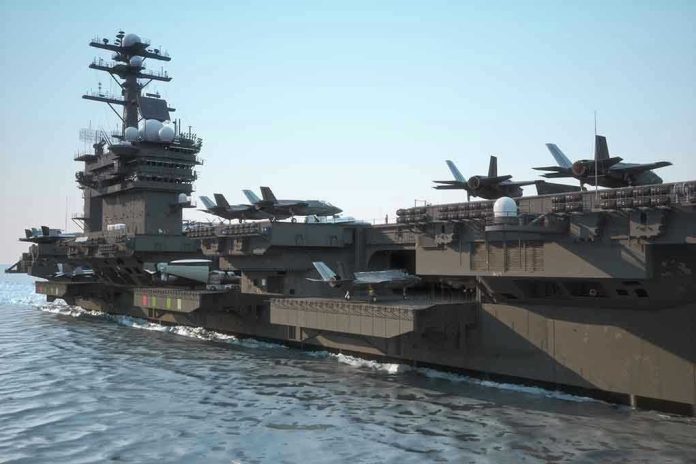
A Russian patrol plane dropped sonar sensors close to Britain’s flagship carrier in the Arctic, turning a routine NATO deployment into another reminder of how major powers play dangerous games far from home.
Story Snapshot
- UK Ministry of Defence says a Russian Tu-142 flew “unnecessarily close” to HMS Prince of Wales and dropped sonobuoys nearby.
- British F-35 jets from the carrier strike group intercepted and escorted the Russian aircraft away in international airspace.
- Officials called the Russian actions “unsafe and unprofessional,” but have not yet released raw radar, audio, or buoy data.
- The incident fits a wider pattern of Russian probing flights near NATO forces, raising fears of an accident or escalation both sides say they want to avoid.
What UK officials say happened over the Norwegian Sea
United Kingdom defence officials report that, on July 2, a Russian Tu-142 “Bear-F” maritime patrol aircraft approached the aircraft carrier HMS Prince of Wales while it was leading a carrier strike group under Operation Firecrest in the Norwegian Sea. The Ministry of Defence says the Russian plane flew at low altitude and “unnecessarily close” to the carrier before dropping a series of sonobuoys into the water near the ship. These buoys are underwater sensors used to detect and track submarines, especially around high-value naval targets.
UK F-35 Jets Intercept Russian Bear-F Plane Near HMS Prince of Wales in Norwegian Sea – UK F-35B Lightning II jets from the HMS Prince of Wales intercepted a Russian Tu-142 Bear-F maritime patrol aircraft last week after it made repeated low-altitude approaches to the UK carrier…
— Planet Today (@PlanetTodayNews) July 6, 2026
The Ministry of Defence released photos showing the Russian aircraft passing near the carrier and described the activity as “unsafe and unprofessional.” British F-35B Lightning II jets from the carrier air wing were scrambled to intercept the Tu-142 and escort it away from the group. Reports in several outlets say the Russian plane either ignored or did not respond to radio calls on safety channels, though the government has not yet shared audio recordings or detailed communication logs to confirm exactly what was said.
Conflicting details and gaps in the public evidence
News reports differ on how many Russian aircraft were involved and what, exactly, they dropped. Some coverage, based on defence sources, says two Russian planes dropped tracking devices near the carrier, including Tu-95 strategic bombers operating over international waters in the Arctic Circle. Other reporting and official social media posts focus on a single Tu-142 Bear-F maritime patrol aircraft as the main actor. This mismatch over aircraft numbers shows that even basic facts can get blurred when information comes out fast and partly through anonymous sources.
There are also important gaps in hard data. The Ministry of Defence has not publicly released radar telemetry, detailed flight paths, or exact altitude figures from HMS Prince of Wales or its escorts, so the “low altitude” description cannot be checked independently. No audio of radio calls has been made public, so outside experts cannot confirm whether the Russian crew received or ignored warnings. Officials say sonobuoys were dropped near the carrier, but have not disclosed the exact model, signal type, or pattern, which would help analysts judge whether this was routine surveillance or a focused intelligence probe.
Routine probing or dangerous escalation risk?
Defence analysts note that Russian maritime patrol aircraft like the Tu-142 often fly near North Atlantic and Arctic NATO carrier groups to test reactions and gather data, including by deploying sonar sensors and electronic gear around submarine lanes. NATO records over the last several years show dozens of similar intercepts, sometimes multiple per month, where alliance jets escort Russian bombers or patrol planes away from sensitive areas without incident. From this view, the Norwegian Sea encounter looks like part of a long-running pattern of mutual cat-and-mouse moves, not a one-off shock.
«"The Bear-F passed at low altitude and unnecessarily close to HMS Prince of Wales and dropped a large number of sonobuoys in close proximity to the carrier.
This activity was unsafe and unprofessional. The Russian aircraft was intercepted and escorted by two UK F-35 jets… https://t.co/9Qhi1mLsJN
— Aspals Legal (@AspalsLegal) July 6, 2026
At the same time, British officials warn that these close passes carry real risk, especially when aircraft are not talking to air traffic control or nearby forces. The Ministry of Defence has used similar language before, saying Russian flights that ignore standard safety rules can endanger civilian planes and raise the chance of a clash. In this latest case, they add the phrase “potential escalation risk,” yet do not point to a specific treaty rule or red line that was crossed. That vagueness feeds public worry that leaders might use such incidents to justify larger military build-ups or political talking points.
How this fits a wider story of mistrust and frustrated citizens
For many people watching from the United States, this story feels familiar. Here, federal leaders argue over defence budgets, foreign threats, and alliance commitments while everyday Americans struggle with high prices, shaky jobs, and a sense that the system is rigged. Conservatives see stories like this as proof that global rivals are testing the West while Washington wastes time on culture fights instead of strong borders and energy independence. Liberals worry that constant focus on military standoffs drains attention and money from health care, schools, and the growing gap between rich and poor.
In both camps, more and more citizens now share one key belief: powerful insiders in government, the military world, and big business shape these narratives to protect their own position. When a foreign aircraft flies too close to a carrier, most people just want honest answers: Was anyone truly in danger? What rules matter? Are we being told the full story, or only the parts that support bigger budgets and more overseas deployments? The mixed details and missing data in this case make those doubts stronger, even as real pilots and sailors face real risks when great powers play near the edge.
Sources:
insiderpaper.com, instagram.com, thetimes.com, navylookout.com, aol.com, telegraph.co.uk, facebook.com, x.com, reuters.com, thebarentsobserver.com