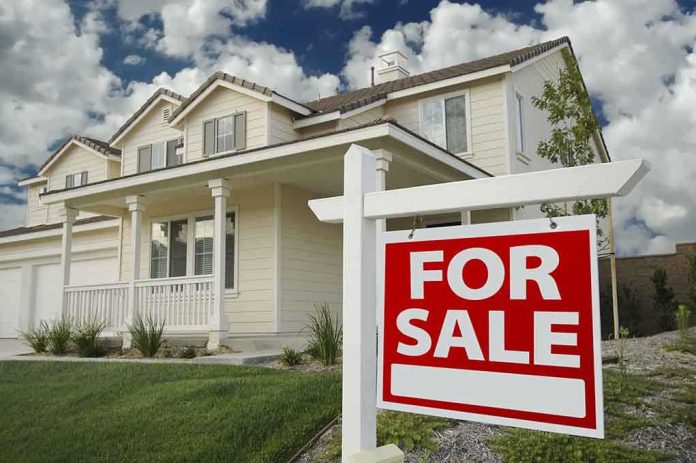
New data confirm what families have felt for years: for most Americans, the “American Dream” of buying a new home has quietly become a luxury item.
Story Snapshot
- Trade-association data show a strong majority of households cannot afford a typical new home under standard lending rules.
- Stagnant wages, high interest rates, and years of big-government inflation have pushed basic shelter out of reach.
- Even modest $150,000–$250,000 homes are unaffordable for tens of millions of working families.
- Conservatives are pressing for deregulation, lower spending, and more supply instead of more Washington control.
New Numbers Show How Far the American Dream Has Slipped Away
National Association of Home Builders data paint a stark picture: in 2024, nearly half of United States households, some 66.6 million families, could not afford even a $250,000 home under standard lending assumptions, while roughly 77 percent could not qualify for the median-priced new home at all when mortgage rates sat at 6.5 percent.[2] That is not a fringe problem affecting only coastal elites; it is a broad affordability breakdown that now defines the housing market for everyday Americans.
The same analysis shows how deep the problem runs at the lower end of the market. To qualify for a $150,000 home at a 6.5 percent mortgage rate, a household needs at least $45,975 in annual income; about 40.5 million United States households fall below that line and can only afford something cheaper than $150,000—if anything exists in their area at that price.[2] These numbers are based on conventional standards that cap mortgage, tax, and insurance costs at 28 percent of income, a long-standing baseline for responsible borrowing.[2]
How Leftist Inflation and Supply Squeeze Crushed Working Families
Independent analysts describe a simple, painful reality: the median home price today is more than six times the median income, making it dramatically harder for young families and first-time buyers to get a foothold.[1] That gap did not appear out of thin air. Years of Washington overspending, cheap money, and regulations that throttled housing supply allowed prices to sprint ahead while paychecks lumbered behind. Urban Institute research finds essential living costs, including housing, outpaced earnings so badly that a majority of families lack the resources for secure, stable lives.[4]
Housing supply is another key piece of the puzzle. The Independent Center bluntly calls it “a severe housing shortage,” explaining that there simply are not enough homes available for the people who want to buy.[1] The National Low Income Housing Coalition reports a shortage of more than seven million affordable homes for the nation’s extremely low-income families, and not a single state has enough units for them.[5] When you combine tight supply with inflated material costs, high property taxes, and green mandates, prices surge most in exactly the starter-home segment conservatives care about protecting.
New-Home Prices and Interest Rates Lock Out the Middle Class
National Association of Home Builders priced-out studies underscore how sensitive families are to both interest rates and home prices. Earlier work showed that with a median-priced new home around $413,595 and a six percent mortgage rate, roughly 65 percent of households—more than eighty-eight million families—could not afford that home.[6] A mere one-thousand-dollar increase in the price of that median home would knock another 156,405 households out of the market, families who barely qualified the day before but no longer meet the income bar after the price bump.[6]
📅 Coming up next during Affordable Housing Month! 🏘️✨
🎉 May 20: Celebrate the opening of new affordable homes
📊 May 21: Discuss housing costs vs. income in Silicon Valley & solutions for the future🔗 https://t.co/QQS4NUK2HP#AHM2026 #AffordableHousingMonth pic.twitter.com/5zxf2nv8e4
— Housing Leadership Council (@hlc_sanmateo) May 15, 2026
The squeeze is not limited to median-priced properties. A separate 2025 National Association of Home Builders special study found that nearly seventy-five percent of households—about 100.6 million—could not afford a median-priced new home valued at $459,826 with a 6.5 percent mortgage rate.[7] At that price, the minimum income needed is about $141,366, well above what most families earn.[7] Every additional one thousand dollars in price hikes raises the income requirement and shoves more than one hundred thousand additional households to the wrong side of the line.[7]
Why Conservative Solutions Focus on Freedom, Not More Washington Control
These numbers should alarm anyone who believes in a broad, property-owning middle class. When homeownership becomes a privilege for the upper tier, families lose their main path to building wealth and local roots. The instinct from the left is familiar: more federal programs, more subsidies, and more command-and-control regulation. Yet the data already show what decades of that approach delivered—high costs, artificial scarcity, and a younger generation that feels locked out of adulthood and family formation.[1][4]
Conservatives argue that reversing this crisis means tackling its causes, not layering more bureaucracy on top. That means ending inflationary spending, cutting red tape that drives up land and construction costs, and getting government out of the way so builders can produce more modest, truly affordable homes. It also means protecting families from new taxes and climate mandates that quietly add thousands of dollars to every new house. If Washington keeps treating housing as a playground for planners rather than a basic right tied to liberty and responsibility, the American Dream will keep drifting further out of reach.
Sources:
[1] Web – Why Does Homeownership Feel Impossible? – Independent Center
[2] Web – Nearly Half of U.S. Households Can’t Afford a $250,000 Home | NAHB
[4] Web – The American Affordability Tracker | Urban Institute
[5] Web – The Problem | National Low Income Housing Coalition
[6] Web – Households Priced-Out by Higher House Prices and Interest Rates
[7] Web – [PDF] Nearly 75% of U.S. Households Cannot Afford a Median-Priced New …