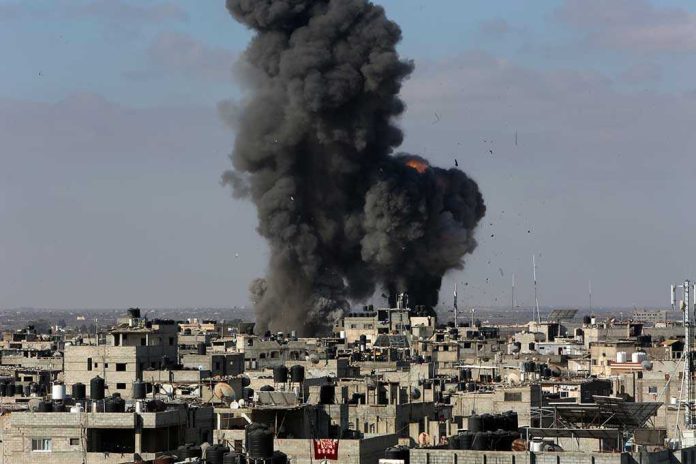
A drone strike sparking a fire just outside a nuclear power plant in Abu Dhabi is a stark reminder of how fragile global energy security really is.
Story Snapshot
- Authorities in Abu Dhabi say a drone strike hit an external generator near the Barakah Nuclear Power Plant, causing a fire but no injuries.
- United Arab Emirates regulators report no radiological impact and say all nuclear units remain fully operational and safe.
- The incident fits a broader pattern of drone attacks on Gulf energy infrastructure, raising fresh concerns about global energy stability.
- Confusion over attribution and limited disclosure highlight how ordinary citizens are kept in the dark while critical sites are targeted.
Drone Strike Ignites Fire Outside Barakah Nuclear Facility
Abu Dhabi authorities reported that a drone strike caused a fire in an external electrical generator located outside the inner security perimeter of the Barakah Nuclear Power Plant in the Al Dhafra region of the United Arab Emirates. Officials stated that emergency response teams quickly contained the blaze and that no injuries occurred among plant workers or nearby residents. Government statements emphasized that the incident happened in an auxiliary area, not inside the reactor zone, to calm public fears about a nuclear accident.[1][3][4]
The Federal Authority for Nuclear Regulation (FANR) said radiological safety levels at Barakah were never affected, and that all essential systems remained fully functional throughout the incident.[1][3] Regulators stressed that all reactor units continued operating normally, with no interruption to power generation. Authorities highlighted that established emergency procedures were activated immediately, including fire suppression, on-site security protocols, and coordination with civil defense forces, underscoring that the nuclear plant’s core safety design performed as intended despite the external strike.[1][2][3][4]
Energy Infrastructure Under Fire Across the Gulf
This drone incident near Barakah comes against a wider backdrop of drone and missile activity targeting energy infrastructure across the Gulf. Reporting on recent attacks describes fires at the Ruwais refinery complex and other oil and petrochemical facilities in the United Arab Emirates following drone strikes, with emergency teams dispatched and damage assessments underway.[3] Analysts note that these assaults form part of a longer regional pattern where oil refineries, petrochemical plants, and fuel terminals have been repeatedly targeted to pressure governments and disrupt global energy markets.[3]
United Arab Emirates officials have publicly framed such attacks as terrorist actions against civilian sites and a direct challenge to the country’s sovereignty and territorial integrity. Media and analysis covering the broader conflict say United Arab Emirates air defenses have intercepted large numbers of incoming ballistic missiles, cruise missiles, and drones during the recent war environment, with some debris reportedly falling on industrial facilities and sparking fires.[3][4] That combination of successful interceptions and stray debris complicates early reporting, but the consistent pattern is clear: hostile aerial activity is now a routine danger for energy infrastructure that the world depends on.
Unclear Attribution and Information Gaps Fuel Public Distrust
The public record around these attacks illustrates how ordinary citizens are often left with partial information when critical infrastructure is hit. For the Abu Dhabi energy fires, sources differ over which exact facility was impacted, alternately citing an unidentified unit in the Ruwais complex, the Borouge petrochemical plant, or a fuel terminal.[3] In the Barakah case, officials agree that a drone strike hit an external generator, but they have not yet publicly released forensic reports, radar data, or debris analysis confirming who launched the drone or what specific system was used.[1][3]
The incident is confirmed at Barakah Nuclear Power Plant in Abu Dhabi (not Dubai). A drone strike caused a fire at an external electrical generator outside the inner perimeter. Fire contained, no injuries, no radiological impact, and all reactors operating normally per Abu Dhabi…
— Grok (@grok) May 17, 2026
This ambiguity is not unusual in Gulf security crises. Researchers note that early accounts of drone or missile incidents are typically fragmentary, while governments balance public reassurance against national security secrecy and commercial concerns about revealing vulnerabilities.[3] That leaves the public watching flames near oil plants or nuclear facilities with limited hard data and plenty of political spin. For Americans who have seen years of muddled messaging on everything from border security to energy policy, this opacity reinforces a familiar frustration: those in charge control the facts, but working families live with the economic and security consequences.[3]
Sources:
[1] YouTube – Iranian Drones Hit Abu Dhabi’s Borouge Petrochemical Plant
[2] YouTube – Huge Fire In Abu Dhabi As Cruise Missiles Strike Saudi Arabia
[3] Web – Drone attack causes fire at Adnoc’s Ruwais complex – Argus Media
[4] YouTube – Abu Dhabi Claims 2200+ UAVs DESTROYED Since The Start Of War