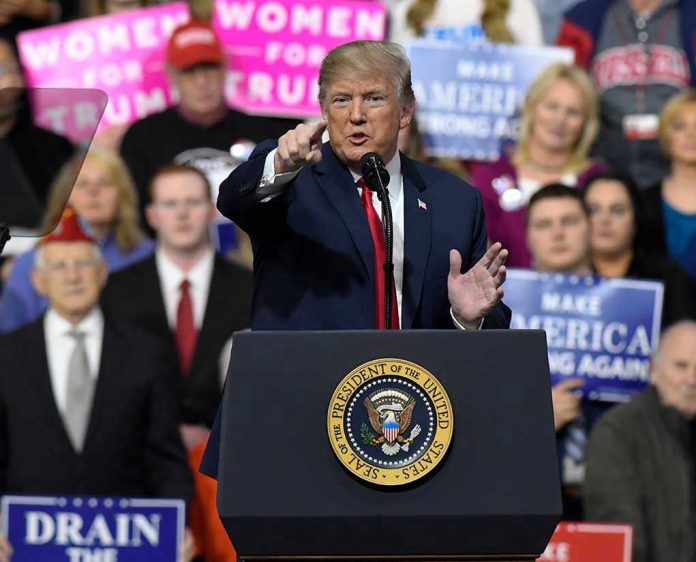
Republicans are learning the hard way that when a president turns the midterms into a running monologue about himself, the country often decides it is time for a new cast.
Story Snapshot
- Trump’s slipping approval and self-focused agenda are turning the 2026 midterms into a referendum on his character, not conservative ideas.
- Historical midterm patterns now cut against Republicans, despite controlling the White House and Congress.
- Strategists warn that Trump’s need for adoration and revenge may suppress right-of-center turnout right when Democrats are fired up.
- The core Republican question is shifting from “Can Trump carry us?” to “Can we survive the cost of carrying him?”
Trump’s Presidency Has Become The Ballot Question
Voters will not walk into the 2026 voting booth thinking about a generic Republican agenda; they will walk in deciding whether they have had enough of Donald Trump’s second term. Nonpartisan analysis at the Brookings Institution notes that by early 2026, “the midterm prospects for Republicans have darkened further” as Trump’s job approval falls to new lows and discontent over his priorities deepens.[1] Midterms are always a mood check, and the mood right now is not gratitude. That is a structural problem for any party tethered this tightly to one man.
History compounds that problem. The United States Vote Foundation explains that midterm elections typically function as a brake on the president’s party; voters “typically want change” and the president’s party “typically loses ground.” That pattern holds even for more disciplined presidents who share credit and spread blame. Republicans have instead built a government that rises and falls on Trump’s persona. When that persona wears thin, swing voters do not surgically punish just one man; they punish his entire party.
Falling Approval And The Cost Of Self-Indulgence
Trump’s political weakness is no longer a matter of “vibes” or Beltway gossip; it shows up in hard numbers. Brookings reports that his approval, once above 50 percent at the start of his second term, has dropped to roughly 40 percent, with disapproval surging to 57 percent.[1] Polling highlighted by analyst G. Elliott Morris shows Trump’s overall rating sinking to roughly negative 25 to negative 30, with support for his handling of prices and tariffs closer to 25–30 percent.[2] Americans might tolerate drama; they do not tolerate pain at the grocery store forever.
Those numbers reflect more than bad press; they reflect a presidency consumed with side fights and self-protection at the expense of kitchen-table issues. Brookings notes that only about one-fifth of Americans think Trump is focusing on the right priorities, while nearly half believe his priorities are wrong.[1] That gap matters. Conservative voters expect a president to keep his eye on inflation, wages, and national security. When too many headlines revolve around revenge, feuds, and self-justification, ordinary families notice that no one seems to be minding their store.
Republican Lawmakers See The Midterm Trap
Republican members of Congress may publicly praise the president, but reporting shows they are increasingly nervous about what his behavior means for their own jobs. Politico describes lawmakers who “fear a self-interested president is needlessly risking their party’s majorities” as Trump pursues control, legacy, and payback. Those are not progressive talking points; they are concerns from within the Republican tent. When the president demands loyalty but does not protect the team, the team eventually does the math.
That math worsens as Democrats sense opportunity. Brookings points to a six-point Democratic lead on the generic House ballot and swings of roughly 14–15 points toward Democrats in recent special and gubernatorial elections, suggesting “substantial Democratic gains in November,” potentially enough to flip the House.[1] NBC’s Steve Kornacki has similarly flagged the “historical headwinds” facing Republicans in 2026. This is precisely the type of environment where a disciplined conservative message on prices, crime, and border security could still resonate—if it were not constantly overshadowed by a running Trump drama.
Base Energy Versus Broader Fatigue
Trump and his allies counter that he remains the party’s indispensable energizer, the man who can turn out blue-collar and rural voters who might otherwise stay home. He repeatedly tells Republican audiences they must “win the midterms” or he faces impeachment, framing the election as a personal shield as much as a national choice. That message can light up the core faithful. It also confirms for many persuadable voters that the project is about one individual’s fate, not the country’s future, which undercuts the conservative promise of limited, accountable government.
wtf is going on? Donald Trump you complete liar, you joke, you've made us a laughingstock, how is this even one inch closer to where we need to be relative to a month ago? This is an atrocious deal. To sign anything even remotely resembling this loses the GOP the midterms and… https://t.co/c11Wb5ogPr
— Big Leslie (@TheNYCLeslie) May 24, 2026
The risk for Republicans is not that Trump’s base will vanish; it is that everyone else will. Brookings highlights polling in which Democrats are more “extremely motivated” to vote than Republicans, hinting at a turnout gap reminiscent of 2018.[1] Morris argues that Trump’s unpopularity is severe enough to produce a “significantly pro-Democratic” midterm, big enough to overcome even aggressive gerrymandering.[2] If energized Democrats meet dispirited conservatives who are tired of constant chaos, the result is not populist realignment; it is a rout.
Sources:
[1] Web – GOP midterm prospects darken as Trump approval falls | Brookings
[2] YouTube – Midterms polling, Trump approval & more | Enten Roundup