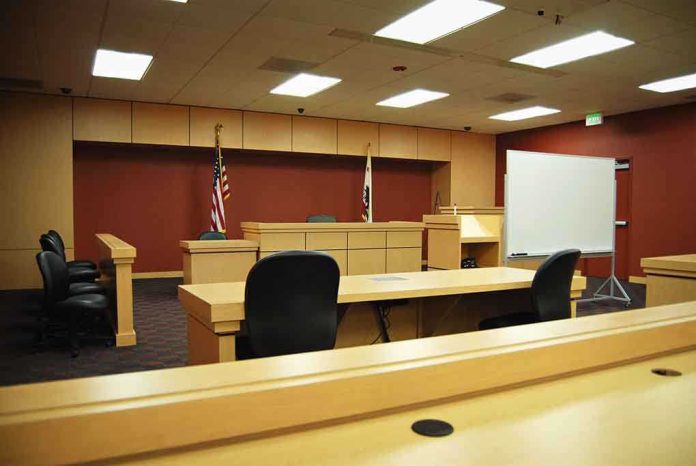
One judge’s ruling turned a backpack, a notebook, and a gun into the central battlefield of the Mangione case.
Quick Take
- The court allowed key evidence from a later police-station inventory search, even after rejecting the first McDonald’s search [1]
- Some statements made before Miranda warnings were ruled admissible, while a narrow set of custodial remarks was suppressed [1]
- The prosecution still argues the seized gun, suppressor, ammunition, and notebook tie Luigi Mangione to Brian Thompson’s killing [1]
- The ruling does not end the fight; it clarifies which parts of the state case can survive suppression challenges [1][2]
The Ruling That Matters Most
The headline is not that evidence existed, but that a judge separated lawful proof from unconstitutional police work. That distinction matters because criminal cases often turn on timing, custody, and search procedures rather than the size of the public outrage. In this hearing, the court drew a line: the first search at the arrest scene failed, yet the later inventory search at the station survived, keeping major physical evidence in play [1].
That split outcome gives both sides something to claim. Prosecutors can say the gun, suppressor, ammunition, and notebook still support their theory of the homicide. The defense can point to the suppression of the earliest search and some statements as proof that police crossed constitutional lines. For readers who expect a clean win or loss, this is the uncomfortable reality of serious criminal litigation: courts often admit the core of the case while discarding the parts that were gathered badly [1][2].
Why the Backpack Search Became the Pivot Point
Police searched Mangione’s backpack first at a McDonald’s in Altoona and then later during an inventory process at the station. The judge found the initial warrantless search improper, but accepted the later administrative search as valid [1]. That difference is more than legal hair-splitting. A proper inventory search is supposed to protect property and document what police already possess; an evidentiary rummage designed to find incriminating material does not get the same protection under the Fourth Amendment.
That is why the state’s remaining evidence still matters so much. If the gun and notebook came in through the lawful station-house search, prosecutors keep the physical backbone of their case. If the defense can later show the inventory procedure was really a search for evidence, the admissibility fight could reopen. For now, the court’s ruling gives prosecutors a usable path and forces the defense to attack the exact sequence of custody, transport, and documentation [1][2].
Custody, Miranda, and the Narrow Window Before 9:47
The statement issue hinges on a clock. Reporting on the ruling says the judge found Mangione was not formally in custody until about 9:47 a.m., which means statements made before that point remained admissible [1]. After Miranda warnings were given shortly after 9:48 a.m., the court still allowed spontaneous remarks and routine pedigree or safety-related answers [1]. That leaves the defense with a narrower exclusion target than it wanted, but not nothing.
Suppression fights of this kind live or die on small facts that sound boring only until they decide a trial. Was the suspect free to leave? Did officers ask a question that required an incriminating answer? Did the warning come before or after the critical statement? The legal system treats those questions as serious because constitutional rights depend on them. The public, understandably, wants a simpler answer. The court gave it complexity instead [2].
What the Decision Still Leaves Open
The ruling is not the same as a verdict, and it does not settle the public story around Brian Thompson’s killing. It only defines what the state may use when the case goes to trial. The defense still has room to challenge chain of custody, forensic links, and whether the admitted items truly prove what prosecutors say they prove. The prosecution still has room to argue that the seized items, taken together, form a coherent narrative of guilt [1].
Judge Rules Partly In Favor Of Luigi Mangione At Key Pretrial Hearinghttps://t.co/V1zL5iYx9Q
— JCN (@CharlieMMAFAN) May 18, 2026
That is why this case keeps drawing attention well beyond the courtroom. High-profile homicide coverage tends to collapse evidence law into morality theater, but the real issue here is narrower and more durable: whether police followed the Constitution closely enough for the state to use what they found. The judge’s answer was mixed. Some evidence came in, some did not, and the fight over the rest will keep moving as long as the transcript and written order continue to shape the next round [2].
Sources:
[1] YouTube – Luigi Mangione pretrial hearing: Defense seeks to suppress evidence
[2] Web – A Look Inside Luigi Mangione’s Pre-trial Suppression Hearings