Mitch McConnell did something many Trump voters never expected: he drew a hard line against a billion-dollar pot of money branded as justice for “lawfare” victims and called it “utterly stupid.”
Story Snapshot
- A $1.8 billion Justice Department “anti-weaponization fund” tied to Trump’s Internal Revenue Service lawsuit triggered a Republican revolt in the Senate.
- Bill Cassidy, John Thune, and Mitch McConnell warned the fund looks like a slush pile with no clear precedent, rules, or accountability.[1]
- Concerns range from bypassing Congress to the risk of payments going to extremists convicted of violence, including January 6 offenders.[1]
- The backlash stalled a major immigration funding bill and exposed a rare intraparty fight over spending, power, and political payback.[1][2]
How A $1.8 Billion “Justice” Fund Turned Republicans On Trump
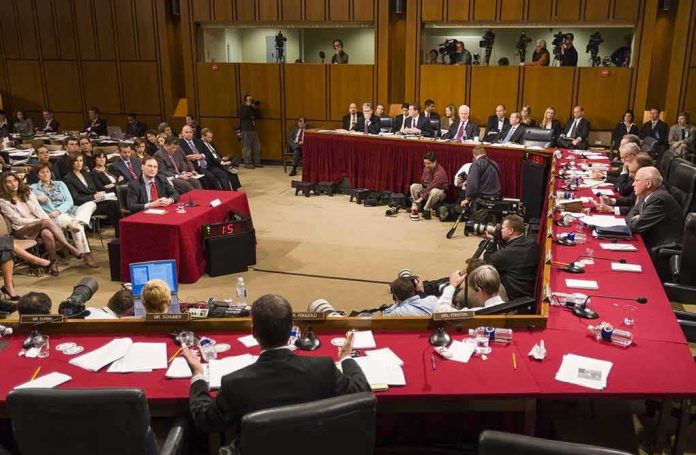
Senate Republicans walked into a private briefing expecting to talk about routine immigration funding and walked out furious about a $1.8 billion pool of money the Department of Justice wanted to create as part of settling Donald Trump’s $10 billion lawsuit against the Internal Revenue Service.[1] The fund, marketed as an “anti-weaponization” program to compensate people who say they were targeted by the prior administration, suddenly overshadowed border security and turned Trump’s allies into skeptics.
Reports described a plan where a five-person commission, handpicked largely by Acting Attorney General Todd Blanche, would dole out taxpayer cash to claimants, with the president able to remove commissioners. No public statute, no open rulebook, no clear audit trail. Senate Republicans, who usually defend Trump against Democratic attacks, now confronted a basic problem: they were being asked to trust a giant discretionary fund they had not written, could not read, and did not truly control.
Why McConnell Called The Fund “Utterly Stupid”
Bill Cassidy captured the kitchen-table objection in one sentence: families trying to pay mortgages, buy groceries, and fill gas tanks are being told Washington needs $1.8 billion for a fund that lets the president and his allies “pay whomever they wish with no legal precedent or accountability.”[1] Mitch McConnell escalated the critique, questioning why law enforcement officers who risked their lives should watch a Washington slush fund potentially send checks to people convicted of assaulting police.[1]
Capitol Police officers who defended the United States Capitol on January 6 took that fear straight into federal court, suing to block the fund on grounds that it could compensate extremists convicted of violent crimes.[1] From a conservative perspective that prizes law, order, and respect for officers, any structure that might reward those who attacked the Capitol crosses a bright red line. Even the hint that such payouts are possible makes the fund look less like justice and more like moral inversion.
Guardrails, Secrecy, And The Fight Over Who Decides
Senate Majority Leader John Thune told reporters that the Department of Justice needed to propose serious “guardrails” before senators could even think about moving forward.[1] Yet when Republicans asked basic questions—who qualifies, what proof is required, what crimes disqualify you—there was no public bill text to point to, just verbal assurances and vague descriptions. That information vacuum made every reassurance sound like “trust us,” which is exactly what a self-respecting legislature should never do with $1.8 billion.
GOP SENATORS REBEL AGAINST TRUMP, DELAY KEY VOTE OVER $1.8B 'ANTI-WEAPONIZATION' FUND
Senate Republicans derailed a vote on immigration crackdown funding, furious over a DOJ push for a fund to pay alleged victims of political persecution. Tensions flared as acting AG Todd…
— STOCK DUTY (@stock_duty) May 22, 2026
Multiple Republican senators worried the fund would pay people who would never win in court: dismissed cases, weak claims, or political allies packaged as victims.[1] Because the proposal relies on an existing judgment fund appropriation, Justice Department lawyers can argue this is just an extension of ordinary settlement authority.[1] But common sense says volume and design matter. When government takes what is normally a case-by-case settlement tool and turns it into a massive, open-ended compensation pool, it starts looking less like litigation management and more like political spending by other means.
Separation Of Powers Meets Populist Grievance Politics
The administration’s defenders frame the idea as overdue relief for Americans “wronged” by what they call lawfare—overzealous prosecutions, politicized investigations, and regulatory harassment.[1] Many conservatives agree that federal law enforcement has been weaponized at times; that is why “anti-weaponization” resonates. But the cure cannot be another form of weaponization, this time of the Treasury. If Congress allows the executive branch to write its own checks to its own chosen “victims,” it teaches future presidents of both parties that they can bypass the appropriations process whenever they feel aggrieved.
Veteran conservatives have seen this movie before in softer form: special settlement funds, regulatory slush accounts, and creative uses of existing appropriations to pursue policy goals voters never approved directly. What is new here is the scale, the explicit political framing, and the possibility of payments reaching people whose conduct courts have already condemned. When even Republican senators, often accused of rubber-stamping Trump, respond by scrapping a key vote on immigration funding, that signals they recognize a deeper constitutional problem, not just a bad press cycle.[1][2]
Why This Revolt Matters Beyond Trump
The loudest conservative warnings are not actually about Trump himself; they are about the precedent. If a Republican-controlled Senate shrugs at a president-aligned $1.8 billion fund today, a future progressive administration will seize that precedent and run with it. The smarter Republican senators seem to understand that restraint has to start on their own side. Saying no to a slush fund now is the only credible way to say no when the other team tries the same maneuver later.
The deeper lesson is simple enough for anyone paying bills at the kitchen table to appreciate. Government should not write blank checks, especially not to unnamed people for unwritten rules under unseen laws. The Senate revolt against Trump’s “anti-weaponization fund” is a rare moment when political loyalty collided with basic constitutional responsibility—and responsibility won, at least for now.
Sources:
[1] Web – GOP senators balk at Trump’s $1.8-billion ‘anti-weaponization’ fund …
[2] YouTube – Senate GOP delays vote to fund immigration agencies amid DOJ …