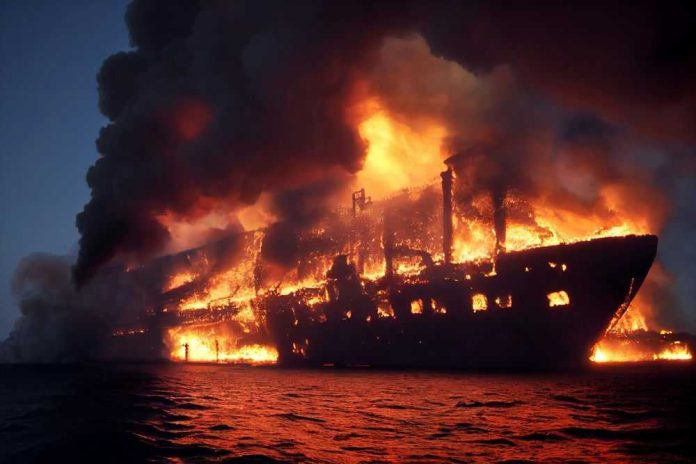
Four U.S. Navy warships caught fire within six weeks in spring 2026 — and the Navy still hasn’t told the public why.
Story Snapshot
- Four Navy ships — USS Higgins, USS Dwight D. Eisenhower, USS Zumwalt, and USS Gerald R. Ford — all had fires or electrical casualties within six weeks of each other in spring 2026.
- The Navy called the USS Higgins incident an “engineering casualty,” saying a short circuit knocked out power and propulsion for hours before the crew restored them with no injuries.
- A Government Accountability Office report found that 90% of Navy ship fires go unreported and that fires since 2008 caused over $4 billion in damage and destroyed two ships entirely.
- No official investigation results have been released for any of the four 2026 incidents, leaving the public with no clear answers about what went wrong.
Four Ships, Six Weeks, No Answers
In spring 2026, four U.S. Navy warships experienced fires or major electrical failures within roughly six weeks. The USS Higgins lost all power and propulsion in the Indo-Pacific after a short circuit in one of its generators. The USS Dwight D. Eisenhower and USS Zumwalt both had fires during maintenance. The USS Gerald R. Ford had a fire that reportedly burned for more than 30 hours. The Navy has not released investigation results for any of the four incidents.
The Navy officially called the Higgins incident an “engineering casualty to the electrical distribution system.” Commander Matthew Comer, a Navy spokesperson, confirmed the ship lost power and propulsion but said the sparking and smoke stopped once crew members cut the power. No sailors were hurt, and the ship was back under power within hours. The Navy said the fire was limited to one piece of equipment and did not spread.
What the Official Story Leaves Out
The Navy’s calm description of the Higgins incident stands in contrast to what the crew actually experienced — a warship left dead in the water in the Indo-Pacific, one of the most strategically sensitive regions in the world. The Zumwalt fire injured three sailors pierside. The Eisenhower fire injured eight sailors during maintenance. The Ford fire reportedly left more than 600 sailors without bunks and caused widespread damage. The Navy says the Ford’s propulsion was not affected and the ship remained operational, but those specific damage claims have not been officially addressed.
Investigations into all four incidents remain open. The Defense Department has said only that the “cause is currently under investigation” — a phrase that has become a familiar non-answer. No root-cause findings, no maintenance records, and no corrective action plans have been made public. For the American taxpayer funding a Navy budget that runs into the hundreds of billions of dollars, that silence is hard to accept.
A Problem the Government Already Knew About
The spring 2026 cluster did not happen in a vacuum. The Government Accountability Office (GAO) documented 15 major Navy ship fires between 2008 and 2020 that caused more than $4 billion in damage and destroyed two vessels completely. The GAO also found that roughly 90% of shipboard fires go unreported because the Navy lacks a standard reporting system. Naval Safety Command data shows an average of about one shipboard fire reported every single day — and that’s only the ones that get reported.
The GAO flagged these problems years ago and said the Navy had not consistently put lessons into practice. That report came out in 2023. Three years later, four ships caught fire in six weeks. Whether this spring’s incidents are isolated bad luck or signs of deeper maintenance and training failures, the public deserves more than “under investigation.” A military that can’t keep its own ships from catching fire — or won’t explain why they do — is a military that owes the American people some real answers.
Sources:
youtube.com, cbsnews.com, militarytimes.com, reddit.com, mezha.net, stripes.com, 13newsnow.com