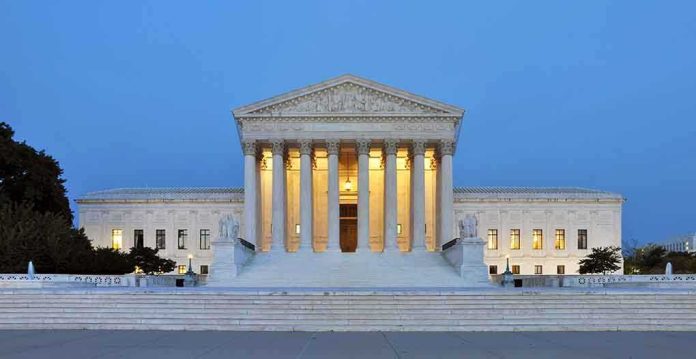
The Supreme Court’s narrow injunction ruling has cracked open a legal loophole that scammers are already using to sell fake “citizenship fixes” to frightened new parents.
Story Snapshot
- Trump’s Executive Order 14160 tried to deny birthright citizenship to many children born in the United States to non‑citizen parents.
- A Supreme Court ruling on nationwide injunctions let parts of the order move forward, creating confusion and room for scams.
- Legal experts across the spectrum say the order clashes with the 14th Amendment and long‑standing Supreme Court precedent.
- Families and critics now push for a rehearing to close loopholes and stop abuse before more Americans get hurt.
What Trump’s Order Actually Does
On January 20, 2025, President Donald Trump signed Executive Order 14160, called “Protecting the Meaning and Value of American Citizenship.” The order says some babies born in the United States are not citizens at birth if their mothers are here unlawfully or only on short‑term visas, and their fathers are not citizens or lawful permanent residents. It directs federal agencies not to issue or accept documents that recognize citizenship for these children, including passports and Social Security numbers. The policy applies only to babies born 30 days after the order, starting February 19, 2025, which means hospitals and parents must track immigration status at birth.
Trump and his team argue that the Fourteenth Amendment’s phrase “subject to the jurisdiction thereof” means only children whose parents owe a stronger, almost permanent allegiance to the United States should get automatic citizenship. They say people who are in the country unlawfully, or on short‑term legal stays like tourist, student, or work visas, do not meet that standard. This reading sharply breaks from more than a century of common practice, where birth certificates have served as basic proof of both birth and citizenship for nearly all children born on United States soil.
How The Supreme Court’s Injunction Ruling Changed The Battlefield
Federal lawsuits quickly challenged the order, and lower courts issued broad, nationwide injunctions that stopped it from taking effect for anyone. Then, in a separate case on injunctions, the Supreme Court ruled that judges usually cannot block a federal policy for the whole country unless that is truly needed to protect the rights of the people who sued. That decision cut back the power of lower courts to freeze Executive Order 14160 across the board, allowing some guidance and preparation steps under the order to move forward while the main constitutional fight continued.
Because the injunction ruling did not decide whether Trump’s order is constitutional, it left families in legal limbo. Agencies were told to plan for the new rules, and some local officials began warning parents about possible changes in how citizenship is proved at birth. That mix of fear and uncertainty created a perfect market for shady “citizenship consultants” and lawyers who promise special paperwork, fast fixes, or secret strategies to “lock in” a baby’s status before the law fully changes, often for large fees and with no real legal basis.
Why Most Experts Call The Order Unconstitutional
Legal scholars from the left and the right point to the plain text of the Fourteenth Amendment and long‑standing Supreme Court precedent to argue that Trump’s order cannot stand. The Citizenship Clause says, “All persons born or naturalized in the United States, and subject to the jurisdiction thereof, are citizens.” In 1898, in United States v. Wong Kim Ark, the Court held that a man born in San Francisco to non‑citizen Chinese parents was a citizen, confirming that the clause covers nearly everyone born here whose parents are subject to United States laws. That ruling has been reaffirmed many times and has shaped government policy for generations.
Groups like the Brennan Center, the American Immigration Council, and civil rights organizations stress that “subject to the jurisdiction” has always meant being under United States law, not having permanent status or deep allegiance. They also warn that denying citizenship at birth would force hospitals, midwives, and local clerks to check parents’ immigration records, adding red tape and risk of mistakes. Everyday Americans would no longer be able to trust a birth certificate as clear proof of citizenship, making life harder for workers, students, and even military recruits who must show their status in simple ways.
Citizenship Scams, Public Anger, And Calls For A Rehearing
As the legal fight drags on, scammers have rushed to fill the gap between fear and facts. Immigrant families with mixed status are being told they must buy expensive legal packages to “protect” their newborns from losing citizenship, even though the Fourteenth Amendment still applies and courts have blocked core parts of the order. Some operators hint they have inside knowledge of how judges will rule, or claim they can file secret forms before a deadline that does not exist, playing on parents’ deep anxiety and confusion.
Across the political spectrum, frustration is growing that the federal government and the courts have allowed such a sensitive issue to sit in a gray zone that invites abuse. Many conservatives who worry about illegal immigration still do not want unelected officials or scam artists deciding which babies count as Americans. Many liberals see the order as another move that deepens the divide between the powerful and ordinary families who lack lawyers and lobbyists. Together, they argue that the Supreme Court should rehear the case, clearly reaffirm birthright citizenship, and shut down the loopholes that now fuel both fear and fraud.
Sources:
pjmedia.com, asianlawcaucus.org, naacpldf.org, aclu-nj.org, brennancenter.org, aila.org, youtube.com, ogletree.com