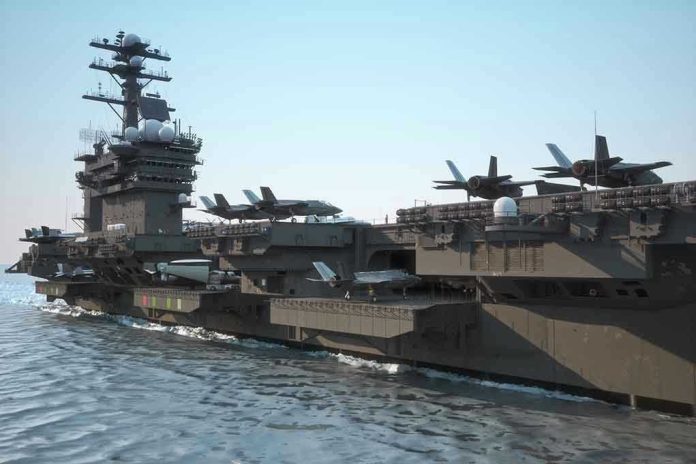
As the USS Theodore Roosevelt prepares to sail with a robot warship in its strike group, the Navy is testing not just new hardware but how much control over warfare Americans are willing to hand to unmanned systems run by distant elites.
Story Snapshot
- The Navy will send a medium unmanned surface vessel to sea alongside the carrier USS Theodore Roosevelt as part of its next carrier strike group deployment, treating robots as frontline assets rather than experiments.[2]
- Recent at-sea drills practiced refueling this robotic ship from a crewed vessel, a key step if unmanned systems are going to operate far from shore for long periods.[1]
- Officials openly describe the deployment as an “experiment,” meaning there is still no public proof that this model works reliably, safely, or affordably at scale.[2]
- Both conservatives and liberals who already distrust the Washington defense establishment see a familiar pattern: expensive new technology pushed forward before the public sees hard evidence it makes America safer.
A Carrier Strike Group Adds a Robot Ship
Vice Admiral Brendan McLane, the Navy’s senior surface warfare officer, told reporters that a medium unmanned surface vessel will deploy alongside the aircraft carrier USS Theodore Roosevelt and its carrier strike group later this year.[2] The Theodore Roosevelt is a Nimitz-class nuclear-powered aircraft carrier that has long served as the flagship of Carrier Strike Group 9, operating with guided-missile cruisers and destroyers in the Pacific and Middle East.[2][3] Navy leaders say they will “evaluate how that pairing works,” underscoring that this is a live experiment, not a finished, proven concept.[2]
The USS Theodore Roosevelt aircraft carrier is set to deploy with an unmanned surface vessel (USV) as part of its strike group for the first time, marking an important milestone in the integration of unmanned systems in the U.S. military https://t.co/W9r5AWHqU2
— Hideki Yui (@HidekiHyui) June 5, 2026
The Navy has spent years talking about a future fleet where crewed ships are teamed with robotic vessels that carry sensors, missiles, or electronic warfare gear.[2] Deploying a medium unmanned surface vessel with a high-profile carrier group is meant to show that vision is moving out of the lab and into real-world operations.[2] However, the service has released no detailed public plan explaining how the robot ship will be tasked day to day, how it will be controlled in combat, or how commanders will manage the risk of technical failures close to a multibillion-dollar carrier.
Refueling at Sea: A Step Toward Real Operations
To prepare for the deployment, the Navy recently practiced refueling a sea drone at sea from a crewed ship, an essential capability if unmanned vessels are expected to stay on station for long missions with a carrier strike group.[1] Refueling at sea is complex even for crewed ships; doing it safely with a drone requires reliable navigation, communication links, and procedures to prevent collisions or fuel spills.[1] This type of drill signals that the Navy wants unmanned ships to operate as true fleet workhorses, not just short-range test platforms or publicity props.[1]
Supporters inside the Pentagon argue that unmanned vessels could help close the gap between the missions politicians assign the Navy and the number of sailors and ships Congress is willing to fund.[1][2] A robotic ship does not need salaries, health care, or family housing, and if it is lost in combat, no American lives are lost with it. Those arguments appeal to leaders in both parties who talk about great-power competition but resist politically painful choices like higher defense manpower spending or clearer war aims.[2] Yet the public still has little insight into whether these systems will truly be cheaper once maintenance, data links, cybersecurity, and replacement costs are included over time.
Promises, Unknowns, and Public Skepticism
The Navy itself emphasizes that this deployment is an experiment in “tailored force pairing,” language that signals important questions remain about how unmanned vessels fit into existing doctrine and command structures.[2] There is no publicly available after-action report showing how similar pairings have performed in combat-like conditions; this is a first-of-its-kind test for a carrier strike group, not a repeat of a proven formula.[1][2] That gap between public relations about “milestones” and hard data about reliability and effectiveness is exactly what fuels skepticism among citizens who already distrust the Washington defense establishment.[1]
For many conservatives, this looks like another costly experiment pushed by defense contractors and Pentagon insiders while basic needs—border security, veteran care, affordable fuel—remain unresolved. For many liberals, it raises fears of a future where war is increasingly automated and less accountable, with lethal decisions shaped by algorithms and shielded from public scrutiny. Both sides see a pattern: new technologies are rolled out with fanfare, but taxpayers rarely see transparent evidence that these programs deliver real security instead of just bigger contracts.[1][2]
What This Shift Could Mean for American Power
Sending a robot ship to sea with USS Theodore Roosevelt signals that unmanned systems are no longer an optional side project but are being woven into the heart of American naval power.[2] If the deployment goes well, it could accelerate plans to field larger numbers of unmanned surface and undersea vessels, potentially reshaping how the United States projects force in contested regions like the Western Pacific and the Persian Gulf.[1][2] If it goes poorly, it could expose vulnerabilities in communications, cybersecurity, and basic reliability that adversaries might exploit, while confirming public fears that leaders rushed ahead without enough real-world testing.
Americans across the political spectrum have good reason to watch this closely. The same political class that has struggled to control spending, protect borders, and manage inflation now promises that robots at sea will help secure the nation and save money over time. The Theodore Roosevelt deployment will not answer every question, but it will offer a rare real-world test of whether unmanned warships are a smart evolution of naval power or another expensive gamble made by a government many citizens no longer trust to put their interests first.[1][2]
Sources:
[1] Web – A Navy Carrier Is About To Deploy With a Robot Ship
[2] Web – U.S. Navy drills in at-sea USV fueling ahead of CSG deployment
[3] Web – Navy to experiment with tailored force pairing with Theodore …