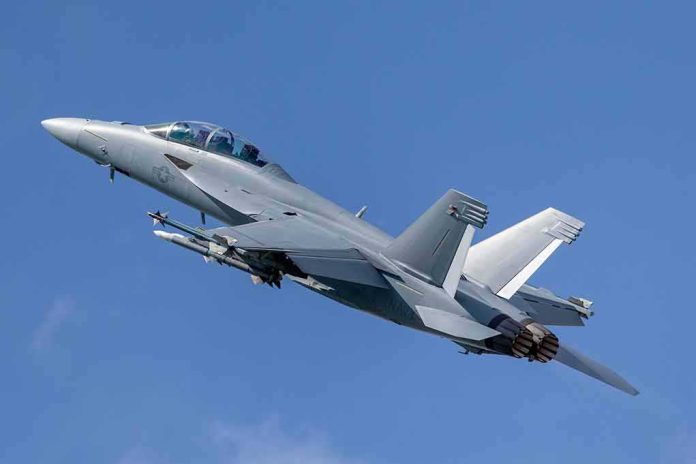
U.S. officials now suspect an American F-15E was brought down over Iran by a Chinese-made shoulder-fired missile, raising urgent questions about Beijing’s quiet support for Tehran and the risks to our airmen.
Story Snapshot
- U.S. officials reportedly assess a Chinese-made shoulder-fired missile likely downed the F-15E over southwestern Iran [1].
- Reports say Chinese radar provided Iran earlier in the war may have improved tracking of advanced U.S. jets [2][3].
- The public evidence remains limited; officials are speaking cautiously in terms like “likely” and “may have” [1][2][3].
- The incident underscores the growing China–Iran military pipeline and rising risk to U.S. air operations [6].
What U.S. Officials Say About The Shootdown
U.S. officials and individuals familiar with the investigation reportedly assessed that a Chinese-made shoulder-fired missile was the most likely weapon used to down the F-15E over southwestern Iran, according to multiple outlets summarizing the original reporting [1]. Separate coverage reiterates that investigators believe a Chinese-made man-portable air defense system was likely responsible, though final public confirmation has not been issued [6]. These accounts describe a cautiously framed assessment, not a formal attribution released with forensic debris or a full incident report [1].
Additional reporting states that Chinese-supplied radar technology provided to Iran earlier in the conflict may have helped Iranian forces better track advanced aircraft like the F-15E Strike Eagle [2]. A related summary echoes that China reportedly gave Tehran stealth-detecting radar support, heightening Iran’s air-defense effectiveness, while the jet was likely hit by a Chinese-made shoulder-fired missile [3]. Public descriptions remain measured, using terms like “likely” and “may have,” which signal confidence without disclosing classified sources or methods [2].
Evidence Limits And Why Language Matters
Publicly available information fits a recurring pattern in air-defense controversies: early, anonymized official assessments circulate, technical labels narrow to a weapon class, and definitive proof often lags behind classified findings [1]. Here, the strongest claims rest on officials’ judgments reported by media, not yet on disclosed debris analysis or captured launchers. Outlets consistently use cautious language—“likely,” “may have”—to describe both the missile type and the radar support, reflecting investigative uncertainty and the need to protect sensitive collection [1].
That caution does not negate the risk picture. If Iranian forces used a Chinese-made missile system to down an American F-15E, it shows how inexpensive, proliferated shoulder-fired weapons can threaten high-end aircraft when paired with competent command, control, and sensor support. Reporting that Chinese radar technology may have improved Iranian tracking compounds the concern: advanced sensing plus mobile launch teams can erode traditional U.S. airpower advantages, especially in contested border zones or covertly defended corridors [2][3].
Strategic Stakes For U.S. Airpower And Policy
The suspected use of a Chinese-made missile underscores a larger strategic problem: the China–Iran military pipeline enabling Tehran to harass U.S. forces with lower-cost tools that impose high-risk dilemmas. U.S.-linked reports highlight officials’ belief that a Chinese-origin man-portable air defense system was the likely culprit, a conclusion that, if confirmed publicly, would reinforce concerns about Beijing facilitating capabilities that endanger American pilots [6]. Even pending confirmation, the pattern is clear—our adversaries are learning to combine sensors and shooters to blunt U.S. reach.
A new report has reignited debate over China's role in the recent US-Iran conflict. Acc 2 NBC News, investigators examining the loss of a US F-15E Strike Eagle over southwestern Iran believe the aircraft may have been hit by a Chinese-made MANPADS missile.https://t.co/es5iDSrQv2
— radhyka 🌎🍀 (@radhyka) June 1, 2026
For Americans who value peace through strength, the policy implications are direct. The Pentagon must harden tactics against infrared-seeking threats, surge countermeasures, and tighten flight profiles in known engagement zones. Diplomatically, Washington should pressure Beijing over transfers that empower Iranian air defenses while reinforcing sanctions enforcement. At home, Congress should prioritize funding for aircraft survivability, electronic warfare, and industrial replenishment—without the bloated, ideologically driven add-ons that waste taxpayer dollars and delay delivery to the warfighter.
What To Watch Next
Watch for any official release of recovered fragments, telemetry, or imagery that would confirm the specific missile model and unit responsible. Monitor indications that Chinese radar assets or advisors expanded Iran’s air-defense picture, which would validate reporting that such technology improved tracking of advanced U.S. aircraft [2][3]. Track changes in U.S. air tasking to reduce exposure to shoulder-fired threats near Iranian territory. Finally, look for coordinated diplomatic signals pressing China to curb transfers that escalate risks to American service members [1].
Sources:
[1] Web – US Officials Suspect Iran Used Chinese Missile To Bring Down F-15E …
[2] Web – Chinese-made shoulder-fired missile reportedly shot down F-15 …
[3] Web – Chinese Missile Likely Downed US F-15 Fighter Jet In Iran: Report
[6] YouTube – How Chinese Tech Downed a US F-15 Strike Eagle!