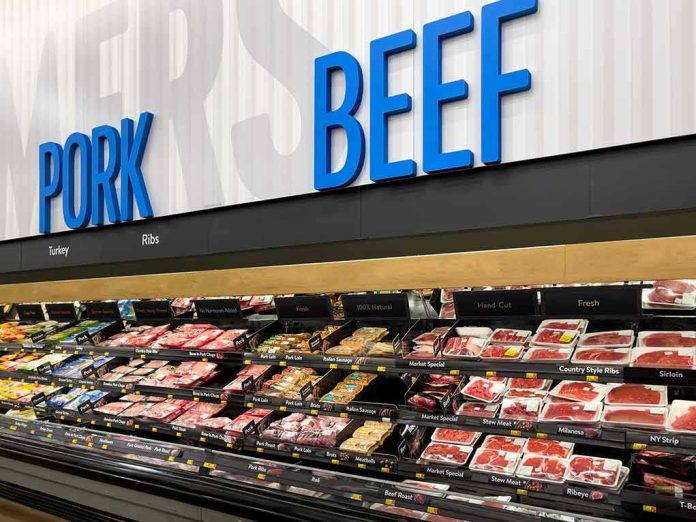
President Trump opened a 90-day window for up to 300,000 metric tons of tariff-free ground beef imports, promising prices 25% below today’s market.
Story Snapshot
- Trump said the U.S. will admit up to 300,000 metric tons of ground beef without out-of-quota tariffs for 90 days.
- The White House said there is a commitment to sell that beef at 25% below current market prices.
- The move targets rising grocery bills and a beef market squeezed by a historically small cattle herd.
- Past changes to beef import quotas show narrow tariffs under quota and steep tariffs above quota.
What the administration authorized and why it matters
President Trump said the United States will allow up to 300,000 metric tons of ground beef imports with no out-of-quota tariff for 90 days. The White House framed the action as a fast way to bring more supply and ease prices at the meat case. Trump added that there is a commitment that this beef will be sold 25 percent below current market prices, aiming to deliver quick savings for families under pressure from high food costs.
BREAKING: President Trump announces a deal to sell 300,000 pounds of beef at a 25% discount to market price as beef prices hit a record high. pic.twitter.com/QTX5h0AXe3
— 🦋 Laraib Fatima 🦋 (@Laraib_Fatiima) August 21, 2026
The program targets ground beef, the item many households buy most often. Extra imported lean trimmings can be blended with domestic fat to make lower-cost ground beef. Removing the out-of-quota tariff lowers the hurdle for that extra supply to land here. Under normal rules, beef shipped above a set quota faces a steep tariff, which can keep prices high at the border and limit volume.
Price pressure tied to a historically tight cattle cycle
The U.S. cattle herd sits near a 75-year low, which has pushed beef prices higher over the past year. The Department of Agriculture’s Economic Research Service reported beef and veal prices up about 11.8 percent in June compared with a year earlier. Tight supply comes from years of drought, costly feed, and ranchers shrinking herds. These cycles last many years, so relief from imports can help ground beef prices, but it cannot rebuild the national herd on its own.
Food economists describe cattle as a long biological cycle. Calves take time to reach market weight, and ranchers respond to prices with delays. That lag means fewer animals today often means higher prices for months or even years. Policymakers often lean on imports during the low point of the cycle to smooth prices at the store. The White House used that playbook earlier this year with quota adjustments to supplement lean trimmings used in ground beef.
How the tariff change may flow through to the checkout line
Tariff-rate quotas split imports into two lanes: a low tariff inside quota and a high tariff outside it. Inside quota, the duty is only a few cents per kilogram, but above quota, the tariff jumps to more than a quarter of the product’s value. By waiving the out-of-quota tariff for this 90-day window, the administration cuts a major cost barrier and invites additional volume to land quickly.
The headline promise is a 25 percent price discount on this imported ground beef. Retail impact will depend on how much arrives, where it is sold, and how stores pass savings to shoppers. The targeted product—lean material for grinding—tends to affect ground beef more than steaks or roasts. Even so, added supply can cool some pressure on everyday items like burger meat, which many families buy weekly, especially during grilling season.
What this means for shoppers, ranchers, and the bigger fight over prices
For shoppers who feel squeezed, cheaper ground beef would be a welcome win at the register. Many Americans across politics feel the system is stacked against them when essentials keep climbing. A short-term import surge can look like common sense: cut a tax at the border, move product, and lower a staple’s price now. The question policy experts track next is how much of the discount reaches the shelf and how long any savings last once the 90 days end.
For ranchers, repeated import moves can send mixed signals. Washington wants both lower prices for consumers and a strong domestic herd. When herds are small, higher cattle prices help those still producing, but they also raise store prices. Import relief tries to thread the needle—help families today without crushing producers. Past data show these tools are blunt. They ease prices at the margin while the long cattle cycle and weather do most of the heavy lifting over time.
Sources:
facebook.com, x.com, reuters.com, devdiscourse.com, kpmg.com