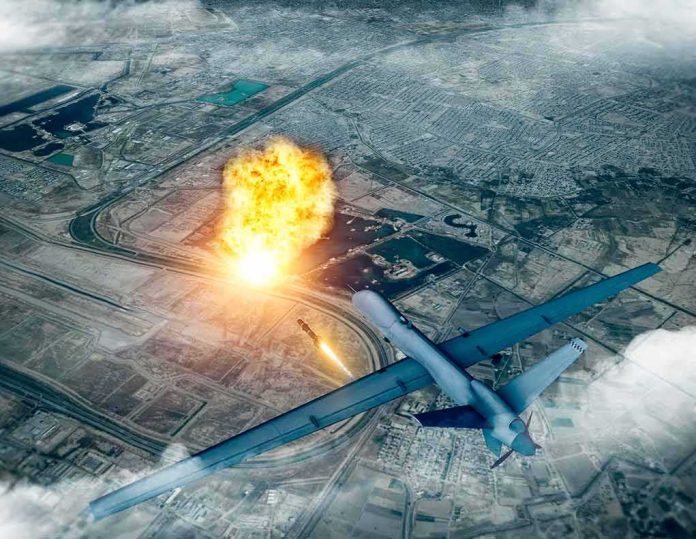
Iran-backed Houthis launched missiles and drones at the Saudi capital, and within hours smoke and flames were reported near Riyadh’s main airport.
As of Sunday, September 20, Saudi authorities say a ballistic missile aimed at Riyadh was intercepted at dawn Saturday. The Houthis claim a far larger strike package than the Saudis acknowledge.
Story Highlights
- Houthi spokesman Yahya Saree said missiles and drones targeted “sensitive sites” in Riyadh.
- The Saudi-led coalition said its air defenses intercepted a ballistic missile aimed at the capital at dawn Saturday.
- Black smoke and flames were reported near King Khalid International Airport, along with flight disruptions.
- The Houthis framed the attack as retaliation for Saudi strikes on Sana’a, marking a sharp escalation.
What Happened: Missiles And Drones Aimed At Riyadh
Yemen’s Houthi movement said it carried out two operations using missiles and drones against “sensitive sites” in Riyadh. Military spokesman Yahya Saree posted the claim and described a large number of ballistic and cruise missiles, along with drones, in the strikes. Multiple outlets carried the claim on Saturday and Sunday. The statements signaled a bid to reach deep into Saudi territory rather than the border regions that have absorbed most Houthi fire in the past.
The Saudi-led coalition said its air defenses intercepted and destroyed a ballistic missile launched toward Riyadh at dawn on Saturday. Coalition spokesman Major General Turki al-Maliki gave the time and said the missile did not reach the capital. The official account confirms at least one launch aimed at Riyadh and underscores the coalition’s missile-defense posture over the capital region.
Smoke Near Riyadh’s Airport
Journalists and outlets reported black smoke and flames near King Khalid International Airport after the Houthi claim, along with flight disruptions as authorities responded. Those details point to an incident at or near the airport complex, even as Saudi officials emphasized the interception. The timing lined up with the claimed strikes and the coalition’s early-morning engagement over the capital.
The Houthis framed the attack as retaliation for Saudi attempts to target the Yemeni capital, Sana’a, and tied the Riyadh operation to wider fighting across the theater. Public sources did not provide a count by weapon type. The coalition’s report addressed a ballistic missile only; the drones and cruise missiles the Houthis described were not part of the Saudi account.
Why This Matters To American Readers
A strike on the Saudi capital hits major U.S. interests: energy stability, safe air travel, and the security of a key counterweight to Iran. When an Iran-backed group fires missiles at Riyadh, the risk spreads fast. Prices can jump. Shipping and air routes can face delays or diversions. American families feel that at the pump and in the store aisle. Strong missile defenses matter, but persistent barrages raise the chance that one gets through at a busy hour.
The pattern is not random. Tracking since 2015 shows the Houthis have used rockets, ballistic and cruise missiles, and drones in hundreds of cross-border actions, growing more frequent and more sophisticated over time. Defenses must keep pace, and partners must share radar data, debris analysis, and quick warnings to blunt surprise shots at cities, airports, and energy sites.
What Comes Next
Saudi authorities will likely publish more on the launch track, debris, and intercept timeline. Aviation notices and airport logs may clarify how operations were affected and when normal schedules resumed. Independent imagery could show blast marks if any debris landed near infrastructure. Fast, clear public updates reduce panic, push back on propaganda, and guide airlines and shippers on routing.
For the United States, the goal is simple: back partners, deter Iran’s proxies, and keep trade moving. That starts with layered air defenses, better early warning, and steady pressure on the arms pipelines that feed these groups. President Trump’s team will be judged on how well it shields Americans from the ripple effects. A firm line against terror missiles and drones is part of that promise.
Sources:
feedpress.me, bbc.com, english.alarabiya.net, france24.com