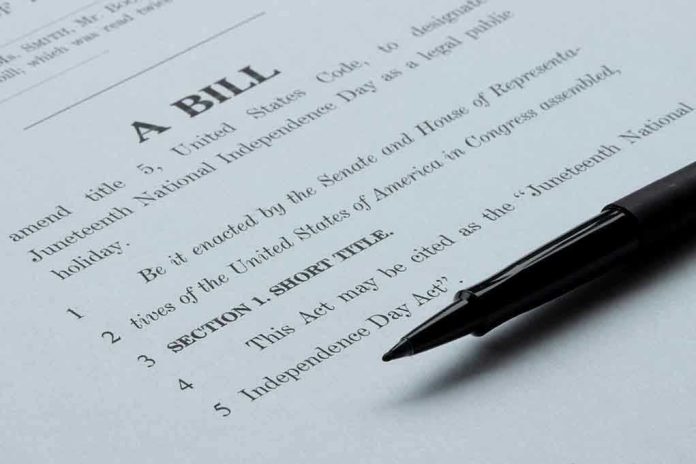
Four Republican senators just handed Democrats another win by helping kill a voter ID and citizenship-verification bill that millions of conservatives see as essential to securing America’s elections.
Story Snapshot
- Four Republicans joined Democrats to block the SAVE America Act, a bill centered on voter ID and proof of citizenship.
- Conservative-backed safeguards are being labeled “voter suppression” by left-leaning advocacy groups and Democrat senators.
- The bill would set nationwide rules for documentary proof of citizenship at registration, and in some versions at the polls.
- The fight reflects a bigger clash between election integrity and expansive access, with activists pushing to stop Trump-era reforms.
Four Republicans Break Ranks And Sink Key Election-Integrity Vote
The United States Senate recently rejected another effort to advance the Safeguard American Voter Eligibility (SAVE) America Act, after four Republican senators sided with Democrats to block the measure in a 48–50 vote.[1] The proposal, offered as an amendment by Senator Lindsey Graham, would have attached the voting bill to an immigration funding package, but it failed to clear even a simple majority, well short of the sixty votes needed to move past procedural hurdles.[1] Democracy Docket reports that Republicans Susan Collins, Lisa Murkowski, Mitch McConnell, and Thom Tillis joined every Democrat to stop the amendment, a move that immediately angered conservatives who view the bill as a basic election-security measure.[1] Their votes effectively stalled a top priority for election-integrity advocates aligned with the Trump administration.
Democracy Docket describes the SAVE America Act as imposing “new national voting restrictions, including ID and citizenship documentation requirements,” and notes that voting-rights groups claim those rules could disenfranchise eligible voters lacking easy access to qualifying documents.[1] Left-leaning organizations such as the League of Women Voters say the SAVE America Act and related bills would require “documentary proof of citizenship” to register and, under some versions, to vote in person, calling those requirements unnecessary because noncitizen voting is already illegal.[5] These groups argue that compelling voters to produce a passport or birth certificate, often in person, would hinder many eligible Americans, especially seniors, low-income citizens, and people who have difficulty retrieving original records.[5] Their pressure campaign framed the Republican-backed measure as an “anti-voter” push rather than a common-sense safeguard, shaping media coverage as the amendment went down in the Senate.[1][5]
What The SAVE America Act Would Actually Do To Federal Elections
Policy explainers note that the SAVE America framework is narrowly focused on tightening voter-registration rules by requiring documentary proof of citizenship for federal elections. The National Conference of State Legislatures says the SAVE America proposal would preempt existing state registration processes and “impose strict voter ID requirements,” effectively creating a federal baseline for how states verify citizenship and identity. Advocacy summaries compiled by the League of Women Voters describe the SAVE America Act and its companion bills as going further than earlier voter-ID laws by demanding proof of citizenship at registration and, in stricter versions, again at the polls before a ballot is counted.[5] Related materials from Rock the Vote characterize the House-passed language as requiring voters to present a birth certificate or passport in person to register, a major shift away from current systems that allow online, mail, and drive-based registration efforts.[4] Together, these descriptions indicate that the bill would standardize citizenship checks nationwide, replacing today’s patchwork of state-level practices with a more uniform federal rule set.
Opponents insist these requirements would collide with real-world document access. A Brennan Center for Justice call-to-action states that more than twenty-one million eligible Americans do not have immediate access to the necessary proof-of-citizenship paperwork, including passports, birth certificates, or naturalization documents, and warns that these citizens could be blocked or delayed from registering.[5] Rock the Vote highlights data suggesting that over 140 million Americans do not hold a passport and that sixty-nine million women who changed their last names after marriage may possess birth certificates that do not match their current legal names.[4] Additional analysis from disability-rights advocates argues that in-person proof-of-citizenship requirements would especially burden people with disabilities, who already report more difficulties navigating voting processes than nondisabled voters. While supporters argue the law targets only ineligible registrations, these figures are being used to paint a picture of widespread friction for lawful voters under the SAVE America regime.[4][5]
“Voter Suppression” Narrative Versus Election-Integrity Concerns
Democrat Senator Alex Padilla, who led the floor effort against the amendment, declared that “no matter how Republicans try to spin it, the SAVE America Act is a voter suppression bill, plain and simple,” portraying it as a “desperate, un-American” attempt to restrict voting rather than protect it.[2] In a House statement opposing the companion measure, Representative Betty McCollum argued that Republicans were trying to “nationalize elections and take power away from local communities” by forcing every state to hand over its voter rolls to the Department of Homeland Security, warning this could enable heavy-handed federal purges of voter lists.[2] McCollum emphasized that it is already illegal for noncitizens to vote in federal elections and contended that demanding “burdensome and expensive” documentary proof of citizenship is an unnecessary barrier that would especially impact women who changed their names after marriage, as well as others whose documents no longer match their current identities.[2] Civil-rights groups, including the NAACP Legal Defense Fund and the Campaign Legal Center, echo this framing, calling the bill “dangerous” and asserting that the real effect would be to dramatically restrict how Americans register and cast ballots.
McConnell and Tillis are gone. Get rid of Murkowski in the general election – make her wish she hadn't played games with ranked voting, and elect other Republican Senators so that Collins is irrelevant.
BREAKING: Senate Votes 48-50 to Reject SAVE America Act – FOUR Republicans…
— Patrick Casey (@PatrickJCasey) June 5, 2026
Neutral analysts observe that the SAVE America fight reflects a broader, recurring pattern in election-law battles: one side stresses integrity, while the other stresses access. The Issue One explainer notes that documentary proof-of-citizenship proposals typically resurface after high-profile election cycles, with supporters claiming that noncitizen registration and weak list maintenance threaten public confidence, and opponents responding that existing law already bans such voting and that added paperwork mostly trips up lawful citizens. The Bipartisan Policy Center similarly explains that the SAVE America Act would require documentary proof at registration and would expose election officials to new implementation duties, while acknowledging that confirmed cases of noncitizen voting remain relatively rare. That context helps explain why emotions are running high on both sides: conservatives see four Republicans helping Democrats block what they consider a basic safeguard, while progressive activists see the same vote as averting a nationwide tightening of rules they portray as a twenty-first-century poll tax.[1][4][5]
Sources:
[1] Web – The 4 Republicans Who Helped Dems Shoot Down the SAVE America Act …
[2] Web – The SAVE Act Status: Congress takes up even worse anti-voter bills
[4] Web – Tell Congress to oppose the SAVE Act Suite of bills
[5] Web – What Is the SAVE America Act and Why Is It Dangerous … – VoteRiders