
A homeless man shot dead by Madison police after an alleged knife attack on an officer has turned one city street into the latest flashpoint over power, trust, and who the system really protects.
Story Snapshot
- Police say 38-year-old Corey Ruiz pulled a knife, injured an officer, and was then shot during a struggle with four Madison officers.
- Bystander video shows a close-range shooting after a failed Taser attempt, but there is no body-camera footage to clarify the full encounter.
- Family members and civil-rights lawyers call the killing an “execution” and demand a homicide investigation with full video and evidence release.
- Days of protests in Wisconsin’s capital highlight rising anger on both left and right over force, transparency, and a justice system seen as protecting its own.
What Police Say Happened On That Madison Street
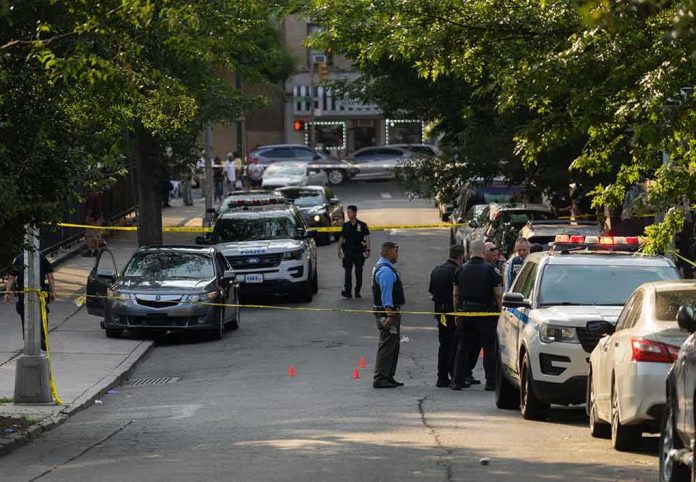
Madison police say the chain of events began with calls about a man checking parked cars and possible bike theft in the Marquette neighborhood early Wednesday afternoon. Officers say they found 38‑year‑old Corey Ruiz, who was homeless, and that he took off on a bicycle through nearby yards when they tried to stop him. Police and city reports say four officers eventually stopped Ruiz at an intersection and moved in to arrest him.
Officials say Ruiz resisted as officers tried to detain him, and a struggle broke out in the street. During that struggle, police Chief John Patterson says Ruiz pulled out a fixed‑blade knife and injured one of the officers, described as a veteran. Another officer then tried to bring Ruiz under control with a Taser, but Patterson says the Taser “was unsuccessful” and did not stop him. Police say the injured officer then fired three shots at close range.
What We Know From Video, And What We Still Do Not Know
Bystander videos, now seen across social media and national news, show several officers surrounding Ruiz after he comes off the bike, then a brief struggle on the pavement. In one angle, an officer yells about a knife while another shouts “Taser, Taser, Taser” before firing the stun device. The group falls toward the ground, and within seconds the officer rises to one knee and fires multiple shots at Ruiz from very close range.
There is no body‑camera footage from the officers, so the public is relying on these short, often shaky clips and on police and witness accounts to fill the gaps. Civil‑rights lawyers for the family say some footage appears to show Ruiz on his knees with both hands restrained at the moment of the shots, and they label the killing an “execution.” The state Department of Justice is treating the case as a homicide investigation, which is standard when police kill someone but also signals that force decisions will be closely reviewed.
Family Grief, Protest Anger, And A City On Edge
Family members describe Ruiz as an “exceptional man” who loved his 13‑year‑old daughter and struggled with homelessness but was more than the worst moments now shown on loop. At vigils near the intersection where he died, relatives say police “took my baby” and demand that the officer who fired be named, charged, and removed from the force. Friends and neighbors have left candles, flowers, and signs calling for justice and for answers from city leaders.
Protests have filled Madison’s streets for several nights, with crowds blocking intersections, chanting against police violence, and linking Ruiz’s death to earlier cases that eroded trust in local law enforcement. Some demonstrators tell reporters they no longer believe any official story when the government investigates itself, especially without body‑camera proof. Others argue that if an ordinary citizen shot and killed a man in a similar struggle, that person would likely be jailed at once, not placed on paid leave.
Why This Case Hits A Nerve Across The Political Spectrum
For many conservatives and liberals, this case feeds a growing belief that government power is out of balance and accountability is weak. People on the right who usually back the police still ask why a major city force is operating without body cameras in 2026, even after years of funding debates and federal grants. People on the left see another Black man killed by officers and point to a pattern where use‑of‑force reviews drag on while families and neighborhoods are left in the dark.
The Madison, Wisconsin, press conference centered on the fatal police shooting of 38-year-old Corey Ruiz, who was killed during an attempted arrest on July 22.
According to Madison Police Chief John Patterson, officers were responding to reports of a man trying to enter… pic.twitter.com/CBhr88Awsy
— Mighty News (@Mighty__News) July 25, 2026
National data show deadly force is a small share of all police encounters, yet shootings like this carry huge weight because they expose how much trust people do or do not have in the system that holds state power. When there is no full video record, people fill the gaps with their own experience of how government treats them, whether that is over‑policing, soft treatment for insiders, or leaders who always seem to circle the wagons to protect agencies first and citizens second. Many see that as one more sign that the “elites” are not playing by the same rules as everyone else.
Sources:
thegatewaypundit.com, abcnews.com, bbc.com, wpr.org, cityofmadison.com, wsws.org, urbanmilwaukee.com, youtube.com, instagram.com, captimes.com