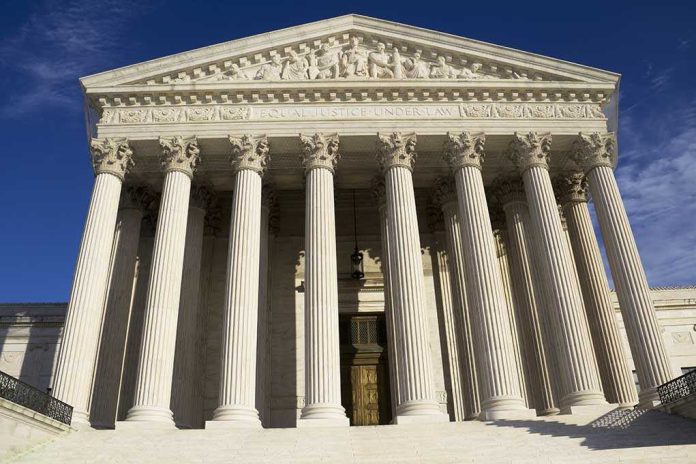
When the Supreme Court lets Alabama scrap a court-ordered map with two Black opportunity districts and go back to one, it sends a loud message about who really gets heard in American elections—and who does not.
Story Snapshot
- The Supreme Court’s conservative majority has cleared Alabama to use a 2023 congressional map with only one majority-Black district for upcoming elections, overruling lower federal judges who found the map racially discriminatory.[1][4]
- Black voters and civil-rights groups say the ruling guts earlier Voting Rights Act victories and cements a map that likely locks in a 6–1 Republican delegation in a state where about 27% of residents are Black.[1][4]
- Alabama officials hail the decision as restoring power to “the people’s elected representatives,” while critics see it as the federal judiciary greenlighting intentional vote dilution.[1][4]
- The fight reflects a deeper national pattern where both right and left increasingly believe political insiders and judges rig district lines to protect their own power rather than voters’ voices.[2]
What The Supreme Court Just Did In Alabama
The Supreme Court issued a 6–3 order allowing Alabama to use its 2023 congressional map, which contains only one majority-Black district out of seven, for the 2026 elections.[1][3] The Court froze a lower-court ruling that had blocked that map as an intentional violation of Section 2 of the Voting Rights Act and instead required a map with two districts where Black voters could elect candidates of their choice.[1][4][5] The unsigned opinion said the lower court improperly “interposed itself” in Alabama’s efforts to run its elections using maps chosen by the state’s elected legislature.[1][4]
Alabama Republicans drew the 2023 lines soon after earlier maps were struck down for diluting Black voting strength by “packing” and “cracking” Black communities, a pattern federal courts said violated the Voting Rights Act.[3][5] Under the court-imposed remedial map used in 2024, Black voters had a real opportunity to elect preferred candidates in two districts.[1][5] By restoring the 2023 plan, the Supreme Court has made it more likely that Republicans will win six of seven seats, reconfiguring the district previously represented by Democrat Shomari Figures.[1]
The Supreme Court just greenlit a congressional map in Alabama that even Republican-appointed judges said went too far.
The Voting Rights Act is under attack. We're fighting to protect fair representation and stop Republican efforts to silence Black voters. https://t.co/KUIqT3ZszK— Congresswoman Nikema Williams (@RepNikema) June 3, 2026
Why Civil-Rights Groups Call The Map Discriminatory
Black voters, the NAACP Legal Defense Fund, and allied groups argue the 2023 map was engineered precisely to limit Black political power despite decades of precedent requiring states like Alabama to create effective minority-opportunity districts where population numbers justify them.[3][5] A federal trial court found the 2023 map not only diluted Black voting strength but was enacted with racially discriminatory intent, concluding Alabama must maintain two districts where Black voters can elect candidates of choice for the rest of the decade.[3] Those judges emphasized that Section 2 of the Voting Rights Act still prohibits maps that leave minority voters with less opportunity than white voters to elect representatives.[3][5]
Civil-rights advocates say the Supreme Court’s emergency order effectively rewards Alabama lawmakers for defying earlier rulings that had forced them to draw a second Black opportunity district.[3][5] The American Civil Liberties Union and voting-rights groups denounced the decision as reinstating an “intentionally discriminatory” map even after voters had already cast ballots under fairer lines. For many Black Alabamians, the whiplash—from a hard-fought win in Allen v. Milligan to a sudden loss of a seat—reinforces a belief that the system bends to protect entrenched power whenever minority communities start to gain ground.[3]
How Both Sides See Power, Representation, And The “Deep State”
Alabama’s governor and attorney general frame the ruling as a victory for state sovereignty and legislative control, arguing that elected lawmakers, not unelected judges, should draw political maps.[1][2][5] Many conservatives, already distrustful of federal courts after years of fights over “woke” policies and perceived liberal judicial activism, view the decision as correcting overreach by a three-judge panel that forced an unwanted map onto their state.[2][4] For them, the case fits a pattern where distant legal elites override local majorities, fueling resentment toward what they see as a liberal legal establishment.
Liberals and many Black voters see almost the opposite story: a conservative Supreme Court majority using obscure emergency orders to quietly bless a map that even Republican-appointed lower-court judges had rejected as discriminatory.[4] They argue this shows how a small circle of powerful insiders—state politicians drawing lines and justices in Washington reviewing them—can sideline whole communities without meaningful accountability.[4] Across the spectrum, the Alabama fight deepens a shared suspicion that district lines are being manipulated behind closed doors to protect incumbents and party machines, not to honor the promise that every citizen’s vote should carry roughly equal weight.[2]
What This Battle Reveals About A System Under Strain
The Alabama dispute is not an isolated storm but part of a long-running national cycle where redistricting battles turn into proxy wars over race, party, and who defines “fairness.”[2][5] Every decade, legislatures redraw maps; voters sue under the Voting Rights Act or the Constitution; lower courts often demand changes; and emergency appeals bounce cases back and forth while elections creep closer.[2][4][5] The Supreme Court’s latest order suggests its majority is more willing to defer to state legislatures, even when trial courts find strong evidence of discrimination.
For Americans across party lines who already believe the federal government serves political insiders first, Alabama’s case looks like more proof that the rules are flexible when power is at stake.[2] Conservatives see judges repeatedly second-guessing state choices—until a conservative Supreme Court steps in; liberals see a high court ready to override fact-heavy findings of discrimination with a few paragraphs.[1][4] Either way, faith that ordinary citizens can secure fair maps through the courts is eroding, and that erosion cuts directly against the founding promise that representation should flow from the consent—and the equal voice—of the governed.
Sources:
[1] Web – Alabama Victorious As SCOTUS Decides They Can Use 2023 Maps, …
[2] YouTube – SCOTUS overturns 2023 Alabama map ruling, clearing the way for …
[3] Web – Supreme Court greenlights 11th-hour Alabama redistricting plan for …
[4] Web – Allen v. Milligan FAQ – Legal Defense Fund
[5] YouTube – Supreme Court overturns 2023 ruling on congressional map in …