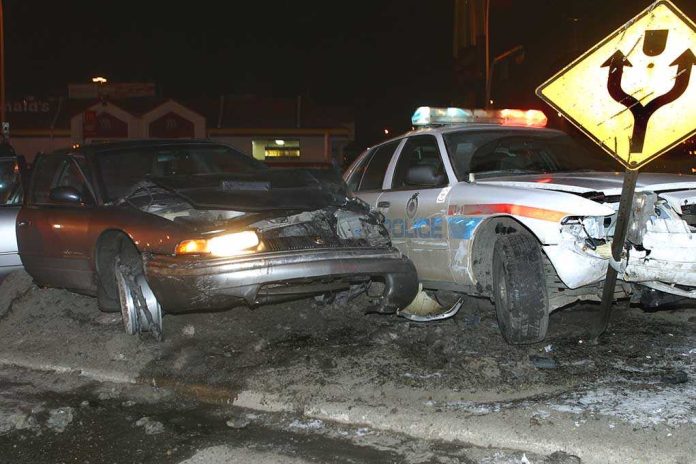
The most explosive revelation in the Chicago “ICE ramming” saga is not the crash itself, but how federal video evidence quietly undercut the government’s own dramatic story.
Story Snapshot
- Federal agencies first sold the public a clear-cut tale of violent attacks on immigration agents with vehicles in Chicago.
- New video and court rulings in at least one case later cast serious doubt on that narrative and led prosecutors to retreat.[2][6]
- Media outlets framed similar street confrontations in wildly different ways, shaping how Americans judged both agents and suspects.[1][3][4]
- The clash reveals a deeper problem: when politics meets street-level enforcement, truth becomes the most fragile thing at the scene.
How A Chicago Crash Became A National Story About “Attacks” On Agents
Federal homeland security officials have spent the last several years warning that immigration agents face a wave of violent attacks, including drivers allegedly weaponizing their cars. One of the most high-profile examples came from Chicago’s Brighton Park neighborhood, where officials said an armed woman and an accomplice deliberately rammed federal vehicles during immigration enforcement sweeps, forcing agents to fire.[3][4][5] Cable news grabbed the story, pairing grainy video with language like “vehicle ramming attack” and “domestic terrorists,” and the public was told the facts were settled.
In another Chicago-area confrontation, federal officials said a red car “aggressively tailgated” a Border Patrol vehicle, collided during a U-turn, and helped spark a hostile crowd that surrounded agents and spat on them as they tried to make an arrest.[1] Video from that incident showed agents wrestling a man to the ground as onlookers shouted and tried to intervene, feeding a second narrative: that neighborhoods were becoming open-air battlegrounds where federal officers risked their safety just doing their jobs.
What The Newly Released Video And Judge Actually Showed
That simple story line started to fray once judges and defense lawyers got their hands on the full footage in at least one key case. Prosecutors had accused two defendants of intentionally ramming federal vehicles during immigration sweeps in Chicago. After reviewing body-camera video and surveillance footage, a federal judge concluded the government’s description of the “ramming” was “difficult” to believe and sharply questioned whether agents were actually victims rather than the aggressors.[2][6] Those are not the words of an activist; they are the words of a federal judge reading the same evidence the public was not initially shown.
The Department of Justice then did something that speaks volumes: it moved to drop the case.[2] Officials did not confess to exaggeration, but their retreat after a judge publicly doubted the narrative tells a common-sense story. When the video played in a courtroom rather than a press conference, the “attack on agents” frame no longer looked rock-solid. For citizens who support law and order, that is a serious problem, because every overstated case makes it harder to defend agents when they are truly attacked.
Why Competing Narratives About Violence And Crowd Control Matter
Supporters of federal agents point out that these are not gentle work environments. In Brighton Park, federal officials say an armed suspect drove at officers after a chase and that agents fired only after facing a deadly threat.[3][4] In suburban Broadview, officials say ten cars boxed in agents near an immigration facility, forcing them to fire “defensive shots” as one driver with a semi-automatic weapon rammed their vehicle.[5] In Evanston, officials described a “hostile crowd” that kicked, spat on, and grabbed at agents during a chaotic arrest after a collision.[1]
Critics counter that “ramming” language often arrives before any real reconstruction of what actually happened on the road. They argue that some of these supposed ambushes look a lot more like messy traffic encounters or escalations triggered by tactical choices made by the agents themselves, especially in dense neighborhoods.[2][6] When judges see enough doubt to throw out charges after watching the same body-camera clips, that criticism starts sounding less like ideology and more like basic fact-checking. The tension between those two views now hangs over every new clip that hits the airwaves.
What This Fight Reveals About Trust, Media, And Common Sense
Americans over forty have lived through enough “breaking news” cycles to know the first official story often ages poorly. The Chicago cases fit that pattern. Officials highlight “car attacks” and “domestic terrorists,” some city leaders answer with inflammatory labels of their own, and television networks pick whichever angle flatters their audience.[1][3] Later, a dry court hearing, watched by almost no one, quietly rewrites the script when video and testimony fail to back up the early narrative.[2][6] The damage, by then, is done—to public trust, not just to reputations.
LIVE HEARING to CHARGE Trump’s ICE Agents | LIVE From Chicago https://t.co/86paPPEaGh via @YouTube
— #CaliBernication (@brooklynnygirl) May 21, 2026
Common sense and conservative instincts both point to the same standard: respect the agents who take real risks, but refuse to give any government office a blank check on the truth. A free republic needs immigration enforcement and border security; it also needs prosecutors and homeland security officials who treat facts as something more than ammunition for press releases. The Chicago “ICE ramming” saga leaves a blunt lesson: before choosing sides on the next viral crash video, demand the whole tape and the judge’s ruling, not just the slogan.
Sources:
[1] Web – Border Patrol crash leads to violent arrest caught on camera
[2] Web – Judge dismisses charges against 2 people accused of ramming …
[3] YouTube – Federal agents shoot, injure armed woman in Chicago …
[4] YouTube – New video shows alleged Brighton Park vehicle ramming
[5] YouTube – 2 federally charged after woman allegedly rams CBP agents with …
[6] YouTube – Federal judge rules on ICE vehicle attacks: ‘Difficult’ to believe