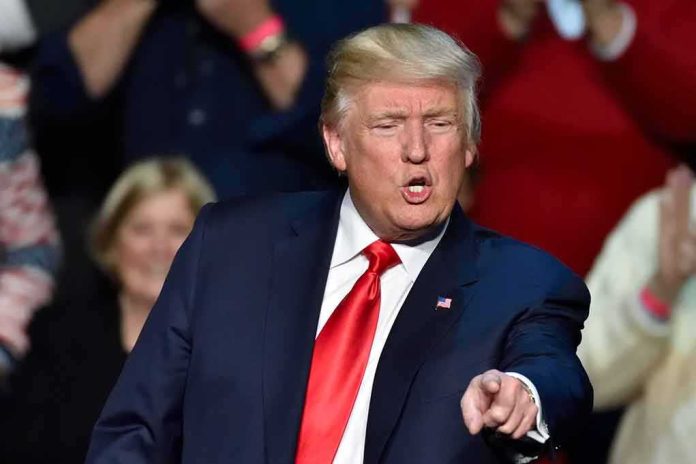
President Trump told the United Nations that Cuba’s communist regime “will fall,” and the island’s delegates got up and walked out of the room.
Story Snapshot
- President Trump called Cuba “an absolutely failed state” during his September 22 speech to the UN General Assembly.
- Cuban officials walked out of the hall as Trump attacked the regime and predicted its collapse.
- Trump said Cuba could not be allowed to remain “a haven for foreign adversaries” near American shores.
- Cuba’s foreign minister fired back on social media, denying his country is any kind of threat.
- Outside experts say Cuba faces real economic strain, but most doubt collapse is imminent.
Trump Calls Out Havana On The World Stage
President Trump used his UN General Assembly address to declare that his administration wants “a fundamental change in the situation in Cuba.” He said the communist regime is “under great pressure, the biggest pressure they’ve ever been under,” and predicted the government “will fall” as freedom comes to the Cuban people.
Trump didn’t stop at insults. He tied his tough talk on Cuba to American national security, saying the United States will not tolerate “a haven for foreign adversaries” so close to its own territory. For conservatives who have watched decades of failed engagement with Havana, that framing lands as common sense, not controversy.
Cuban Delegates Walk Out Mid-Speech
Cuban officials got up and left the assembly hall as Trump delivered his harshest lines about their government, according to multiple reporters covering the event live. Different outlets described the exit in slightly different terms, from a full walkout to delegates being spotted leaving, but the core fact stands: Havana’s representatives could not sit through the president’s remarks.
The moment fit a familiar pattern at the United Nations, where delegations often walk out to reject a speaker rather than to dispute specific facts. Similar walkouts have followed speeches by leaders from Iran and Israel in past years. Still, for a regime that insists it has nothing to hide, storming out looked a lot like an admission that Trump’s words hit a nerve.
Havana Fires Back On Social Media
Cuban Foreign Minister Bruno Rodríguez Parrilla did not stay silent. He posted on social media that “Cuba is not a threat to the US nor to any country” and accused Washington of refusing to accept Cuba’s right to be “a fully independent and sovereign country”. Cuban President Miguel Díaz-Canel also pushed back, insisting “there is no failed state, there is resistance”.
Díaz-Canel went further, calling the entire collapse narrative an “imperial philosophy” rather than reality on the ground. That is a predictable response from a dictatorship that has spent 67 years denying its own failures while its people flee by the thousands and suffer blackouts, food shortages, and a collapsing economy.
What The Evidence Actually Shows
Independent analysts paint a mixed picture. Groups tracking Cuba’s political stability describe a regime under serious economic and legitimacy strain, worsened by the loss of Venezuelan support after Nicolás Maduro’s capture in January, but most stop short of calling collapse imminent. One regional institute noted that misrule has “worsened in recent years, causing a profound crisis visible at various levels,” while other researchers say the ruling elite’s cohesion has kept the government standing despite the chaos.
That gap between Trump’s blunt prediction and the more cautious expert view does not make the president wrong. It means the timeline is uncertain, even as the underlying rot in Cuba’s economy and government is real and well documented. Conservatives have long argued that propping up failed communist experiments only prolongs suffering, and Trump’s willingness to say so bluntly on the world stage, rather than tiptoe around a dictatorship, is exactly the kind of straight talk his base has wanted for years.
Why This Moment Matters
Trump’s speech also touched on Cuba as a security concern, not just a humanitarian one, linking the regime to broader adversarial networks near American borders. That argument resonates with voters who remember Cuba’s historic ties to hostile powers and its role sheltering anti-American movements. Whether or not the regime falls on any particular timeline, the president made clear his administration sees ending Havana’s grip on its own people as a real policy goal, not just a talking point.
🇺🇳Watch : The Cuban delegation reportedly left the UN General Assembly hall as Trump described Cuba as a "failed state" during his address
🗣️ The walkout came as Trump criticized Cuba's government and its policies from the UNGA podium. pic.twitter.com/NaqkBoNuEj
— Kirikaar (@Kirikaar77) September 22, 2026
No Cuban government spokesperson offered a detailed rebuttal to the “failed state” label beyond the sovereignty claims from Rodríguez Parrilla and Díaz-Canel. Until Havana provides real evidence of stability, rather than slogans about imperialism, Trump’s blunt assessment will keep resonating with an American audience tired of excuses for failed socialist regimes.
Sources:
sanluisobispo.com, the-express.com, wdez.com