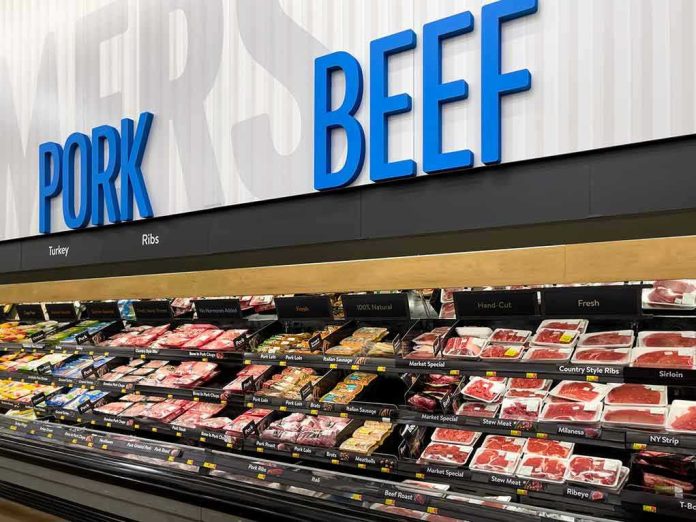
President Trump plans to slash tariffs on imported beef to combat record-high prices, risking fury from American ranchers who see it as a betrayal of domestic producers.[1][7]
Story Snapshot
- Trump to sign two executive orders expanding beef imports, mainly lean trimmings from Argentina, to address U.S. supply shortages.[1][7]
- Ground beef averages $6.70 per pound, up 21% since Trump took office, amid smallest U.S. cattle herd in 75 years.[1][4]
- Cattle industry blasts move as undercutting producers; National Cattlemen’s Beef Association calls it misguided.[8]
- Temporary measures aim for consumer relief ahead of midterms, but experts doubt significant retail price drops.[1][4]
Executive Orders Target Supply Shortfall
President Donald Trump schedules signing of two executive orders on May 11, 2026, to expand beef imports and tackle short-term U.S. market issues. A White House official confirms the actions address supply constraints in beef products under tariff-rate quotas, including lean beef trimmings.[1][7] The first order, titled “Ensuring Affordable Beef for the American Consumer,” temporarily increases in-quota imports, allocating additional volumes to Argentina—20,000 metric tons quarterly through year-end.[7] This responds to the U.S. cattle herd shrinking to its lowest level in 75 years, per administration reports.[4]
U.S. Department of Agriculture projections forecast record beef imports of 5.8 billion pounds in 2026, a 6% rise from 2025 and 25% from 2024, mostly lean trimmings for ground beef.[4] Secretary of Agriculture monitored domestic supplies of specific Harmonized Tariff Schedule codes like 0201.30.5091, confirming shortfalls when combined with estimated imports.[7] Ground beef prices hit $6.70 per pound in March 2026, up nearly 21% since Trump’s inauguration.[1]
Cattle Industry Backlash Intensifies
National Cattlemen’s Beef Association (NCBA) condemns the import expansion as President Trump undercutting America’s cattle producers.[8] NCBA labels it a misguided effort that ignores domestic production challenges, urging federal tax credits for heifers and access to 19 million acres of grazing land instead.[4] The move infuses key Republican allies in cattle states, timed ahead of midterm elections.[1]
Agricultural economist David Anderson from Texas A&M states more imports may cut costs for hamburger restaurants but expects no significant consumer price drops.[4] Critics frame the policy as a short-term band-aid, highlighting reliance on anonymous sources for initial announcements and lack of detailed long-term herd rebuilding plans in the second order.[1][9]
Broader Policy Patterns and Consumer Pressures
Trump’s actions fit historical U.S. agricultural responses to cattle cycle contractions every 10-12 years, driven by droughts and feed costs.[7] Past interventions under the Uruguay Round Agreements Act added quotas, like 40,000 metric tons in 2015 and 64,000 from Australia in 2020.[1] The administration pairs imports with a second order on Small Business Administration lending to ranchers and potential herd growth measures, though specifics remain vague.[1]
The Trump administration is planning to temporarily reduce #tariffs on #beef #imports, according to people familiar with the matter, part of a broader effort to address record-high #beef #prices.https://t.co/h4oAwrkrlB
— FarmPolicy (@FarmPolicy) May 12, 2026
Americans across political lines grapple with grocery inflation, fueling shared frustration with government priorities favoring short-term fixes over sustainable solutions.[1][7] While imports target affordability for families, ranchers demand focus on rebuilding the herd without foreign competition. Outcomes hinge on post-implementation price data from Bureau of Labor Statistics.[4] This clash underscores tensions between consumer relief and producer protection in a strained economy.
Sources:
[1] Web – White House plans to reduce barriers to beef imports in an effort to …
[4] Web – Trump to sign orders to boost beef imports, grow herds to try to …
[7] Web – Ensuring Affordable Beef for the American Consumer
[8] Web – President Trump Undercuts America’s Cattle Producers
[9] Web – Trump administration cuts beef import tariffs amid record prices