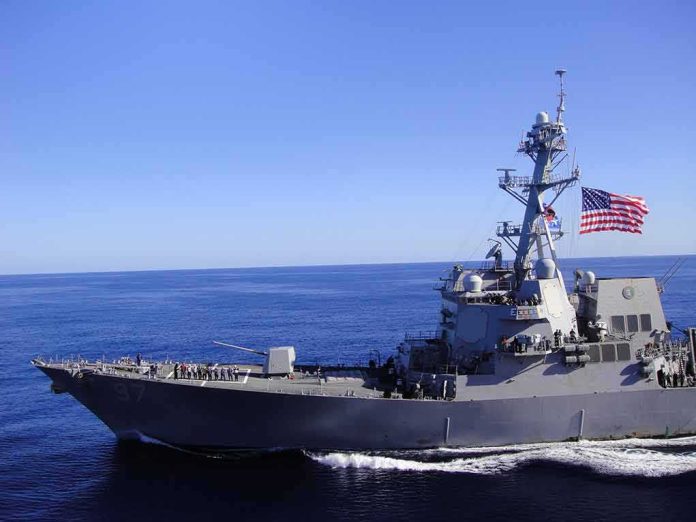
The Navy set out to build 32 futuristic destroyers, paid billions, and ended up with three ships whose giant guns never fired in service because the bullets cost as much as a house.
Quick Take
- The plan shrank from 32 ships to 3, driving up costs and crushing key features.
- Total program cost landed in the low-to-mid $20 billions by official reports.
- The custom 155 millimeter round rose to about $800,000, ending buys in 2016.
- Navy leaders later shifted the ships to carry hypersonic missiles, not guns.
How A Big Idea Got Small And Very Expensive
The Navy pitched the Zumwalt-class as the next leap in surface warships. The plan called for 32 stealth destroyers packed with new tech and two 155 millimeter guns for long-range fire support. Budget hits and program turbulence cut that vision to three ships. Each cut raised the cost of everything left on board. Congress and official documents trace that steep drop in quantity, which set off a cost spiral the program could not escape.
Selected Acquisition Reports show how the money stacked up. The December 2018 defense report lists the program’s Total Acquisition Cost at over $31 billion in base year dollars, while later accounting pegs it in the low-to-mid $20 billions in then-year dollars. The swing reflects different bases and what each report includes. Either way, the class sits among the most expensive surface programs ever fielded for so few ships.
The $800,000 Shell Problem That Broke The Guns
The two 155 millimeter Advanced Gun Systems needed a special round, the Long Range Land Attack Projectile. It promised precision strikes out past 60 miles. When the buy fell from dozens of ships to three, the price per round jumped to around $800,000. Navy officials said the gun worked, but the round became unaffordable with so few ships to spread costs. The Navy halted buys, and the guns never entered operational use with ammunition.
Reports at the time captured the core admission: the issue was price, not a broken barrel. The Navy did not adopt an alternative round, because the gun and magazine were built around the special projectile and automation. That tight design locked the system in place. Once the round died, the gun’s purpose died with it. Spending more to reengineer the entire chain made little sense for a fleet of three hulls.
From Shore Fire Support To Hypersonic Launch Pads
Without a viable gun mission, the Navy pivoted. The service moved to remove the guns and convert space for new long-range strike options. The ships are being refit to carry hypersonic missiles, turning them into testbeds and future strike platforms. This shift admits the original concept failed on cost and scale, then tries to save value by leaning on the hull’s power, space, and stealth for a different mission set.
Government Accountability Office reporting long warned about this pattern: start big with immature tech, cut quantity when costs rise, then watch unit costs soar. That script fit the Zumwalt program. Early audits flagged design risk, schedule strain, and budget gaps. Each risk matured on cue. By the time the first ship sailed, the class carried fewer sisters, fewer original features, and far less political support than planned.
What This Teaches About Buying Weapons That Actually Work
Large programs fail when ambition outruns stable budgets and scale. The Navy built a custom gun, a custom round, and a custom ship class. The gamble needed a large production run to make the numbers work. Once that run collapsed, each custom part became a boutique item. That is not how you build an arsenal at war scale. Reliability and cost discipline are not glamorous, but they are what put working weapons in sailors’ hands. On those terms, the ammunition plan never penciled out once the fleet shrank.
Future programs should lock requirements early, keep new tech to a minimum on the lead ship, and buy enough units to hold vendor prices down. Use existing munitions where possible. If a bespoke round is truly needed, do not hinge the entire ship’s primary weapon on a single vendor and a small buy. The Zumwalt class still may earn its keep as a strike platform. But the country paid gunship prices and got missile ships years later. That trade should be rare, not routine.
Sources:
19fortyfive.com, popularmechanics.com, defensenews.com, gao.gov, media.defense.gov