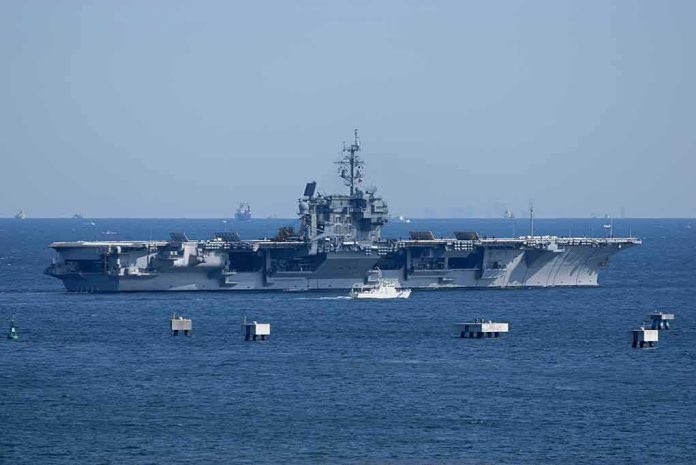
China is quietly building the kind of drone swarms that could turn the waters around Taiwan into a tracking grid for U.S. aircraft carriers — and drain American defenses round by round.
Story Snapshot
- China is testing new drone “motherships” and mini drone carriers designed to launch large swarms over the Western Pacific.
- War games and expert studies say U.S. forces inside the First Island Chain could be overwhelmed by cheap Chinese drones if they do not adapt.
- Recent Chinese naval surges of 100-plus ships near Taiwan show how drones could plug into a much larger blockade or strike network.
- Both China and the United States are racing to use swarming drones, raising risks for American sailors and taxpayers while Washington argues about priorities.
China’s New Drone Carriers and Swarm “Motherships”
Chinese state media and open-source images show Beijing moving from theory to practice on unmanned sea and air power. Reports describe at-sea testing of uncrewed helicopters from a so-called “mini drone carrier,” signaling that the People’s Liberation Army Navy is learning how to launch and recover drones from small, cheaper ships instead of relying only on big deck carriers. Other work highlights a “drone mothership” aircraft, Jiu Tian, built to release more than one hundred loitering munitions in a single mission.
These systems sit on top of earlier Chinese moves, like the Zhu Hai Yun drone carrier, a ship able to carry aerial, surface, and undersea drones and operate with artificial intelligence. Analysts say China’s leaders want “unmanned, intelligent combat capabilities” to be a bigger share of their forces and are churning out new designs at a rapid pace. Together, these programs point to a clear goal: fill the seas and skies around Taiwan with cheap, networked robots that spot and wear down high-value U.S. assets.
War Games: How Swarms Could Threaten U.S. Carriers
American think tanks have run detailed war games on a Taiwan fight and many reach the same warning. A team at the Center for a New American Security found that Chinese forces used mixed drone swarms to sustain attacks on U.S. forces, especially inside the First Island Chain, the band of territory from Japan through Taiwan to the Philippines. A separate report from the same group judged that drones will be central in a future U.S. effort to defend Taiwan, meaning both sides expect unmanned systems to shape the battle.
Research from the Center for Naval Analyses describes China testing drone swarms for amphibious landings and “island-blocking scenarios” with targets built to resemble Taiwan. These tests include uncrewed surface vessels and formations of intelligence and strike drones meant to confuse defenses and open gaps. Other studies explain how China could use countless cheap drones, unmanned submarines, and small surface craft to guide missile strikes and threaten any U.S. carrier that sails into range. The shared theme is volume: numbers and complexity, not single silver bullets.
First Island Chain Pressure and a Drone-Enabled Blockade
China’s drone push is not happening in a vacuum. Taiwan’s security officials say Beijing recently deployed more than one hundred ten naval and coast guard vessels along the First Island Chain, the highest level they have ever tracked. Maritime analysts describe this as China’s largest East Asia naval surge in three decades, stretching from Japan down past Taiwan toward the Philippines. While these ships mostly carried out “exercises,” they showed how quickly Beijing can mass hulls near critical sea lanes.
Chinese military writers are already talking about using uncrewed minelaying drones to seal waters around Japan and Taiwan during a crisis. Other reporting describes plans to combine drones, missiles, and submarines to create an anti-access “hellscape” that punishes any U.S. carrier group crossing into the region. For Americans who feel Washington ignored supply chains and borders for years, it is not lost that Beijing appears more focused on locking down the seas that feed its rise than U.S. leaders seem on protecting America’s own coasts.
The Cost Problem: Cheap Drones vs. Expensive Defenses
Multiple studies stress a basic math problem that should alarm taxpayers on both the right and the left. Chinese planners are building very cheap drones designed to force U.S. ships to fire very expensive defensive missiles. One Asia-based analysis describes a peer-reviewed Chinese concept in which decoy drones and low-cost cruise missiles soak up U.S. interceptor shots before stealthier weapons move in for the kill against dispersed carrier groups, even as far away as Guam.
Videos and expert commentary walk through how a single “mother ship” could unleash over one hundred kamikaze drones beyond the reach of many current defenses, forcing Aegis destroyers and carriers to spend millions of dollars in interceptors on targets that cost a tiny fraction of that to build. This kind of imbalance feeds the wider anger many Americans feel about a government that spends lavishly on high-end programs yet struggles to protect basic economic security at home. The same pattern now threatens to repeat at sea.
U.S. and Allies Race to Catch Up
The story is not one-sided. The United States is also working on its own drone “hellscape” plans, aiming to flood a future Taiwan battlefield with thousands of cheap friendly drones instead of putting manned jets and ships in constant danger. Japan is planning new long-range surveillance drones on islands like Iwo Jima to better track Chinese naval movements beyond the First Island Chain. These efforts show democracies waking up, but they also highlight years of delay while both parties in Washington argued, spent, and blamed.
Critics warn that many of the scariest drone-swarm scenarios remain untested in real combat and could be overhyped. At the same time, China’s steady testing rhythm, its naval surges near Taiwan, and its clear writings about swarms for blockade and invasion all point in one direction: a push to make it too risky, slow, and costly for U.S. carrier groups to operate inside the First Island Chain. That reality should concern Americans across the spectrum who already feel the system is failing to protect long-term national strength.
Sources:
19fortyfive.com, asiatimes.com, visiontimes.com, modeldiplomat.com, youtube.com, scmp.com, easternherald.com, geosirius.ifz.ru, maritime-executive.com, geostrategy.org.uk, thedefensepost.com, understandingwar.org