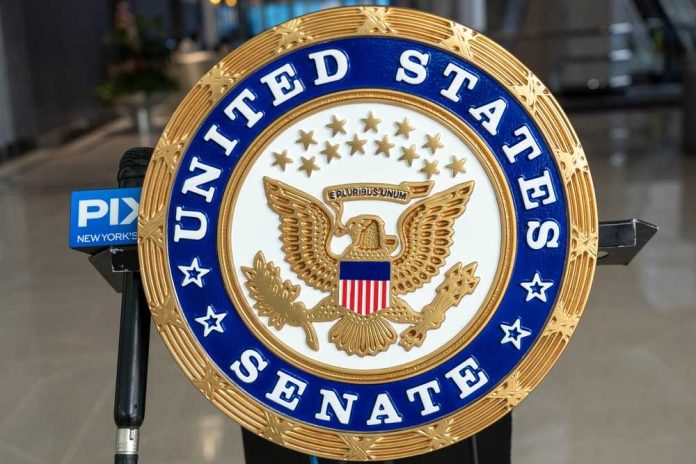
A key Republican holdout just flipped to support the SAVE America Act, jolting the Senate fight over voter citizenship checks.
Story Snapshot
- The House passed the SAVE Act to require proof of citizenship for federal voter registration [1].
- Senate debate centers on stopping ineligible voting and foreign interference versus access concerns [2][3].
- Opponents warn the paperwork could burden eligible voters who lack documents [1][3].
- A Republican switch to “yes” signals rising pressure to secure elections [2].
What the SAVE America Act Would Do
The SAVE America Act would require documentary proof of citizenship to register for federal elections. Supporters say this tightens the front door of the voter rolls and closes gaps that could allow ineligible registrations. Backers argue that a clean voter file protects every lawful ballot and deters outside meddling. Reports on the bill describe requirements such as a passport or birth certificate to prove citizenship at signup, along with photo identification to vote [2].
The House approved the bill on July 10 with a recorded vote, showing it cleared one chamber and moved to the Senate for action. That passage put the issue on the national stage and increased pressure on senators to take a clear side. The measure’s advance confirmed that a majority of House members backed proof-of-citizenship checks at registration, which supporters view as a basic eligibility test for federal elections [1].
Why Backers Say Citizenship Checks Matter
Senate backers frame the policy as a simple rule: only citizens vote in federal elections. They argue stronger checks protect election integrity before a single ballot is cast. They also say federal elections draw the interest of foreign actors and that better screening helps block outside influence. Their case focuses on targeted verification at registration, not on stopping eligible citizens from voting. They claim the steps mirror common identity checks in other parts of daily life [2].
Supporters stress that clear standards reduce gray areas and boost trust. They argue clean rolls shorten lines, cut provisional ballots, and help local officials keep accurate records. They see proof-of-citizenship as a way to prevent problems rather than chasing them after votes are cast. That forward approach, they say, guards each lawful ballot from being canceled out by an ineligible vote. They view this as a constitutional duty to protect self-government [2].
Susan Collins
last minute is a YES
On the SAVE ACT
Thank God
HOPE THE REST OF THESE CLOWNS
SAY YES ALSO pic.twitter.com/DZzkoSo2sU— Yiota P Kiriakes (@hypertension57) June 9, 2026
What Opponents Warn Could Happen
Opponents say the plan creates a new barrier for eligible citizens who lack immediate documents. They point out that many Americans do not have a passport at home and may face hurdles finding or paying for a certified birth certificate. They argue the burden would fall hardest on seniors, students, rural residents, and naturalized citizens who need time to pull papers together. They warn the change would reduce registration and participation among lawful voters [1][3].
Critics also argue local election offices would face heavy paperwork and backlogs. They fear people who think they have registered might learn too late that their forms were rejected for missing documents. They say that risk could push down turnout and strain trust. Their case is that any gain from tighter rules is small compared with lost access for eligible citizens. They frame the bill as a nationwide version of earlier documentary fights that saw mixed results in court and practice [1][3].
The Senate Drama and a Notable Flip
Earlier Senate votes showed a tight chamber and moments where several Republicans joined Democrats to block the SAVE America Act language. One noted vote was 48 to 50, which kept the measure from advancing at that time. Those margins signaled how a single switch could change the bill’s fate. Coverage highlighted that a few Republicans sided with Democrats in that key vote, which angered election-integrity advocates [2].
New reports and social chatter now point to at least one Republican holdout moving into the “yes” camp. That flip places fresh pressure on others and shows where the base is leaning. It also suggests the debate is not settled in the Senate. With the House already on record, each Senate vote now carries extra weight. A unified Republican front would make the path clearer, while more defections would keep the bill stalled [2].
What This Means for Voters and States
If enacted, states would need to verify citizenship at the start of the federal registration process. That would likely require clearer guidance, secure document checks, and fast ways to fix small errors. Supporters believe this can be done with simple steps and modern systems. Opponents warn that rollout missteps could block eligible voters and overwhelm local staff. The results would hinge on timelines, training, and whether states offer easy, low-cost ways to get needed papers [1][3].
For readers, the stakes are direct. Every fraudulent registration erodes trust, and every lawful voter turned away does the same. The balance is the whole fight. Backers argue citizenship checks protect the ballot box at the source. Opponents argue new paperwork will keep neighbors off the rolls. The Senate flip shows momentum for tighter rules. The final outcome will show whether security or access claims won the day, and how states must adjust if it passes [1][2][3].
Sources:
[1] Web – This GOP Holdout Is Now on Board With the SAVE America Act
[2] Web – Requiring Proof of Citizenship to Register for Federal Elections
[3] YouTube – 4 Senate Republicans Join Democrats to Defeat the SAVE Act