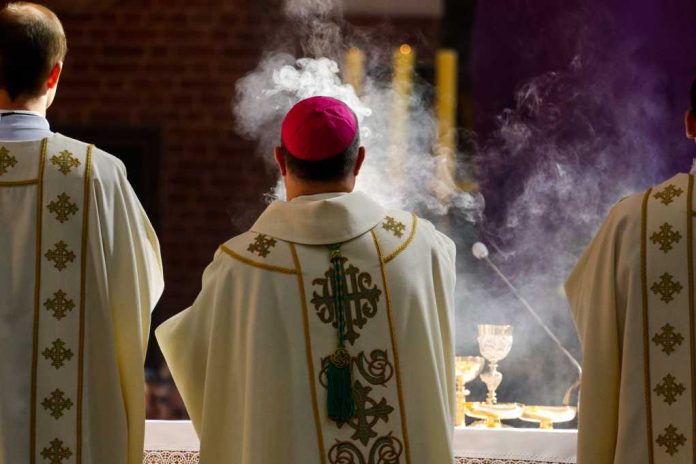
A newly appointed German bishop is quietly raising the question of ending mandatory priestly celibacy, putting one of the Catholic Church’s most sensitive rules back under the spotlight.
Story Snapshot
- Pope Leo has appointed Christian Würtz to lead the Diocese of Eichstätt in Germany.
- Würtz calls relaxing priestly celibacy a “fascinating question” with several possible models.
- His openness to discussing celibacy fits a wider pattern of regional pressure on Church discipline.
- The Vatican still officially defends celibacy, but recent debates show growing strain on the rule.
New Bishop’s Comments Put Celibacy Rule Under Fresh Pressure
Pope Leo XIV recently named Auxiliary Bishop Christian Würtz of Freiburg as the new bishop of Eichstätt, making him the youngest diocesan bishop in Germany. In public remarks, Würtz did not call for direct abolition of priestly celibacy but described loosening the obligation as a “fascinating question” with “various models” to weigh. He stressed that the Church must carefully balance what it would give up and what it might gain if it relaxed the rule, signaling real openness to change while avoiding a clear proposal.
German reports describe Würtz as a cautious reformer who supports many elements of the German Synodal Way, including greater lay involvement and blessing ceremonies for same-sex couples. At the same time, he has sometimes held back, abstaining on one key text about priestly existence and celibacy rather than voting for or against it. This mix of reform sympathy and restraint suggests he aims to test boundaries without directly breaking with Rome, a style that worries traditional Catholics and excites many church reformers.
Celibacy: A Changeable Discipline Backed Strongly By Rome
Priestly celibacy in the Latin Catholic Church is a discipline, not a core doctrine of the faith, which means it can be changed by Church authority. Historical studies show that mandatory celibacy developed slowly, becoming firmly rooted in the Western Church by the Middle Ages and later reinforced after the Council of Trent. Yet the modern papacy has tied celibacy closely to priestly identity, arguing that it supports total dedication to Christ and to the people the priest serves.
Pope Leo XIV has repeatedly reaffirmed that Catholic priests are expected to remain celibate and has described celibacy as a gift to be “conserved and educated” in seminarians. Official Vatican texts still insist that the law of celibacy should continue to be linked to ministry and warn against weakening it without serious cause. However, the same documents allow narrow exceptions, such as married ministers from other Christian communities who become Catholic priests, showing that limited flexibility already exists inside the system.
Global Pattern of Regional Challenges to Celibacy
Würtz’s cautious openness to relaxing celibacy is not an isolated German idea but part of a broader pattern of regional pressure on the rule. Since the Second Vatican Council, groups of bishops have raised the issue every decade or so, often in response to priest shortages and changing social expectations. In recent years, debates have accelerated, with bishops at the Amazon Synod discussing married priests for remote areas and Belgian bishops formally asking for optional celibacy for their region.
These repeated challenges highlight a growing divide between the official line from Rome and the lived reality in many local churches. Reform-minded bishops argue that calling celibacy a discipline, not unchangeable dogma, logically opens the door to local exceptions or broader change. Defenders reply that celibacy is now so deeply tied to the Latin priesthood that loosening it would damage the Church’s spiritual witness and weaken trust in long-standing commitments. The clash leaves many ordinary Catholics feeling that distant leaders and church elites argue over rules while failing to address deeper crises of faith and leadership.
Why This Matters Beyond Church Walls
For many Americans, especially those who feel the federal government is run by distant elites, the fight over priestly celibacy looks familiar. A powerful central authority insists a long-standing rule must stay, while local leaders and ordinary people point to hard realities like shrinking parishes, aging clergy, and scandals, and ask if the system still serves the people it claims to protect. When a new bishop like Würtz floats change but stops short of taking a clear stand, it can feel like yet another example of leaders avoiding hard choices.
Conservatives who value tradition worry that bending ancient rules just to meet modern demands will repeat the same pattern they see in politics: institutions chasing trends instead of holding firm to core beliefs. Liberals who want reform see the Vatican’s firm defense of celibacy as part of a broader tendency of top-down control, keeping power in the hands of a small clerical class and slowing change they believe could help the poor, families, and victims of abuse. Both sides, inside and outside the Church, share a growing sense that large institutions, whether Rome or Washington, often protect their own stability first and the people they serve second.
Sources:
lifesitenews.com, zeit.de, catholicculture.org, katholisch.de, cathcon.blogspot.com, en.wikipedia.org, insidethevatican.com, youtube.com, hprweb.com, mushare.marian.edu, cejsh.icm.edu.pl, vatican.va