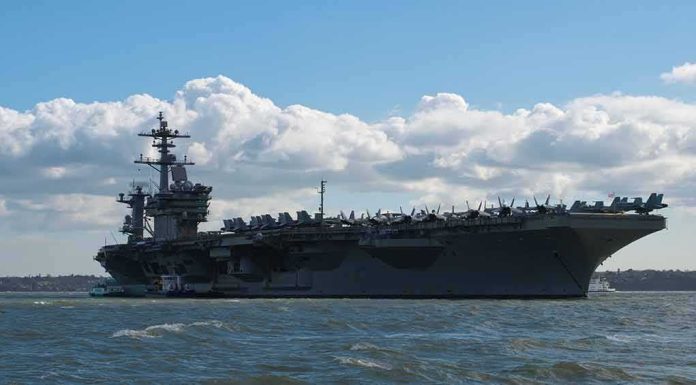
Families say multiple USS Abraham Lincoln sailors tried to go overboard as the carrier’s record-long deployment stretched crew stamina to the breaking point.
Story Snapshot
- Military families report several overboard attempts during the carrier’s ninth month at sea.
- Published accounts tie distress to repeated extensions, scarce supplies, and poor conditions.
- Lawmakers are pressing the Navy for answers on morale, safety, and mental health support.
- The Navy has used “duty status whereabouts unknown” in past man-overboard cases, reflecting limited real-time details.
Reports of Overboard Attempts During Prolonged Deployment
Military Times reported that at least two families say sailors tried to jump overboard from the USS Abraham Lincoln during the current deployment, now deep into its ninth month at sea. One spouse said her husband had been “repeatedly overextended” before his attempt, while another described a shipmate stopping a sailor on watch from going over the side. The Guardian reported the carrier has spent about 250 consecutive days without a port visit, which families and some lawmakers link to rising stress.
India Today and Moneycontrol summarized family accounts of tight rations, broken toilets, and moldy showers that, taken together, suggest poor living conditions aboard a warship tasked near Iran. These outlets framed the alleged shortages as compounding factors during a long, uncertain mission window. While these details come from family reports and secondary outlets, they align with the central theme raised by Military Times and The Guardian: long deployments strain crews and can erode morale.
USS Abraham Lincoln sailors tried to jump overboard amid extended deployment all because of Netanyahu’s BS No threat Iran war – @SenateDNC @SenateGOP @WSJ @Guardian @CNN @FoxNews – All for no treat to US. All about “power & Money” for Trump https://t.co/rAS2F13wlW
— Miguel A Nunez Jr (@MiguelANunezJr) August 13, 2026
Lawmakers Demand Accountability and Clarity From the Navy
The Guardian reported that members of Congress are pressing the Navy for specifics on what happened, what support sailors received, and why the ship’s time at sea keeps stretching. Their questions focus on mental health care, manning levels, and whether senior leaders ignored warning signs. This oversight push highlights a shared concern across the political spectrum: when missions drag on without clear endpoints, the people on the front line carry the cost in silence until a crisis surfaces.
Military families told Military Times that repeated extensions left sailors exhausted and isolated, with limited contact home and fewer ways to reset between high-tempo watches. Lawmakers’ letters, according to press accounts, ask for data on suicide prevention, counseling access, and staffing for embedded mental health teams. They also want a timeline of reported incidents and the ship’s operational schedule decisions that kept port calls off the calendar.
What the Navy Has Said — and What Remains Unclear
Official Navy disclosures on at-sea self-harm are often narrow while inquiries proceed. Past man-overboard cases used “duty status whereabouts unknown,” which confirms an incident but withholds detail until facts are firm. A March statement from the Navy’s Middle East command described a non-combat injury aboard the Lincoln and noted the sailor was stable after evacuation, showing the service does release limited updates from underway operations. Specifics on recent overboard attempts remain under review.
That gap leaves families and the public leaning on secondhand accounts while waiting for formal findings. Responsible reporting treats those accounts as allegations tied to named outlets, not as final proof. The pattern is familiar: partial data at sea, strong signals of stress ashore, and lawmakers stepping in to force clarity. The Navy will likely publish more once investigations close. Until then, the best-supported facts tie crew distress to a very long deployment window.
Why This Matters Beyond One Ship
Extended missions without port breaks risk more than morale. They can weaken readiness, increase accidents, and push young service members past safe limits. Families describe supply and habitability problems that would challenge any crew, and those claims line up with what experts have warned about long carrier deployments for years. When the schedule keeps slipping, leaders must decide whether mission goals justify the human strain placed on the deck plates.
260+ days at sea. No return date. Multiple sailors reportedly trying to jump overboard.
The USS Abraham Lincoln crew is being ground down — moldy showers, broken toilets, rationed food, 12-16 hr shifts with no relief — for a war with Iran that never should’ve happened.
The…
— Webba (@WebbaBroadside) August 13, 2026
Americans across the political divide see a bigger issue here. People on the right and the left both worry that distant decision makers ignore front-line realities until a headline appears. If Congress must pry basic facts from the Navy after months at sea, trust erodes further. Clear answers on what happened, why the deployment stretched so long, and what fixes are coming would show that leaders value the people who carry the load — not just the mission itself.
Sources:
realcleardefense.com, theguardian.com, militarytimes.com, reddit.com, moneycontrol.com, navy.mil, x.com