

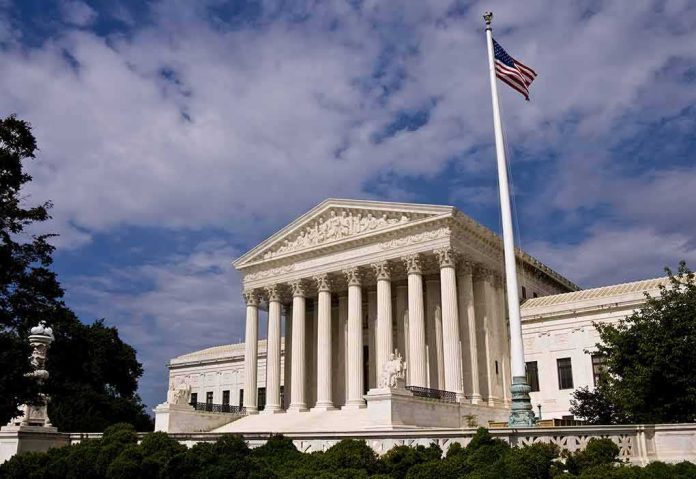
The Supreme Court will decide whether President Trump can shut off asylum at the southern border, a case that will set how far any president’s power over the border reaches.
Story Highlights
- The Supreme Court agreed to hear the fight over Trump’s ban on asylum for people who cross the southern border illegally.
- Two lower courts ruled the ban unlawful, but it stays in force while the justices review it.
- The core question: does a president’s power to suspend “entry” also let him block asylum claims?
- Arguments are expected in the spring, with a decision by late June or early July.
What The Supreme Court Agreed To Decide
On Friday, November 13, the Supreme Court said it will hear the Trump administration’s appeal over its asylum ban at the southern border. The administration asked the justices to step in because a federal judge, and then a federal appeals court in Washington, D.C., ruled the ban unlawful. Asylum is legal protection for people who fear persecution in their home countries, and federal law lets them ask for it no matter how they entered the country.
The ban comes from a proclamation, a formal presidential order, that Trump signed on his first day back in office in January 2025. It declared an “invasion” at the southern border, suspended the entry of migrants who cross between official ports of entry, and barred them from asylum and other protections that would let them stay. Federal officers have used it to quickly remove migrants without letting them apply.
The stakes reach past this one policy. The justices will decide whether a president’s power to suspend the “entry” of foreigners also lets him close off asylum for people who are already on U.S. soil. Their answer will shape what this president, and every one after him, can do at the border without a new law from Congress.
What Each Side Says
Solicitor General D. John Sauer, the government’s top lawyer before the Supreme Court, told the justices that “border encounters have fallen by 93 percent” since the proclamation took effect, reaching their lowest levels since the 1960s. The administration argues the law lets it deny asylum across the board to migrants covered by the order, and that it does not have to accept applications it would turn down. Homeland Security General Counsel James Percival called the order the “single most important factor in the President’s success at the border.”
The challengers, including the American Civil Liberties Union and other immigrant-rights groups, say border crossings were already falling before Trump took office. They argue asylum must be decided case by case and that the law does not let a president stop people from applying at all. “The plaintiffs in this case fled persecution and torture, including political imprisonment and threats from the Taliban,” said Keren Zwick, executive director of the National Immigrant Justice Center, an immigrant legal aid group.
How The Case Got Here
Three nonprofit groups and 13 migrants sued in February 2025. In July 2025, U.S. District Judge Randolph Moss in Washington, D.C., found the asylum limits unlawful. He ruled that neither the Constitution nor federal immigration law let the administration replace the rules and steps Congress wrote, and that the law does not give the president power on his own to limit the right to apply for asylum.
In April 2026, a divided three-judge panel of the U.S. Court of Appeals for the D.C. Circuit agreed. The two judges in the majority found the president cannot suspend migrants’ right to apply for asylum or deport them through the new fast-track removals. The appeals court then put its own ruling on hold while the Supreme Court reviews the case, which is why the ban is still being enforced.
What The Law Says About Presidential Power
Federal law gives presidents broad power to suspend or restrict the entry of foreigners when their entry would hurt the country’s interests. That power sits in Section 1182(f) of the immigration law. In 2018, the Supreme Court upheld Trump’s first-term travel ban in a 5-4 decision, finding he had lawfully used that power. The appeals court in the asylum case read the same section more narrowly: by its plain text, the court said, it lets the president suspend only “entry,” not the asylum steps Congress set up for people who are already here.
Presidents of both parties have turned to executive action on asylum when Congress has not passed lasting border laws. Trump’s first term used “Remain in Mexico,” which made asylum seekers wait in Mexico for their U.S. court dates, along with a public-health order known as Title 42. The Biden administration used parole programs, a phone app for border appointments, and its own 2024 border order. Each drew lawsuits. This case gives the Supreme Court the chance to draw the line itself.
It is one of three major immigration cases the justices will hear this term. The others ask whether migrants can be quickly deported to countries other than their own, and whether immigrants can be held indefinitely while their deportation cases play out. A decision on the asylum ban is expected by late June or early July 2027, and until then the policy stays in place.
Sources:
cbsnews.com, wsoctv.com, cnn.com, news.bloomberglaw.com, media.cadc.uscourts.gov, whitehouse.gov