Russia’s largest strike on Kyiv in the war so far turned homes and a historic monastery into a killing ground, while leaders worldwide kept debating instead of protecting the people under fire.
Story Snapshot
- Russian forces launched one of the biggest missile and drone attacks of the war on Kyiv and other Ukrainian cities, killing at least a dozen civilians and injuring more than 100.
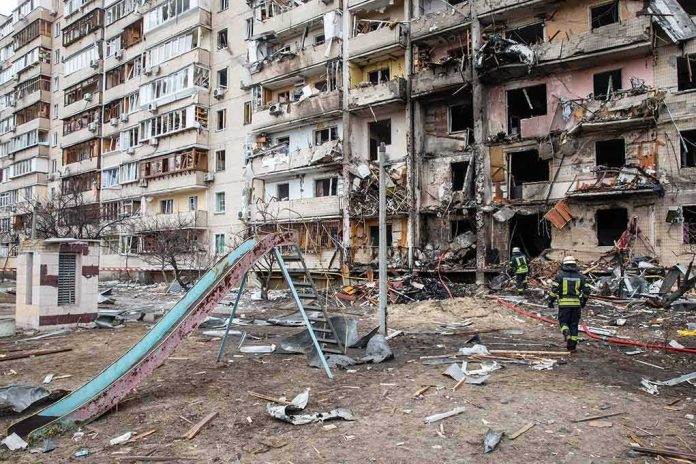
- A nine-story apartment building in Kyiv collapsed, trapping residents, and fires broke out at a major religious site and across several districts.
- Russia claims it targeted factories and military sites, but the worst damage fell on homes, schools, gas stations, and a famous monastery.
- Conflicting casualty counts and slow outside response deepen a growing belief that ordinary people, not elites, pay the price when wars escalate.
What happened in Kyiv overnight
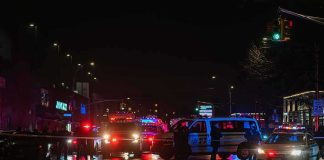
Overnight, Russian forces launched a huge mix of missiles and drones at Kyiv and several other Ukrainian cities, in what officials and many reporters describe as one of the largest air attacks since the full-scale invasion began. Kyiv’s mayor reported multiple strikes across the city, including direct hits on tall apartment blocks that left whole sections torn away. Rescue crews worked through the night, pulling bodies from rubble and searching for survivors who might still be buried.Authorities said more than 20 people were killed nationwide, with Kyiv suffering some of the worst losses.
City and national officials say hundreds of projectiles were launched in waves, designed to overwhelm air defenses and hit many neighborhoods at once. In Kyiv, one nine-story residential building was reportedly demolished down to the basement after a direct missile strike, with fears that the death toll would rise as crews dig deeper into the wreckage. Other districts saw damage to 15- and 24-story buildings, fires at gas stations, and debris falling near a kindergarten. These details match a clear pattern: large, mixed barrages that blend drones and missiles to hit wide areas rather than single military targets.
Civilian targets versus Russia’s official story
The Russian Ministry of Defence claims the goal was to hit industrial sites such as arms factories and workshops for drones and missiles in Kyiv, Kharkiv, and Dnipro. On paper, that sounds like a classic “military target” list. But on the ground, the worst destruction landed on ordinary homes, apartment towers, schools, and local shops, plus a major religious site in Kyiv. Moscow’s narrative does not square with the images of collapsed housing blocks and burned-out civilian cars, and Ukraine has not confirmed any large military facilities were destroyed in these strikes.
One of the most painful blows fell on the Kyiv-Pechersk Lavra Monastery, a historic religious and cultural site known worldwide. Ukrainian and foreign media report that fires were sparked there by falling debris and nearby explosions. For many Ukrainians, hitting a landmark monastery goes beyond a normal battlefield target and feels like an attack on national identity and faith. Independent analysts tracking Russia’s long-range strikes say this fits a broader shift toward “punishing society” with mass bombing, rather than winning clear military gains.
Why casualty numbers keep changing
Different outlets reported different death tolls in the first hours after the attack. Some said four people were killed, others said 11, and later counts rose to 18 or even into the twenties as more bodies were found and injured victims died in hospitals. This kind of confusion is common after major strikes, especially when several cities are hit at once and rescue work is still under way. Early numbers usually come from local mayors and emergency crews working with limited information and chaos around them.
Kyiv has seen this pattern before. Past large attacks were first labeled as killing “a handful” of people, then updated to far higher totals once officials completed searches and medical checks. In one earlier strike, the State Emergency Service eventually reported 28 dead and 134 wounded in Kyiv alone after a tall building was torn open, even though initial figures were far lower. These jumps do not prove anyone is lying; they show how hard it is to count the dead and injured when whole floors collapse, fires rage, and families are scattered.
What this attack shows about today’s wars and today’s governments
This latest barrage is part of a longer trend of Russia using mass air attacks to batter Ukraine’s cities, power grid, and daily life. Analysts note that from late 2022 through 2024, Russia launched over eleven thousand missiles at Ukraine, even though most get shot down. When missiles keep flying despite low “success” rates, the aim starts to look less like winning battles and more like breaking a country’s spirit, forcing people to live with fear, darkness, and loss day after day.
GLOBAL NEWS UPDATE
11-hour massive barrage strikes Kyiv involving 570 missiles & drones.
At least 18 civilian casualties reported amid heavy infrastructure damage.
Moscow cites retaliation for Ukrainian strikes targeting Russian fuel lines.#BreakingNews #Kyiv #sensibleinfo pic.twitter.com/wC6ZjmWbcQ— Sensibleinfo (@sensibleinform) July 2, 2026
For Americans watching from far away, this story touches a raw nerve. Many on both the right and the left feel our own government talks big about defending freedom and democracy, yet drags its feet on basics like protecting civilians, securing borders, and keeping energy and food affordable. In Ukraine, ordinary families are crushed under rubble while Russian and Western elites argue over weapons, sanctions, and talking points. At home, many voters see the same pattern: leaders protect systems and careers first, and ordinary people last.
Where the frustration on left and right meets
Conservatives who are tired of endless foreign wars and globalist talking shops look at Kyiv’s shattered homes and ask why international rules never seem to stop bloodshed. Liberals who worry about growing gaps between rich and poor see another example of civilians paying the price while powerful players on all sides stay safe and well-funded. Both groups see a “deep state” style problem, where defense bureaucracies, intelligence agencies, and political insiders manage conflicts for years without ever really ending them.
Russian strikes that level apartment blocks and damage sacred sites should be a clear red line. Yet the world’s response often sounds like the same careful statements and slow meetings that Americans now associate with failure at home—on border security, crime, inflation, and health care. The Kyiv attack is a reminder that when government systems drift or stall, whether in Washington, Moscow, or Brussels, the people who suffer most are the ones who cannot hide behind walls, bodyguards, or private jets.
Sources:
insiderpaper.com, pbs.org, abcnews.com, en.wikipedia.org, facebook.com, apnews.com, youtube.com, csis.org, eng.mil.ru