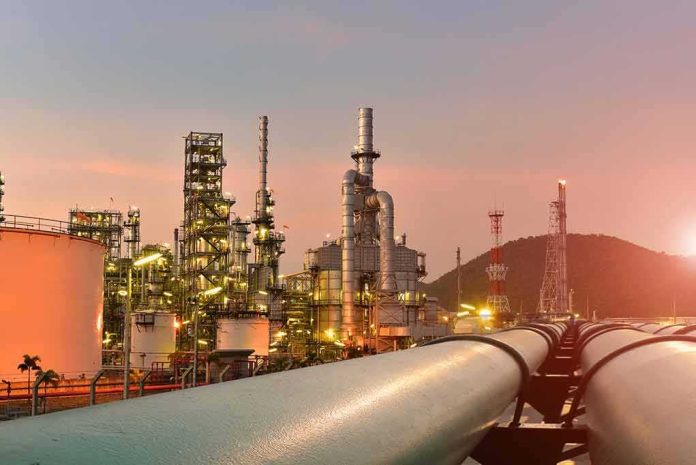
As President Trump touts Texas and Alaska as “alternatives” to the Strait of Hormuz, the hard facts on pipelines, geography, and cost tell a very different story about who really controls America’s energy lifeline.
Story Snapshot
- Trump is backing new Middle East pipelines to bypass the Strait of Hormuz, but they only cover a slice of current flows.
- Energy analysts say no pipeline network today can fully replace Hormuz, and doing so would take many years and tens of billions of dollars.
- There is no physical or planned link that makes Texas or Alaska pipelines true substitutes for this key global chokepoint.
- Both parties’ voters see a pattern: big energy promises in Washington, limited follow-through, and working families still exposed to global shocks.
What Trump Is Actually Proposing Around Hormuz
President Trump has tied his energy security pitch to a plan to revive a roughly 500-mile oil pipeline from Kirkuk in northern Iraq to the Syrian port of Baniyas on the Mediterranean Sea. That line, first built in the 1950s, would let some Iraqi oil move to global markets without passing through the narrow Strait of Hormuz, where recent attacks and a United States blockade have choked traffic and raised prices. Iraqi, Syrian, and American officials are reported to be working on the deal as part of a broader strategy to cut Iran’s leverage over this chokepoint. Trump has also floated the United States as “guardian” of the Strait and, at one point, proposed a 20 percent fee on cargo for protection, before later walking that back under pressure from allies and markets.
At the same time, Gulf partners like Saudi Arabia and the United Arab Emirates are racing to expand their own bypass routes that avoid Hormuz. Saudi Arabia is pushing more crude through its East–West pipeline to the Red Sea port of Yanbu, turning that corridor into a busy outlet for tankers heading to Europe and beyond. The United Arab Emirates is doubling down on its Habshan–Fujairah pipeline and related projects, aiming to move larger volumes to the Arabian Sea city of Fujairah by 2027 so that ships can skip the strait entirely. Together, these efforts do create a “new map” of oil flows that puts somewhat less weight on Hormuz, but they still sit inside the same rough region and face the same regional tensions.
Facts: The Strait of Hormuz moves 21M barrels daily for dozens of nations. US pipelines serve domestic infrastructure. Trump said he does not want to negotiate. Iran claims 3 US service members killed. This is escalating fast.
— MisinfoMirror (@MisinfoMirror) July 15, 2026
Why Texas and Alaska Cannot Replace the Strait of Hormuz
Trump’s suggestion that pipelines in Texas or Alaska can serve as “alternatives” to the Strait hits a hard wall of basic geography and math. The Strait of Hormuz sits between Iran and Oman and carries about 20 million barrels of oil per day for many nations, especially in Asia and Europe. United States pipelines from Texas run to Gulf Coast ports, not to the Middle East. Alaska lines run to the Pacific coast. No pipe connects North America to Persian Gulf or Red Sea export terminals, and none is under serious study in public documents. To make United States routes a true replacement, oil from the Middle East would still have to cross oceans by ship, then move back through American pipes and ports, adding time, cost, and risk instead of reducing them.
Energy experts also stress that even the best existing bypass lines in the Gulf region cover only a fraction of what moves through Hormuz today. One detailed analysis finds that all current pipelines that avoid the strait can move at most between about 2.6 million and 5.5 million barrels per day, against roughly 20 million barrels that normally pass through Hormuz. That means they can reroute only about 13 to 28 percent of the flows that are now stuck when the strait is under threat. There is also no backup for liquefied natural gas shipments, which rely even more heavily on this narrow waterway. By contrast, United States crude exports, boosted by high prices and the crisis, are expected to average around 5 million barrels per day, with a “soft ceiling” not far above that due to port and shipping limits. That helps some buyers, but it does not come close to replacing a fully blocked Hormuz.
The Huge Cost and Risk of Truly Bypassing Hormuz
Building a network that really could replace Hormuz would demand massive time and money that no government has yet committed. One engineering estimate reviewed in public debate explains that a single large 48-inch pipeline can move around 2 million barrels per day, at a cost of 4 to 6 billion dollars. To match the 20 million barrels per day currently going through the strait, the world would need roughly ten such lines plus storage, pumping stations, and ports, pushing the total price tag toward 40 to 60 billion dollars and timelines of 10 to 12 years. Analysts at respected institutions say that in past crises, the commercial case for these kinds of mega-projects “simply was not there,” because building so much extra capacity would only pay off during rare periods of extreme disruption.
Security experts also warn that land pipelines are not magic shields. While ships in Hormuz can be hit by mines or drones, pipes that cross Saudi Arabia, the United Arab Emirates, Iraq, or Syria sit within range of the same kinds of missiles and aircraft. Recent strikes in the region have shown how fast Iran or its partners can target fixed energy assets on land. That means even if governments spent tens of billions on new lines, they would still be vulnerable during war or severe tension. For families in the United States trying to plan gas and heating costs, this is the key point: no one project, whether in Texas, Alaska, or the Gulf, can fully insulate them from global shocks in a conflict zone.
What This Fight Reveals About Washington and the “Deep State”
The clash over Texas, Alaska, and Hormuz taps into a deeper frustration shared by many Americans on both the right and the left. Conservatives hear yet another grand promise of energy dominance and cheap fuel, after years of policies that, in their view, drove up prices and hurt domestic producers. Liberals see another example of fossil-fuel-first thinking that ignores the long-term push for clean energy and leaves working people exposed to wars they did not choose. Both sides watch leaders trade talking points about pipelines and tolls while the basic facts show slow, partial fixes that do not match the rhetoric.
Non-partisan experts point out that global energy systems are now more fragile when geopolitical tensions rise, with oil and critical raw materials reacting sharply to conflict. The International Energy Agency notes that low-emission power sources are set to grow, but oil and gas demand will still be high for years. That means America will stay tied to chokepoints like Hormuz, even as cleaner options expand. For citizens who feel the federal government answers more to powerful global interests than to them, this episode fits a pattern: leaders talk about “checkmate” moves and easy fixes, but the real system remains complex, risky, and shaped by deals far from public view. The hard truth behind the headlines is that no quick pipeline promise from Washington can change that overnight.
Sources:
mediaite.com, youtube.com, foxnews.com, cbc.ca, cnbc.com, gulfnews.com, reuters.com