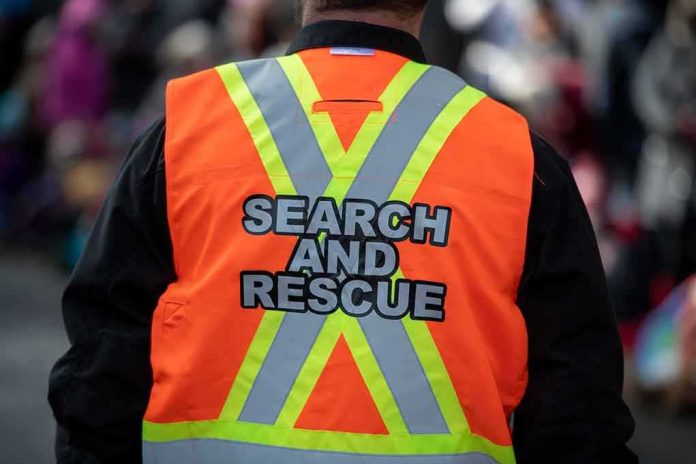
Video from Michigan officials shows the moment rescuers found three missing tubers alive after three days in the woods, even as the more dramatic survival claims remain less firmly documented.
Quick Take
- The three missing tubers were found alive after a three-day search on the Muskegon River.
- Officials identified them as Jazmin Hock, Sarah Vida, and Vida’s 9-year-old son, Kayden Kovalcik.
- Bodycam and department video captured the rescue and the clues that led search teams to them.
- The public record strongly supports the rescue itself, but it does not fully prove every survival detail now circulating.
Rescue Captured on Camera
Michigan Department of Natural Resources video and bodycam footage show search crews locating the three tubers alive on Friday afternoon after days in the wilderness. News reports say officers followed footprints, bent grass, tipped ferns, broken sticks, and other signs into a wooded area near the Mill Iron Boat Launch before finding the group. That footage gives the story a rare level of visual proof for a wilderness rescue.
The core event is not in dispute. Multiple reports say the missing group was found safe after a search that began when they disappeared during a tubing trip on Tuesday. The search covered water, land, and air, and rescuers used boats, drones, helicopters, and search dogs. The public record also places the rescue at roughly three-quarters of a mile northeast of the Mill Iron Boat Launch.
Who Was Found and How They Were Found
Reports consistently identify the rescued group as Jazmin Hock, 28, Sarah Vida, 28, and Vida’s son, Kayden Kovalcik, 9. The group was found after officers noticed physical clues in the search area and tracked those signs through thick woods. News accounts say the rescue happened just after 4:30 p.m. Friday, which lines up across several outlets and video reports.
Several reports say the three were dehydrated, exhausted, and covered in cuts, bruises, mosquito bites, and poison ivy rashes when found. They were taken to a hospital, and later reports said they were expected to recover. One follow-up account said the child was released while the women remained hospitalized, which suggests a difficult but successful outcome. That part of the story is well supported and does not depend on rumor.
What the Public Record Does and Does Not Show
The strongest part of the reporting is the rescue itself. The weaker part is the more colorful claim that the group survived on bark and flowers. Some reports repeat that account through family comments, but the public materials provided here do not include a medical record, sworn statement, or forensic report that independently proves exactly what they ate over those three days.
Three people who went missing during a tubing trip on Michigan’s Muskegon River have been found alive after spending nearly four days stranded in remote woods.https://t.co/QXKDCzWT0Y#BreakingNews #Michigan #Rescue #MuskegonRiver #USNews
— Lokalupdate (@LokalupdateX) August 12, 2026
There is also some uncertainty around the flotation devices. One report says police found four pool floats and were still trying to verify whether they were the same devices used by the missing group. Other reports say the tubes deflated after hitting a log jam. That leaves a gap between the simple rescue story and the fuller question of what failed, why it failed, and whether the equipment was meant for river use at all.
This kind of story travels fast because it has all the parts that grab attention: children in danger, a time clock, and a dramatic rescue video. But the deeper public question is the one that often gets buried under the footage. How much of the story is backed by direct records, and how much comes from official narration and later retelling? In a country where many people already mistrust institutions, that difference matters.
Why the Story Resonates Beyond One River
The Muskegon River rescue fits a wider pattern in American news. A successful search can become a clean hero story, while the hard questions about safety, planning, and documentation stay in the background. Search-and-rescue experts have long stressed that time, terrain, and lost-person behavior shape outcomes more than dramatic luck. That broader lesson matters here because the public saw the rescue, but not the full chain of decisions that led to it.
For readers frustrated with government transparency, the story cuts both ways. On one hand, state officers did their job and saved three people. On the other hand, the public record still depends heavily on agency statements, short video clips, and local recaps rather than a full incident file. That is why the rescue is clear, but the broader story remains incomplete.
Sources:
wilx.com, wftv.com, youtube.com, freep.com, facebook.com, woodtv.com, cbsnews.com, midmichigannow.com, detroitnews.com, news.virginia.edu