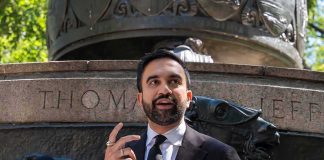
Abdul El‑Sayed, the Democratic nominee for U.S. Senate in Michigan, is on video from 2016 telling an audience, “I carry dual citizenship.” His campaign had said flatly that he is not a dual citizen and never has been.
Story Highlights
- A 2016 video shows El‑Sayed saying he carries dual citizenship, which means being a citizen of two countries at once. The second country is Egypt.
- His campaign said in January that he “is not a dual citizen by any verifiable metric and never has been.”
- On Tuesday, October 6, Michigan Democratic voters said on a cable news program that they cannot back him.
- Lansing Mayor Andy Schor, a Democrat, said he will not vote for El‑Sayed or his Republican opponent until El‑Sayed talks with him.
What He Said and What His Campaign Said
The trouble for El‑Sayed is simple. He said one thing on camera, and his campaign said the opposite. In the video, published Monday, October 5, he tells a Detroit audience that he holds citizenship in two countries. In January, campaign spokeswoman Roxie Richner had said, “Abdul is not a dual citizen by any verifiable metric and never has been.” The campaign did not answer questions about the 2016 video, according to the report that first published it.
El‑Sayed is a doctor and public health official who was born in Michigan in 1984. His parents came to the Detroit area from Egypt in 1978. He is running against Republican Mike Rogers, a former congressman, for a seat in the U.S. Senate. Election Day is Tuesday, November 3.
The 2016 Video
El‑Sayed was Detroit’s health director when he spoke at a 2016 conference of GlobeMed, a student group that works on global health. “I carry dual citizenship, and I grew up spending most of my summers in another country where I understood what it meant not to have the right to self‑govern,” he said. He also told the audience about being questioned by Egyptian police after he spoke out against Hosni Mubarak, who was then Egypt’s president.
The video is the second record of its kind. A résumé he posted on an academic website in 2014, around the time he joined the faculty at Columbia University’s school of public health, listed his citizenship as “USA, Egypt.” That résumé was first reported in January.
The Campaign’s Explanation
When the résumé came out, Richner said El‑Sayed was told as a child that his grandfather had sought Egyptian citizenship for him. She said he and his family later could not find any papers to back that up. She called the résumé entry “an error based on what he was told by family members secondhand.”
That answer covered the résumé. It does not cover a speech two years later in which he said the words himself. The campaign has not released records from either government. No law keeps a dual citizen out of the Senate. The Constitution asks only that a senator be at least 30, a U.S. citizen for nine years, and a resident of the state.
Democrats Who Say They Cannot Back Him
The video landed as El‑Sayed was already having trouble with voters in his own party. In a cable news segment that aired Tuesday, October 6, Michigan Democrats said they could not support him. Their stated worry was his record on Israel and the Jewish community. One voter said she wanted him “to make a definitive statement” that he supports Israel and the Jewish people. Asked whether they would believe him if he did, another answered, “How could we?”
Schor, the mayor of Michigan’s capital city, said he will not vote for El‑Sayed or for Rogers until he has a conversation with El‑Sayed, and that the conversation has not happened. Schor, who is Jewish, said some of El‑Sayed’s statements made him uncomfortable. “If he doesn’t need me, he doesn’t need me,” he said.
Why It Matters in a Close Race
Rogers lost his last Senate run by fewer than 20,000 votes, and he has been asking unhappy Democrats to cross over. Michigan has an estimated 70,000 Jewish voters. A nominee who cannot hold his own party’s mayors and regular voters has little room to spare.
For voters, the issue is trust more than paperwork. A candidate told a room he was a citizen of two countries. Ten years later his campaign said that was never true. El‑Sayed can settle it by showing the records and explaining his own words. With four weeks to go, he has not done so.