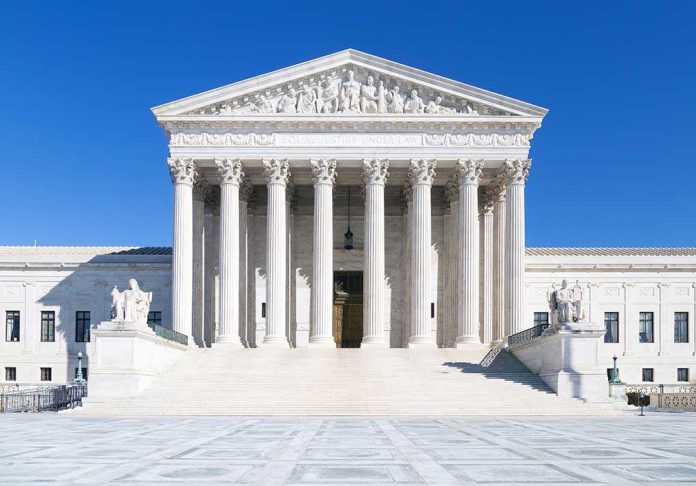
When a sitting senator says reshaping the Supreme Court should be “on the table,” it signals just how far America’s fight over power has moved from elections to the courts.
Story Snapshot
- Senator Raphael Warnock says Supreme Court expansion and term limits must stay “on the table” when Democrats regain power.
- He ties the push to a recent voting rights ruling he calls a “massive blow” that fuels a “redistricting arms race.”[4]
- Supporters frame this as saving democracy; critics see partisan court-packing that threatens judicial independence.
- Both right and left hear the same message: the system is so broken that changing the Court itself is now fair game.
Warnock’s comments: what he actually said about the Court
Senator Raphael Warnock used a recent interview to argue that the Supreme Court has helped gut voting protections and now sits at the center of a political crisis.[4] He said a new 6–3 decision on election maps was “devastating” and a “massive blow to voting rights,” and he warned it would deepen an already fierce “redistricting arms race” between parties fighting over district lines.[4] Against that backdrop, he said reforms such as ethics rules, term limits, and even expanding the Court should all “be on the table.”[4]
Warnock backed this up by pointing to a pattern of decisions. He linked the latest ruling to earlier cases that weakened key parts of the Voting Rights Act and to the Citizens United decision, which opened the door to more corporate and “dark money” spending in elections.[4] In his words, the same Court that “dismantled” voting protections also empowered big donors.[4] That, he argued, is why changing how the Court works can no longer be dismissed as a fringe idea.
From voting rights fight to “everything on the table”
Warnock did not present expansion or term limits as stand-alone power grabs. He tied them to a larger plan built around voting and representation.[4] He said Democrats need to win back power so they can pass the John Lewis Voting Rights Advancement Act, ban racial and partisan gerrymandering, grant statehood to the District of Columbia, and then look at Supreme Court reforms, including enforceable ethics rules, term limits, and possibly adding seats.[4] In his view, these moves fit a single goal: protecting what he calls a democracy “on fire.”
Warnock also framed the issue in moral and historical terms that speak to his base. A press release from his office said “democracy is the house we live in,” and accused “Make America Great Again” politicians, including some on the Court, of “burning and looting” that house.[5] He often invokes civil rights leaders like Martin Luther King Jr. and John Lewis when he talks about voting rights and the courts, casting the current fight as a next chapter in a long struggle.[2][5] That language fires up supporters but convinces critics he sees the Court as just another political target.
Why this alarms people across the spectrum
For many conservatives, talk of adding seats looks like old-school court-packing dressed up as reform. The United States Constitution gives federal judges life tenure during “good behaviour,” which opponents say makes fixed term limits a clear break from the founders’ design. They argue that punishing the Court whenever it issues rulings one side hates destroys judicial independence. To them, Warnock’s timing, right after a ruling he strongly opposes, proves this is retaliation, not neutral reform.[6]
At the same time, many liberals and some moderates hear something else in Warnock’s comments: confirmation that the system is so captured by elites and big money that only big structural changes seem left. Warnock’s focus on dark money, corporate power, and maps that lock in control feeds a growing belief on both sides that regular people no longer have a fair shot.[4][5] When a senator says “everything should be on the table,” he is echoing a fear shared by millions that the old rules no longer protect them.
How media framing turns reform into a brawl
Partisan outlets on the right quickly blasted Warnock for “pushing court expansion,” using the charged phrase “packing the Court” in headlines and posts. Social media accounts piled on, mocking him and warning that adding justices would destroy the country’s checks and balances. On the left, activist groups and friendly commentators highlighted his “democracy is on fire” warnings and praised him for saying the quiet part out loud about a Court they see as “on the side of the powerful.”
This split framing makes it hard for voters to sort real reforms from raw power plays. Mainstream clips and viral posts often reduce the whole argument to a yes-or-no question on court-packing, with little time spent on the voting rights rulings or dark money concerns that Warnock says justify change.[2][4] That leaves many Americans with a familiar feeling: each side uses fear of the other to dodge deeper debate, while the same small group of leaders and donors keeps control of the system either way.
What this moment says about a tired system
The fight over Warnock’s comments shows how far trust has fallen in all three branches of government. Conservatives who watched years of liberal judges rewriting social rules now see a chance to lock in their gains and fear any effort to shrink that edge. Liberals who see the Court strike down voting and campaign rules believe the bench now serves the wealthy and well-connected instead of regular citizens. Both sides suspect the other wants to rig the rules forever.
Underneath the noise, there is a quieter but broader worry. When leaders argue about changing the Court itself instead of fixing the laws most people deal with every day, many Americans on both left and right feel like pawns in a game they did not ask to play. Warnock’s “everything on the table” line captures that sense of emergency. It also raises a hard question: if the only answers our leaders offer involve more power for themselves and new battles over the rules, who is left to defend the simple promise that hard work and fair elections should still matter more than insider deals?
Sources:
[2] YouTube – Sen. Warnock says voting rights decision “poured fuel on …
[4] Web – Senator Reverend Warnock Testifies Before Senate Finance …
[5] Web – Senator Raphael Warnock sits down with the hosts of Politically …
[6] Web – Sen. Raphael Warnock – AFL-CIO