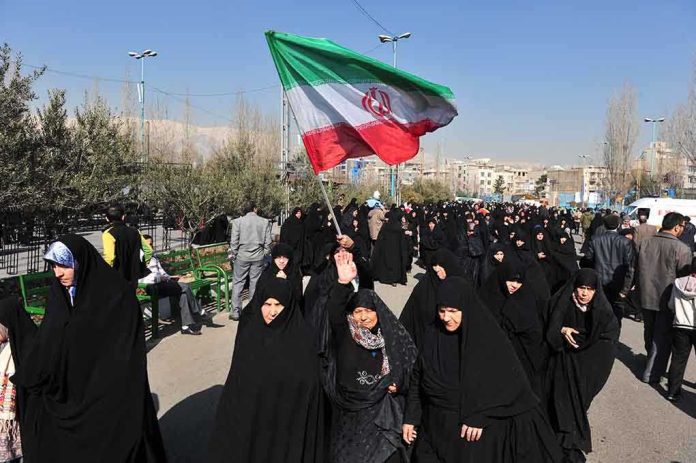
Iran’s rulers are pouring money, technology, and fear into policing women’s hair, because they know that if women ignore them, their whole system starts to crack.
Story Snapshot
- More women across Iran are openly refusing compulsory hijab, even under threat of jail, lashes, and crippling fines.
- The regime is turning hijab enforcement into a full security operation, using cameras, drones, text warnings, and business shutdowns.
- A 2024 “chastity and hijab” law packs harsh penalties, showing how vital women’s obedience is to the ruling clerics.
- This fight over a headscarf is really a fight over who controls public life — citizens or an unaccountable state.
Women Defying Hijab Rules In The Streets
Across Iranian cities, from Tehran to smaller towns, more women are walking in public without the compulsory headscarf, despite knowing they can be fined, arrested, or jailed. Reporters describe unveiled women in malls, on sidewalks, and even driving, turning everyday errands into quiet acts of protest. Some women tell foreign media they are “ready to pay the price” because hijab is the regime’s main tool to keep them down. This steady defiance has continued long after the first protest waves.
Many women say they are not rejecting faith itself but the state’s power to force them to dress a certain way. Human rights groups explain that in today’s Iran, key parts of life—jobs, school, health care, even simple presence in public—depend on obeying hijab rules. That makes a bare head more than a fashion choice; it is a direct challenge to a system that treats women’s bodies as government property. Polling cited by one research group found only a small minority of Iranians support compulsory hijab.
Even in Iran, where hijab was long mandatory, defiance is growing. Many women now appear in public without it, especially as enforcement wanes.
Polls show most Iranians want choice, not compulsion. The “requirement” is often political/cultural pressure, not pure scripture. pic.twitter.com/N4aDN5lzYH
— US Public Safety Citizen (@PubSafetyHero) July 20, 2026
Harsh Laws, Smart Cameras, And Economic Pressure
Iran’s leaders are not taking this defiance lightly. Parliament approved a new “chastity and hijab” law in 2024 that sharply raises fines and prison time for women and for businesses that “allow” unveiled customers. Amnesty International calls it a “draconian” measure that adds flogging, long prison sentences, travel bans, and even the death penalty in some cases for peaceful activism against compulsory veiling. Older laws already allowed up to 74 lashes for appearing unveiled in public. These punishments aim to make disobedience feel too costly for ordinary families.
Police and security forces are also modernizing their crackdown. A national police chief announced a “smart” program that uses surveillance cameras to catch women whose hair or clothing does not meet state rules. Media and rights groups report the use of facial recognition, drones, text-message warnings, and even tracking transit cards and phones to flag alleged violations. Cars can be confiscated if female passengers are unveiled, and repeat offenders can face court. This digital dragnet turns every street, shop, and highway into a monitored zone, controlled not by citizens but by the state’s security machine.
Closing Businesses And Targeting Daily Life
The battle over hijab now reaches deep into Iran’s economy. Authorities have sealed or temporarily closed dozens of cafes, restaurants, wedding halls, clothing shops, tourist sites, and other businesses simply for serving or hosting unveiled women. A rights organization outside Iran documented at least 50 closures between late June and early October 2025 over “improper hijab,” mostly outside Tehran. New rules allow fines up to months of profits, travel bans for owners, and more for repeat cases. This approach punishes not just women but anyone who tries to give them normal public space.
Analysts say the proposed hijab law is designed to use money pressure, not only force, to restore social control. Fines can reach levels that most Iranian households simply cannot afford. Those who cannot pay may see their passports blocked, car papers frozen, and bank accounts partly locked. For many Americans, this looks familiar in spirit: a government using rules and fees to squeeze regular people while elites stay safe. Here, the goal is not tax revenue but fear—reminding every shop owner and family that a woman’s uncovered hair can wreck their finances.
Hijab As A Symbol Of Deeper State Power
Scholars and activists say compulsory hijab in Iran is a political symbol, not just a religious rule. Since the early years after the 1979 revolution, the veil has been used as a sign that citizens accept the Islamic Republic’s authority. When women remove it, especially in public and on camera, they are saying the state no longer has the right to control their bodies or their place in society. That is why security forces respond with such intensity: they see unveiled women as proof that fear is fading.
Human rights reporting links hijab enforcement to wider crackdowns that include beatings, torture, mass arrests, and deadly force during protests. For many Iranians, the same system that polices hair also decides who can speak, work, or protest. One university article notes that the regime “fears women” because it knows their refusal to obey can destabilize social order. That fear is something Americans across left and right recognize: when rulers are more scared of their people than of breaking the law, liberty is in danger everywhere.
Sources:
realcleardefense.com, nypost.com, apnews.com, cbc.ca, bbc.com, thestoryexchange.org, theguardian.com, fortune.com, amnesty.org, factcheck.afp.com, en.wikipedia.org, news.un.org, vidc.org, hrw.org, institute.global, merip.org, brandeis.edu, atlanticcouncil.org