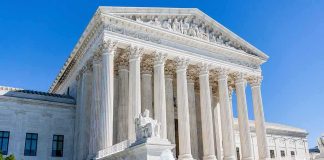


A full federal appeals court ruled 9-8 that the House broke the Constitution when it let absent members be counted by proxy to pass the $1.7 trillion spending law of December 2022.
Story Highlights
- The full Fifth Circuit said the House’s COVID-era proxy voting rule violated the Constitution’s Quorum Clause, which requires a majority of members to be present to do business.
- The majority held that members must be physically present to count toward a quorum: “Presence-by-proxy does not suffice.”
- The ruling keeps a block on enforcing the Pregnant Workers Fairness Act, a part of that spending law, against the state of Texas.
- The decision does not strike down the whole spending law, but reports say it opens the door to new challenges to other parts of it.
- More than half the votes on the bill, 226, were cast by proxy for members who were not in the room, according to the dissent.
Fifth Circuit Rejects Proxy “Presence”
On Friday, November 20, the full U.S. Court of Appeals for the Fifth Circuit, based in New Orleans, ruled 9-8 in Texas v. Blanche that the House’s proxy voting rule broke the Constitution. Texas sued to stop the federal government from enforcing one part of the December 2022 spending law against the state, arguing the law was never validly passed because too few members were in the room. The court agreed. “Members must be present to satisfy the Quorum Clause,” the majority wrote.
Proxy voting let a House member who stayed away name a colleague on the floor to cast his vote for him. The House adopted the rule in 2020, under Speaker Nancy Pelosi, during the COVID-19 public health emergency. The House resolution that created it, H. Res. 965, said any member “whose vote is cast or whose presence is recorded by a designated proxy” would be counted toward a quorum. A quorum is the minimum number of members who must be present before the chamber can do business.
The spending law, known as the Consolidated Appropriations Act, 2023, passed the House 225 to 201, and 226 of those 431 votes were cast by proxy, according to the dissent. Judge Cory Wilson, a Trump appointee, wrote for the majority. Eight judges, including Chief Judge Jennifer Walker Elrod, joined him.
Why Quorum Means Showing Up in Person
Article I, Section 5 of the Constitution says “a Majority of each shall constitute a Quorum to do Business.” In plain words, more than half of the members must be there for the House or Senate to act. Judge Wilson pointed to the clause’s “text, context, original understanding, and unbroken historical application” to conclude that being present means being physically in the chamber.
The House has broad power to write its own rules, but the majority said that power has limits. “The Quorum Clause’s constraints on congressional power cannot be circumvented by congressional fiat,” Wilson wrote, meaning Congress cannot get around the rule simply by declaring absent members present. A 2020 analysis by the Congressional Research Service, Congress’s own nonpartisan research office, noted that neither the House nor the Senate had ever before used a way of counting a quorum that was not tied to physical presence.
What the Ruling Does and Does Not Block
The Pregnant Workers Fairness Act requires employers with 15 or more workers to make reasonable accommodations for limits tied to pregnancy, childbirth or related conditions. It was added to the spending law and signed by President Joe Biden on December 29, 2022. In February 2024, U.S. District Judge James Wesley Hendrix ruled for Texas and barred the federal government from enforcing the act against the state and its agencies as employers. The full Fifth Circuit’s ruling affirms that order and says Texas is entitled to a permanent injunction, a court order that bars enforcement for good.
The ruling covers only Texas’s challenge to the pregnant workers law, according to reports. It does not void the rest of the $1.7 trillion law, and the earlier order did not reach private employers in Texas, according to legal analyses of that order. Still, reports say the reasoning opens the door to new challenges to other parts of the same law. One law professor writing about the decision named the Electoral Count Reform Act and a ban on TikTok on government devices as parts of the law that could be challenged next.
The Other Side: The Dissent and House Democrats
Judge James Graves Jr., an Obama appointee, wrote the main dissent, joined by six other judges. “Texas asks the courts to graft an additional requirement to the Quorum Clause of the Constitution,” he wrote. He argued that the plain text, past practice and the framers’ intent all weigh against a physical-presence rule. He also faulted the majority for blocking only one small part of the law if, in its view, the whole law was passed the wrong way. Judge Catharina Haynes dissented separately.
In a 2024 friend-of-the-court brief, a filing by people who are not parties to a case, House Democratic leaders Jerrold Nadler, Rosa DeLauro, Jim McGovern and Joseph Morelle argued that each chamber can decide “how and when a ‘Majority’ is present.” They said the Quorum Clause “does not explicitly mention a physical presence in the Chamber” and that proxy voting kept the government working while protecting public health during the pandemic.
How the Case Got Here
The case has gone back and forth. After Judge Hendrix ruled for Texas in 2024, a three-judge Fifth Circuit panel reversed him in August 2025 and found that Congress had acted within its power. The full court then set aside that panel decision and heard the case again. During those arguments, conservative judges sounded doubtful of the Justice Department’s defense of the proxy rule, according to reports.
Only the House used proxy voting during the pandemic; senators voted in person. Other federal courts turned away challenges to the proxy rule when it was first adopted, according to reports.
What Comes Next
The decision is widely expected to be appealed to the Supreme Court, according to reports, though no appeal had been reported as of Saturday, November 21. The Texas attorney general’s office brought the case, and a Democrat won the race for that office and takes over in January, which could affect whether the state keeps pressing it, according to reports. Under the ruling, the federal government may not enforce the pregnant workers law against the state of Texas as an employer.
Sources:
reason.com, news.bloomberglaw.com, congress.gov, rules.house.gov, democrats-cha.house.gov, congress.gov (CRS), govinfo.gov