

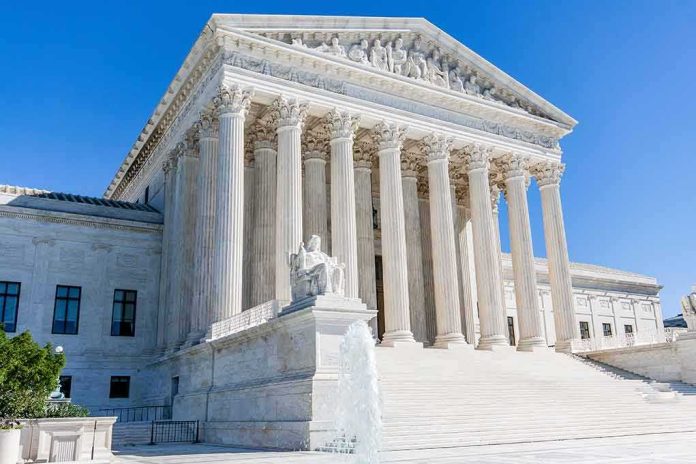
Justice Sonia Sotomayor said her Supreme Court leans on “legal theory” instead of what society has come to understand, a pointed remark about the birthright citizenship fight the Court decided by one vote.
Story Highlights
- Sotomayor spoke Friday, November 20, in Philadelphia, where she received the Benjamin Franklin Medal.
- She said the Court is “focused on sort of legal theory” rather than on what “we as a society have achieved.”
- In June, the Court upheld birthright citizenship, but only five justices said the Constitution itself requires it.
- Conservative scholars say judges must follow the Constitution’s original meaning, not changing public views.
- Asked whether the Court lost something because most justices took similar paths to the bench, she said, “For sure,” and “They’ve forgotten that at the center of every case is people,” according to reports.
Sotomayor Puts Society Ahead Of Legal Theory
On Friday, November 20, Justice Sonia Sotomayor accepted the Benjamin Franklin Medal from the American Philosophical Society in Philadelphia, a learned society Franklin founded in 1743. On stage, retired federal appeals judge David Tatel asked her about the Court’s big cases. Discussing birthright citizenship, the rule that a child born on U.S. soil is a citizen, she said: “We have a court focused on sort of legal theory, rather than one focused on where and what we as a society have achieved in terms of our understanding.”
Her words matter because the Court’s constitutional ruling on birthright citizenship in June drew only five votes, and a newer Trump order on the issue is being fought in lower courts. Critics on the right say her “society” remark shows she wants rulings to follow public opinion instead of the Constitution’s text. Asked whether the Court lost something because most justices took similar paths to the bench, she said, “For sure,” and added, “They’ve forgotten that at the center of every case is people,” according to reports. She also said, “I wouldn’t be unhappy with term limits” for justices.
What The Court Actually Held On Birthright Citizenship
On June 30, 2026, the Supreme Court decided Trump v. Barbara and struck down President Trump’s Executive Order 14160, which sought to deny citizenship to some children born here. The Court held that children born in the United States to parents who are here unlawfully or only temporarily are citizens at birth under the Fourteenth Amendment. Chief Justice John Roberts wrote the opinion. Sotomayor, Elena Kagan, Amy Coney Barrett and Ketanji Brown Jackson joined him.
The judgment was 6-3, but the constitutional ruling had only five votes. Justice Brett Kavanaugh agreed the order was unlawful because it broke a federal law, 8 U.S.C. 1401(a), not the Constitution, and he wrote that Congress could change that law. Justices Clarence Thomas, Samuel Alito and Neil Gorsuch dissented. The majority relied on the 1898 case United States v. Wong Kim Ark, which held that a man born in California to Chinese parents was a citizen.
The Competing Conservative Case: Follow The Original Meaning
Conservative law professor John Yoo, a former Justice Department lawyer, takes the opposite view. He wrote: “If the Founders adopted a constitutional provision with a clear meaning, even if it advances a policy that does more harm than good, we must still follow the original understanding.” In that view, judges apply the text as it was understood when it was adopted, and elected lawmakers handle the policy.
Critics of broad birthright citizenship focus on five words in the Fourteenth Amendment: “subject to the jurisdiction thereof.” They argue that this phrase leaves out at least some U.S.-born children of illegal immigrants and temporary visitors, according to a summary of the scholarly debate. That reading lost in June, but four justices did not join the Court’s constitutional ruling.
Why Sotomayor’s Frame Matters For Constitutional Governance
Conservatives argue that judging by society’s “understanding” moves power from voters to judges, who then pick which social trends count. They say that method weakens the separation of powers and blurs who answers to the people. They also warn it could reach other issues, such as gun rights, religious liberty and parental rights, if courts drift from text and history.
The fight over birthright citizenship did not end in June. In September, a federal judge in Maryland blocked a newer Trump order on the same issue, and challenges to it are moving through lower federal courts. Kavanaugh’s opinion points to Congress as the place to set limits by law. For readers who want clear rules, the question is whether the Constitution’s words or society’s changing views will decide who is an American.
Sources:
thegatewaypundit.com, heyjared.ai, scotusblog.com, congress.gov, journals.law.harvard.edu, legaltheoryblog.com