

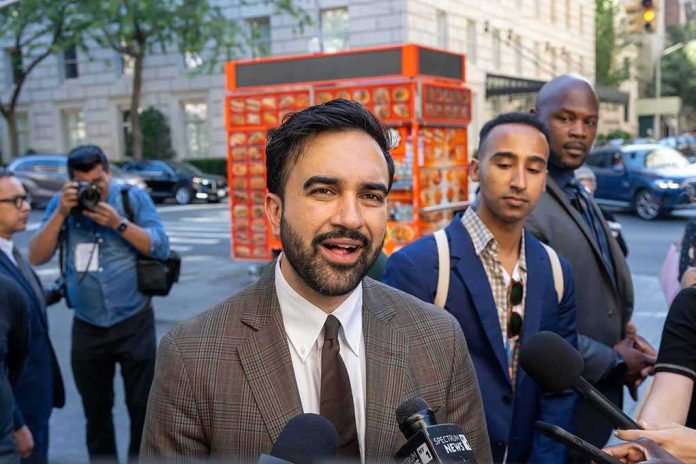
New York City Mayor Zohran Mamdani’s office confirmed it will break up the NYPD unit that handles both violent protests and terror attacks, keeping a campaign promise to his left-wing base.
Story Snapshot
- Mamdani’s office confirmed it “will disband” the NYPD’s Strategic Response Group (SRG), a unit of roughly 500 to 600 officers, according to different reports.
- The SRG handles riots and large protests, and it also responds to terror attacks and mass shootings.
- Mamdani says protest policing and counterterrorism should not sit in one unit. He has accused the SRG of using too much force on protesters.
- On Monday, November 16, Mamdani and Police Commissioner Jessica Tisch made it official. The unit’s counterterrorism work moves to another NYPD bureau, and a civilian-led team with no weapons or arrest powers will lead the response at protests.
City Hall Confirms The Unit Will Go
On Thursday, November 12, Mamdani spokeswoman Dora Pekec confirmed the plan. “As the Mayor has said, our administration will disband the Strategic Response Group and separate protest response from counterterrorism,” she said. “We will have more to share soon.” The next day, Friday, November 13, Mamdani told reporters he remains committed to disbanding the unit. He did not directly answer questions about what would replace it or how terror response would change.
Mamdani, a Democrat and member of the Democratic Socialists of America, says the unit relies too much on physical force at protests and draws a high rate of misconduct claims. In a December 2024 post on X, he vowed to “disband the SRG” and said it had cost taxpayers millions in lawsuit settlements. In September he said, “I do not believe that those purposes need to be dual purposes,” meaning protest duty and counterterror work. The New York City chapter of the DSA has made ending the unit a top goal.
What The Unit Does
Then-Police Commissioner Bill Bratton created the SRG in 2015 by merging several borough task forces. It was built to strengthen the city’s counterterrorism response. According to the NYPD, the unit “responds to citywide mobilizations, civil disorders, and major events.” Its officers handle crowd control at large demonstrations, and they also train for terror attacks and mass-casualty events. In 2023 the NYPD called SRG members “highly trained, well-vetted and professional police officers.”
The unit’s protest record has drawn lawsuits. During the 2020 George Floyd protests, the SRG was accused of unlawfully detaining more than 100 demonstrators. A 2023 court settlement over those protests limits how and when the NYPD can send the SRG to demonstrations. After taking office, Mamdani barred the NYPD from using the SRG for protest arrests without City Hall’s sign-off.
Warnings About Terror Response
Police leaders have defended the unit. Police Commissioner Jessica Tisch, whom Mamdani kept on from the prior administration, has said the SRG does not usually handle peaceful protests and is sent mainly when protests involve crime. She told the City Council in March that the NYPD handled 4,255 protests in 2025 and the SRG was available at 245 of them, about 6 percent. She has suggested reforming the unit rather than ending it.
Sources who spoke to reporters warned that scrapping the SRG entirely could leave the NYPD with “no dedicated unit for terror attacks or mass-casualty events.” The concern is sharp because the SRG is the force the city calls on its worst days, such as last year’s Park Avenue office shooting, in which a gunman killed four people.
The Plan Is Now Official
On Monday, November 16, Mamdani and Tisch announced that the SRG will be disbanded. The changes begin in January, and the city says they will come at no added cost, with no officers hired or laid off. The unit’s counterterrorism work, including heavy weapons deployments, moves to the NYPD’s Intelligence and Counterterrorism Bureau.
At protests, a new civilian-led Community Dialogue and De-escalation Division inside the Mayor’s Office of Community Safety will take the lead. It will have no weapons or arrest powers. It will work alongside a First Amendment Support Team of 30 uniformed officers trained in de-escalation. A new NYPD Patrol Support Division, whose officers will mostly handle patrol duty, will get crowd management training. The plan also limits police tactics at protests, including long guns, tear gas and pepper spray.
“We are establishing a new, civilian-led approach that prioritizes dialogue, engagement and de-escalation,” Mamdani said. Tisch said, “These changes will make us a stronger, more effective department.” Patrick Hendry, president of the city’s largest police union, criticized the decision.
Mamdani is also expected to back the CURB Act, a City Council bill that would bar the SRG from protests and ban tactics such as kettling, which means boxing protesters in, and tear gas. About half the council has signed on, but the bill has not had a hearing, and its passage is not certain.
Sources:
nbcnewyork.com, cbsnews.com, fox23.com, politico.com, nydailynews.com, cityandstateny.com, nbcnewyork.com, nymag.com, cityandstateny.com