

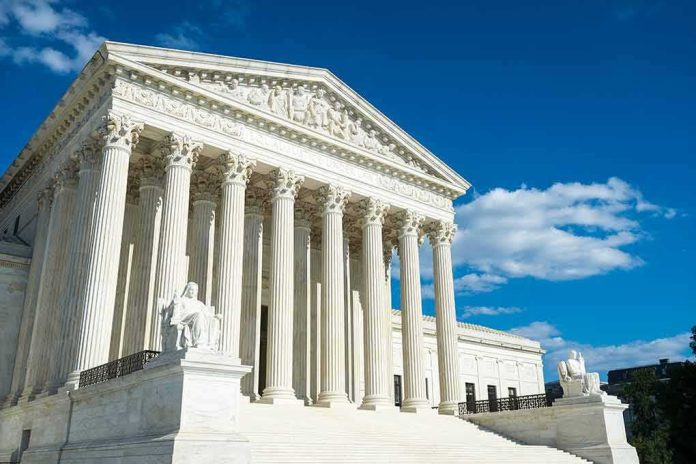
A disbarred Texas lawyer serving 20 years for helping a Mafia family loot a mortgage company asked the Supreme Court to move him out of prison early, and the government’s lawyer ended up apologizing to the justices.
Story Highlights
- William Maxwell says the Bureau of Prisons shorted him “somewhere between 42 and 48 months” of First Step Act credits that should already have moved him to a halfway house or home confinement.
- The government told the justices the case will soon be moot, then admitted it never raised that point earlier: “That was our bad.”
- Justice Sonia Sotomayor cut the government’s lawyer off with one word: “Enough.”
- Both sides urged the Court to rule before Maxwell’s projected release date of January 22, 2027. No ruling has been issued.
What Maxwell wants and why
The justices heard Maxwell v. Dinis on Monday, November 2. William Maxwell is a former Texas lawyer convicted of racketeering, conspiracy and fraud for his role in a La Cosa Nostra takeover of FirstPlus Financial Group, a Texas mortgage company. La Cosa Nostra is the formal name for the American Mafia. He lost his law license and is serving a 20-year federal sentence.
Maxwell v Dinis
Crim: Habeas
Hansford (P) – Clarity (3), Mastery (3), Adaptivity (1), Interplay (1)
Barber (SG R) – Clarity (3), Mastery (3), Adaptivity (3), Interplay (3)
Barnes (Amicus) – Clarity (2), Mastery (2), Adaptivity (1), Interplay (1)https://t.co/Q3Y8tDCTPV
— Brian Downing (@brianrdowning) November 3, 2026
Maxwell is not asking to walk free. He wants to finish his time in a halfway house or on home confinement. He says the Bureau of Prisons failed to count some of his work and classes and denied him 42 to 48 months of credits under the First Step Act. That 2018 law, signed by President Trump, lets federal inmates earn time credits for programs meant to keep them from committing new crimes. Once an inmate earns enough, the law says he moves to a lower level of custody.
He brought his claim as a habeas petition. Habeas is the old legal tool a prisoner uses to ask a judge to rule that he is being held unlawfully. The lower courts threw his case out. The Fifth Circuit, the federal appeals court for Texas, said habeas works only when winning would “automatically entitle” an inmate to early release. Other appeals courts have ruled the other way, and the Supreme Court took the case to settle the split.
“That was our bad”
The government’s lawyer, Kevin J. Barber, works in the Solicitor General’s office, which argues for the federal government at the Supreme Court. He asked the justices to dismiss the case without deciding it. His reason was mootness. A case is moot when there is nothing left for a court to fix. Once Maxwell reaches his projected release date in January 2027, there is no transfer left to order.
Justice Neil Gorsuch asked whether the case would be moot in the lower court “real quick.” Barber said, “Absolutely, yes.” He then admitted the government never raised the problem when the justices were deciding whether to take the case. “That was our bad,” he said. “We apologize for that.”
Justice Sotomayor was not moved. “But you want to win on an argument that you failed to raise on cert?” she asked. Cert is the stage when the Court picks which cases it will hear. When Barber began to answer, she cut him off: “That’s what you want to do. Enough.” Gorsuch was kinder. “I haven’t heard ‘my bad’ before at the podium,” he said. “Good on you.”
What the justices and lawyers said
Maxwell’s lawyer, Masha Hansford, told the Court the Fifth Circuit was wrong to say habeas covers only full release. Justice Samuel Alito asked whether Maxwell met all four requirements for moving to prerelease custody. “Yes, he has,” Hansford said. “He has the lowest recidivism rating. He has a qualifying crime. He has satisfied everything.” Recidivism means the risk of committing new crimes.
Justice Ketanji Brown Jackson pressed for a narrow ruling. “A narrow ruling would be helpful because this kind of situation comes up a lot,” she said. Hansford agreed: “We’re happy with a narrow ruling here.”
The other side of the argument came from Brian Barnes, a lawyer the Court appointed to defend the Fifth Circuit’s ruling. He said Maxwell’s claim “may be pursued, if at all, only as a civil rights claim,” and that if Maxwell wins, “his term of imprisonment won’t be shortened by even a single day.”
Hansford closed by calling Maxwell’s case a “heartland habeas claim.” She urged the justices not to drop it, telling them they had no reason for “buyer’s remorse.” The Court has not said when it will rule.
Sources:
law360.com, spectrumlocalnews.com, supremecourt.gov, law.cornell.edu, scotusblog.com