
U.S. officials say Iran’s Revolutionary Guard fired on an American aircraft near the Strait of Hormuz, and U.S. forces answered with strikes on Iran’s Qeshm Island.
Story Highlights
- U.S. officials say Iran fired at a U.S. aircraft first, and the U.S. answered with limited strikes on Qeshm Island.
- Iranian state media reported five blasts in quick succession on the island.
- Qeshm hosts a large underground missile site and a naval base at the mouth of the strait.
- President Trump said other Iranian sites, including Pickaxe Mountain, could be hit “in literally one hour.”
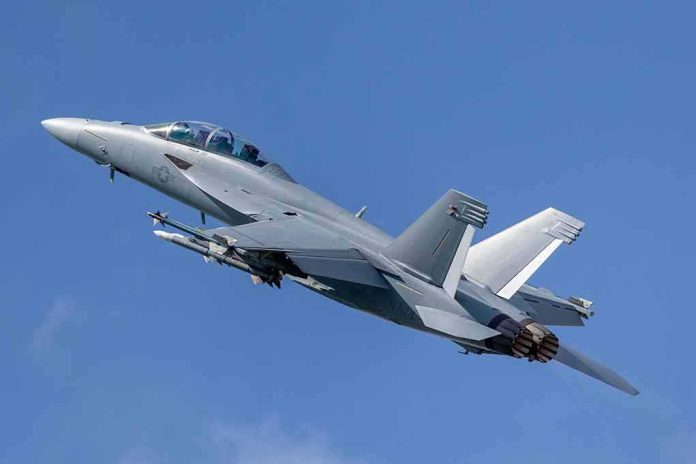
- U.S. officials say a U.S. fighter jet struck back after the Revolutionary Guard fired a surface-to-air missile at it, and reports say the jet hit a Revolutionary Guard missile launcher on the island.
What Happened On Qeshm Island
On Monday, November 2, U.S. forces carried out limited strikes on Iran’s Qeshm Island, three U.S. officials said. A senior U.S. official said the strikes came after Iran’s Islamic Revolutionary Guard Corps fired at an American aircraft. The Revolutionary Guard is the branch of Iran’s military that answers to the country’s supreme leader. According to U.S. officials cited in reports, a U.S. fighter jet struck back after the Revolutionary Guard fired a surface-to-air missile at it. That is a missile launched from the ground to bring down planes. Reports said the jet hit a Revolutionary Guard missile launcher on the island.
U.S. officials said the goal was to protect American forces and commercial shipping. One official said U.S. forces also stopped an Iranian missile fired from Qeshm at commercial ships the same day. Iranian state media reported five explosions in quick succession on the island, and residents said they saw two planes overhead. Iranian officials have not formally confirmed a direct attack, and U.S. Central Command, which runs American forces in the Middle East, issued no statement.
Why The Strait Of Hormuz Matters
Qeshm is the largest island in the Persian Gulf. It sits at the mouth of the Strait of Hormuz, the narrow sea lane that carries about one in five barrels of the world’s oil. The island hosts a large underground missile site, a naval base and a major plant that turns seawater into drinking water. The U.S. has struck Qeshm in earlier rounds of fighting, and officials have discussed seizing it, according to reports.
Iran’s attacks on ships in the strait have kept fuel prices high and pushed up insurance costs for tankers, according to reports. Those costs reach American gas pumps and home energy bills. That is why each exchange of fire near Qeshm matters to families far from the Gulf.
Iran’s Messaging And U.S. Response Framing
Iran answered with warnings. On Tuesday, November 3, Iran’s parliament speaker, Mohammad Bagher Ghalibaf, said any U.S. strategic mistake would open “a new battlefield in the war.” He said Iran was at its highest level of defensive readiness and that “the ball is in America’s court to prevent war.” Iran’s Revolutionary Guard separately claimed it brought down U.S. drones near the strait.
U.S. officials called the strikes self-defense. One official said the campaign has been kept quiet on purpose, so as not to signal a return to major combat. The two sides tell the story differently, but reports from both agree that blasts hit Qeshm Island on Monday night.
What This Means For American Interests
Trump spoke about Iran on Monday night in a TV interview with host Sean Hannity. He called the conflict a “very soft war” and said Iran is “the number one state sponsor of terror anywhere in the world.” About Pickaxe Mountain, a site suspected of supporting Iran’s nuclear program, he said: “We might have to go after Pickaxe, but that’s not a big deal. We can do it in literally one hour.”
On Tuesday, November 3, Trump called the Qeshm strike a “minor attack, it wasn’t a war.” He has also said he is in no hurry to restart full-scale strikes, as U.S. and Qatari mediators work on a deal. The strikes came on the eve of the Tuesday, November 3, midterm elections. The message to Tehran is plain: fire at American aircraft, and the U.S. will answer.
Sources:
redstate.com, cbsnews.com, us.cnn.com, usnews.com, afp.com, sg.news.yahoo.com, lemonde.fr, haaretz.com