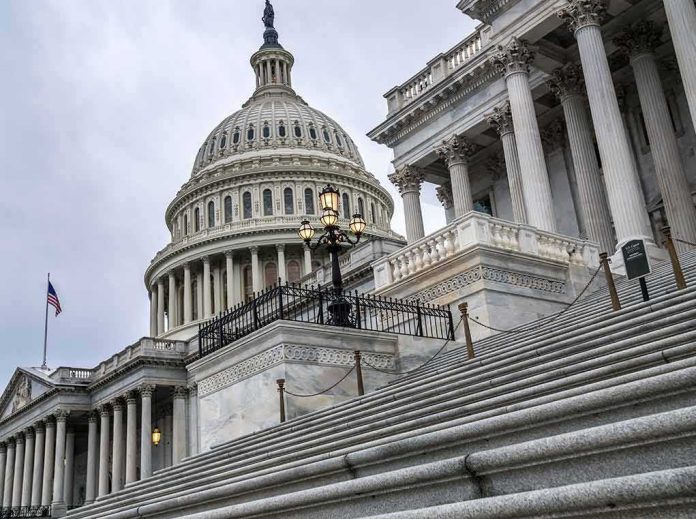
Late Tuesday night, September 15, the House of Representatives voted 220 to 204 to direct President Trump to end hostilities with Iran. Seven Republicans crossed the aisle to vote with Democrats, and eight more Republicans did not vote at all. It is the third time this year the House has tried to pull the president back from the war, and it is likely the last thing Congress does about Iran before the November 3 midterms. And for all the drama, the president is under no practical obligation to do what it says.
Story Highlights
- The House passed a resolution ordering an end to U.S. hostilities with Iran, 220-204, late Tuesday night.
- Seven Republicans voted yes; eight Republicans were absent for the vote.
- The measure was introduced by Rep. Seth Moulton (D-MA) with 14 Democratic co-sponsors.
- The Senate has already blocked one Iran war-powers measure this year, and no court has ever forced a president to obey one.
Why He Doesn’t Have To Listen
The resolutions rest on section 5(c) of the 1973 War Powers Resolution, which lets Congress direct the president to remove U.S. forces from hostilities that were never authorized. Supporters say that is exactly what the law was written for. But the measure now goes to the Senate, which has shown no appetite to take up an Iran war-powers vote since it blocked one in March. If it somehow cleared that chamber, the White House would almost certainly refuse it. The administration has argued it already satisfied the law’s 60-day requirement, and legal analysts have long noted that a resolution of this kind is hard to enforce against a president who declines to comply. No court has ever made one stick.
That leaves Tuesday’s vote as a marker rather than a command: a record of where every member of the House stands on the war, taken weeks before voters go to the polls.
The Seven Republicans Who Voted Yes
The Republicans who joined Democrats were Tom Barrett of Michigan, Warren Davidson of Ohio, Brian Fitzpatrick of Pennsylvania, Thomas Massie of Kentucky, Nancy Mace of South Carolina, Mariannette Miller-Meeks of Iowa, and Zach Nunn of Iowa. Massie and Fitzpatrick were also among the four Republicans who backed the first House resolution in June. Barrett defended his vote by pointing to the clock, saying, “I’ve been consistent on that since the war powers provision expired after 60 days of engagement.”
The eight absent Republicans did not change the result, but they did shape the margin. Had they all voted no, the resolution still would have passed. The count that matters politically is the seven, because each of them will have to explain the vote to primary voters and to the president before the midterms. For them, the record is now part of their campaigns.
Third Try, Widest Margin
This is not the first time the House has moved against the war. In March, a similar resolution failed by a single vote, 213 to 214, a day after the Senate rejected its own version 47 to 53. In June the House passed one 215 to 208 with four Republicans on board, and in July it passed another, 214 to 208. Tuesday’s 220-204 vote is the widest margin yet, and the largest number of Republicans to break with the president on Iran. Each time, the war went on.
Sources:
thegatewaypundit.com, apnews.com, constitutioncenter.org, lawfaremedia.org