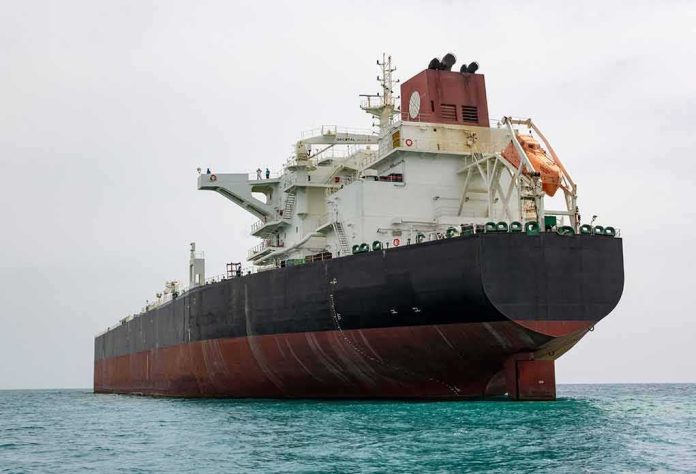
Thousands of civilian seafarers are still stuck in the Persian Gulf, and the shipping lane they need to escape remains too dangerous for normal travel.
Story Snapshot
- About 6,000 seafarers remain stranded on roughly 500 ships, according to the International Maritime Organization (IMO).
- UN reporting says very few ships, if any, are crossing the waterway, and evacuation is the top priority.
- Reuters, NPR, and NBC News describe serious strain, supply problems, and deaths tied to the conflict.
- The public record still shows a gap between the 6,000 figure and larger counts near 20,000.
What the Maritime Agencies Say
The IMO says roughly 6,000 seafarers remain stranded in the Persian Gulf and cannot leave safely. Arsenio Dominguez, the agency’s secretary-general, said recent attacks have deepened the fear, uncertainty, and psychological strain already faced by crews who are unable to depart the region safely. UN News reported that “very few ships, if any” are crossing the waterway and that evacuation is the first priority.
That official language matters because it frames the crisis as a civilian safety problem, not just a trade delay. The crews are not described as combatants. They are being asked to keep working aboard ships while waiting for a safe route out. UN and maritime reporting say that maintenance, watch duties, and cargo checks continue even as the wider conflict makes movement risky.
Why the Situation Keeps Dragging On
Reuters reported that more than 20,000 sailors were confined to about 2,000 vessels at one point, with many unable to disembark and struggling with food and fresh water shortages. That larger figure is one reason the story stays confusing in public debate. Some reports count everyone affected by the shutdown, while others focus only on the crews still physically unable to exit the Gulf.
The gap also shows how war-zone shipping works in practice. A vessel may be delayed because the route is unsafe, because mines have not been fully cleared, or because owners do not want to risk a crew through a hostile zone. Reuters, NPR, and other outlets say the strait remains dangerous, and one reported evacuation effort was slowed because mines were still not fully cleared.
The Human Cost for Crew Members
The strongest reporting does not just describe a shipping delay. It describes a human toll. NBC News reported that at least seven seafarers have died and others have been badly hurt in attacks on commercial vessels. Reuters also described sailors facing poor supplies, fear, and an uncertain future in a conflict zone. Those details help explain why maritime agencies have focused so heavily on evacuation.
That human cost cuts across politics. Supporters of a tougher national-security line can point to the risk from missiles, drones, and mines. Critics of the war can point to the civilian crews who did not choose the conflict but are paying for it anyway. Either way, the basic fact is the same: the Gulf has become a trap for people whose job is to move cargo, not fight wars.
What Still Remains Unclear
The public evidence still leaves important questions unanswered. The record does not clearly separate crews who are physically trapped from those who are waiting because movement is too risky. It also does not give ship-by-ship medical logs, supply inventories, or a full evacuation timetable. That means the broad danger is well documented, but the exact size and shape of the stranded population remain less clear than the headlines suggest.
Even so, the central picture is hard to miss. Civilian sailors are still stuck behind a blocked or nearly blocked Strait of Hormuz, and the agencies charged with maritime safety are still calling for their safe departure. Until that changes, the crisis will remain one of the war’s clearest examples of how global conflict can leave ordinary workers stranded between military power and commercial risk.
Sources:
ndtv.com, iranintl.com, fakti.bg, news.un.org, x.com, reuters.com, npr.org, marineinsight.com, bloomberg.com, nbcnews.com