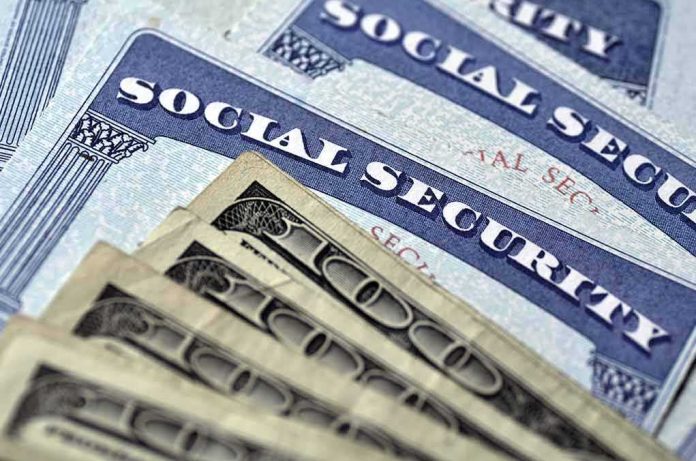
Social Security’s own books now show a painful truth: without Congress stepping up soon, retirees will face an automatic cut of roughly one‑fifth in their monthly checks once the trust fund runs dry around 2032.
Story Snapshot
- Social Security’s main retirement trust fund is projected to be depleted in late 2032, a few months earlier than last year’s forecast.
- Under current law, depletion does not end Social Security, but it does trigger an automatic benefit cut in the 20%–24% range.
- More than 70 million Americans could see smaller checks, hitting middle‑class retirees who planned their lives around promises from Washington.
- President Trump’s administration now owns the problem and the chance to fix decades of fiscal mismanagement before seniors pay the price.
Trust Fund Deadline Moves Closer For Retirees
The Social Security Administration’s latest Trustees Report says the Old‑Age and Survivors Insurance trust fund can pay full benefits only until the fourth quarter of 2032. At that point the reserves that built up over past decades are gone, and ongoing payroll taxes would cover about 78 percent of promised benefits. Financial groups translate that shortfall into a roughly 22 percent across‑the‑board cut for every retiree and survivor who depends on a monthly check. This new date is several months earlier than last year’s forecast, showing the problem is getting worse, not better.\
New bipartisan plan seeks to prevent Social Security benefit cuts before trust fund depletionhttps://t.co/1VweKgeXnS.
Ponzi schemes just don’t work well, even when it’s the government.— k palm (@hawk14112) July 21, 2026
Reporters and analysts note that this is not the first time Social Security has raced toward insolvency. In the 1980s, Congress waited until the last minute and then raised taxes and changed benefits to keep the program alive. Today’s projections follow a familiar pattern: officials issue a dry actuarial warning, then outside groups turn it into a simple message of “about a 22 percent cut” if nothing is done. For conservative readers, the key fact is clear: the law allows no bailouts or money printing here. Once the trust fund is empty, Washington cannot legally pay more than it collects.
What A 20%–24% Cut Would Mean For Seniors
Policy analysts estimate that if Congress does not act, the average retiree could lose around $450 to $500 a month from their Social Security check. The Committee for a Responsible Federal Budget warns that in some states the typical cut would be even larger, thanks to higher average benefits in those areas. The Congressional Budget Office has modeled a drop in payments of roughly 28 percent in some scenarios, while other experts land closer to 20 or 21 percent, but all agree the hit will be large and permanent under current law. For many seniors, that is the difference between paying the mortgage and falling behind, or between buying medicine and skipping doses.
These numbers also expose a deeper unfairness that many conservatives have complained about for years. The Roosevelt Institute points out that the shortfall grew as more income flowed to very high earners whose pay above a set cap is not taxed for Social Security. That means middle‑class workers paid in every paycheck, while the wealthy and Washington enjoyed decades of rising revenue elsewhere and ignored the trust fund’s long‑term health. Now, everyday retirees who followed the rules are told they must accept smaller checks because political leaders refused to fix the math when they had the chance.
Why The Problem Exists And Who Must Fix It
The Trustees Report and outside research agree on the basic cause: promised benefits are growing faster than the payroll taxes that fund Social Security. Demographics are a big driver. Americans are living longer, and there are fewer workers for each retiree, so today’s taxes must stretch over more years of payments. On top of that, taxable wages did not keep pace with the broader economy as inequality rose, weakening the base that Social Security depends on. Since the program can only pay what it collects once reserves are gone, this mismatch shows up as that 20%–24% benefit gap just ahead.
For calendar year 2025 (the most recent full year with finalized data from the 2026 Trustees Report): https://t.co/ErAjHiLLJa
Combined OASI + DI Trust Funds (Social Security)Total Income: $1.45 trillionNet payroll tax contributions: ~$1.32 trillion (the vast majority)
Taxation…— Richard Belloff (@rrbelloff) July 23, 2026
Fiscal watchdogs warn that every year of delay makes the fix harder. Actuaries at the Social Security Administration calculate that if lawmakers act soon, changes can be phased in gently. If they wait until the trust fund is on the brink, cuts or tax hikes would need to be much steeper to close the hole. For conservatives, this is a classic case of big government putting off hard choices, then forcing ordinary Americans to pay when the bill comes due. President Trump’s team now has an opening to demand a solution built on limited government, respect for workers who funded the system, and protection for current retirees rather than new spending schemes.
Sources:
theatlantic.com, cnbc.com, aarp.org, bipartisanpolicy.org, pgpf.org, npr.org, usatoday.com, crfb.org, conduitstreet.mdcounties.org, en.wikipedia.org, facebook.com, thefiscaltimes.com, theconversation.com, youtube.com