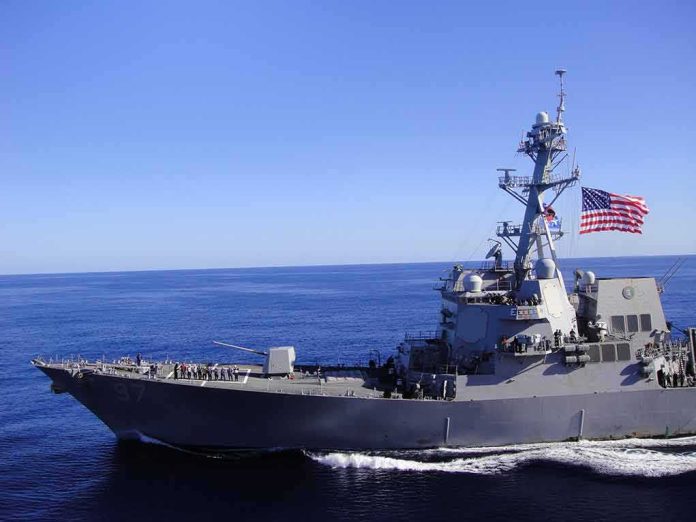
As American bombs hit Iran for the tenth straight night, the fight over one narrow waterway is quietly reshaping global power — and reminding many Americans that distant wars keep exploding because our leaders never fix the causes at home or abroad.
Story Snapshot
- The United States confirms 10 straight nights of strikes on Iranian military targets tied to tanker attacks in the Strait of Hormuz.
- Iran claims the waterway is under its control and reports dozens of deaths, while denying some U.S. shipping claims.
- Global oil prices jump and airlines cut routes, showing how a small strait can hit wallets and jobs far from the Gulf.
- Both countries accuse each other of breaking a ceasefire and a recent agreement, feeding public anger at unaccountable “elites” on all sides.
What Exactly The U.S. Says It Is Doing And Why It Matters
The United States Central Command says U.S. forces are in their 10th straight night of strikes against Iranian military targets near the Strait of Hormuz. Officials say the goal is to reopen the strait and stop attacks on commercial ships, not to start a full invasion. Recent strikes have hit Iranian air defenses, command centers, coastal radar sites, anti-ship missiles, and more than sixty small military boats, which the U.S. calls a key part of Iran’s “mosquito fleet” used to harass tankers.
Central Command describes the strikes as designed to “degrade” Iran’s ability to attack civilian mariners and commercial ships moving through the waterway. U.S. officials say one trigger was a drone assault on a cargo vessel that damaged its upper deck, along with other recent attacks that left ships disabled and crews forced to abandon ship. Secretary of State Marco Rubio has told reporters the “only reason” for these strikes is Iran’s attacks on global commercial shipping, tying the campaign directly to protecting trade routes rather than regime change.
The Iranian Response: Sovereignty Claims, Casualty Numbers, And Denials
Iran’s leaders tell a very different story. The Islamic Revolutionary Guard Corps says the Strait of Hormuz is under Iranian sovereignty and that Iran will continue to “manage” passage there, framing U.S. strikes as foreign interference in their backyard. Iranian officials claim the United States broke a new memorandum of understanding by revoking an oil sanctions waiver, calling it a “blatant violation” that helped trigger this crisis. State media outlets report more than fifty people killed and hundreds wounded by U.S. attacks, pushing the idea that America’s “measured” response is anything but.
Iran’s Revolutionary Guards also deny some U.S. claims about safe shipping, saying no commercial vessels crossed the strait during certain hours when Washington insisted tankers had moved under U.S. protection. They argue that at least one hit vessel ignored repeated warnings and safe lanes announced by Iran’s Ports and Maritime Organisation, implying Iran was enforcing rules rather than firing at random. At the same time, Iran has not provided public forensic proof—like drone parts or missile fragments—to disprove U.S. accusations about who launched specific attacks, leaving both sides trading statements instead of hard evidence.
A Dangerous Pattern: Tit-For-Tat Strikes And A Strained Global Economy
This showdown fits a longer pattern many readers will recognize: short ceasefires, sudden attacks, and fast “retaliatory” strikes that do not solve anything. A sixty-day truce negotiated in mid-June collapsed within weeks after new attacks on ships, sending both countries back into a cycle of blows and counterblows. Earlier this year, U.S. and Israeli forces carried out nearly nine hundred strikes in twelve hours against Iran’s nuclear and military sites, showing just how quickly limited conflict can surge.
IRAN WAR ~ Nearly 100 US service members have been injured over the last two weeks of escalating U.S. strikes on Iran. The vast majority of those injured only experienced “minor concussions” and 96% had since returned to work. In the last week three US soldiers have been killed… pic.twitter.com/nHfNcs6m2z
— J.Michael Dennis ll.l., ll.m. (@jmdlive) July 21, 2026
For everyday people, the cost shows up less in military maps and more in their bank accounts. Analysts warn that Brent crude prices have already climbed toward ninety dollars a barrel, and could push higher if the Strait of Hormuz stays disrupted, since a large share of global oil flows through this narrow passage. Airlines such as Air France have suspended flights to Gulf hubs over security fears, while shipping insurance costs rise and some tankers reroute around the region at greater expense. Workers and families far from the Middle East see higher gas prices, more expensive goods, and fresh pressure on already tight budgets.
Why Both Left And Right Feel The System Is Failing
For many Americans, this latest clash reinforces a familiar frustration: leaders in Washington seem able to fund endless foreign strikes but rarely fix the problems blocking the American Dream at home. Conservatives who resent decades of “globalist” wars and high energy costs see another conflict risking higher fuel prices and heavier debt. Liberals angry about shrinking social programs and growing inequality see money and focus flowing to missiles and drones while housing, health care, and wages lag behind.
Policy experts note that Iran and the United States have settled into a “blockade versus blockade” standoff, with Iran disrupting shipping and America blockading Iranian ports instead of pursuing durable political solutions. Central Command talks about “short and powerful” strikes to change Iran’s behavior, but the record shows repeated operations and rising costs rather than a clear endgame. That kind of open-ended conflict, chosen by a small group of political and military elites, feeds the belief on both left and right that the system mainly serves insiders, not citizens.
What To Watch Next: Evidence, Oversight, And Pressure On Leaders
There are ways this could become more accountable, though they depend on political will. Independent forensic analysis of the drones and missiles used on tankers could confirm who is truly behind each attack, reducing spin from both Washington and Tehran. Crew testimony and detailed logs from maritime safety agencies could clarify whether vessels ignored lawful warnings or were hit without cause. Releasing the full text of the recent U.S.–Iran memorandum of understanding would also let the public judge which side broke its promises.
Congress and the media could press harder for these facts, as well as for clear limits on how long U.S. forces will strike Iran and what conditions must be met before attacks stop. Without that kind of oversight, Americans may feel once again that decisions about war, oil, and trade are made far above their heads, by people who answer more to donors and bureaucracies than to voters. In that sense, the battle over one narrow strait is also a test of whether the United States still lives up to its own founding promise of government by and for the people, not just for the powerful.
Sources:
facebook.com, jns.org, ajc.com, bbc.com, cnbc.com, npr.org, cbsnews.com, aljazeera.com, vanguardngr.com, cnn.com, youtube.com, cfr.org, en.wikipedia.org, x.com, everycrsreport.com, hudson.org