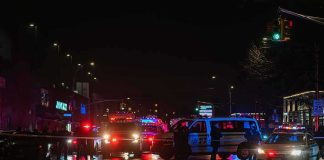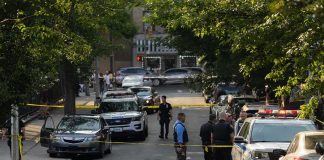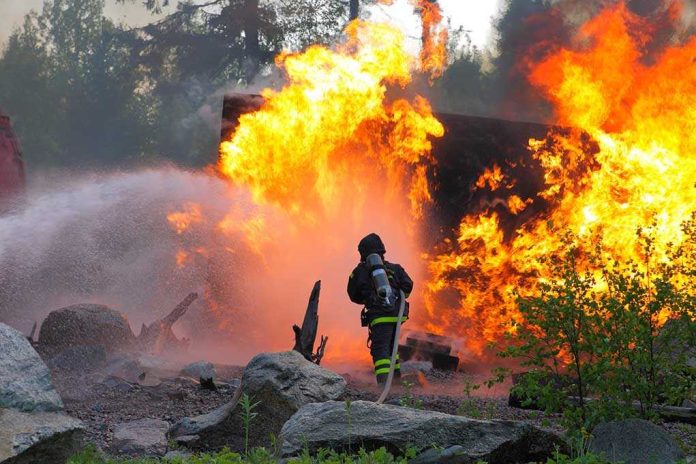
Three firefighters are dead, two are hurt, and the fire line still has not stopped moving.
Story Snapshot
- Three firefighters were killed and two were injured while responding to the Snyder wildfire on the Utah-Colorado border.
- Colorado Governor Jared Polis declared a disaster emergency response and called in the Colorado National Guard.
- The fire was estimated at 28,000 acres and remained at 0% containment.
- Officials said the blaze started as the Snyder Mesa Fire, then merged with the Jones and Knowles fires.
What Happened on the Border
Reuters reported that three firefighters were killed and two others were injured while responding to the Snyder wildfire burning along the Utah-Colorado border. The Colorado governor’s office said the fire had burned an estimated 28,000 acres and was still at 0% containment. Officials also said the fire began Saturday morning as the Snyder Mesa Fire in eastern Utah’s Grand County before spreading into Colorado and merging with smaller fires there.[1]
KUTV and NPR both said the firefighters were responding to the Knowles and Gore fires, while Reuters used the Snyder wildfire name. That naming mix matters because it shows how fast the incident changed as the flames crossed the state line and fused into one larger fire. Even before the smoke cleared, the public record was already catching up to a fast-moving emergency.[2][5]
Why This Fire Drew a Fast Response
Governor Polis declared a disaster emergency response on Saturday and authorized the Colorado National Guard to support response efforts.[1] That move shows how quickly local fire crews, state leaders, and federal land managers had to react once the blaze jumped borders and began threatening smaller communities in Mesa County. Evacuation warnings were issued as the fire spread, which is a sign that officials saw the risk as immediate, not distant.
The situation also fits a wider pattern that many Americans know too well. A wildfire can move from a local emergency to a regional crisis in hours, while families, crews, and small towns are left waiting for answers. In this case, the human cost came first, and the explanation came later. The available reports do not yet identify the three dead firefighters, and they give only limited details about the two injured.[1][2]
What Remains Unknown
Officials have said the deaths happened during a burnover incident, but the early public reports do not include the full tactical or weather record behind that call. They do not yet spell out the exact wind shift, terrain effect, or crew movement at the moment the firefighters were trapped. That gap is important because the first public version of a tragedy is often the simplest one, not the most complete one.[2][6]
🚨 BREAKING: Three firefighters are dead after battling a wildfire along the Utah-Colorado border.
Officials say three wildland firefighters were killed while fighting the rapidly growing #SnyderFire. Two other firefighters were seriously injured and transported to the hospital… pic.twitter.com/Sdz47r50Lg
— Chase Thomason (@ChaseThomason) June 28, 2026
The bigger issue is trust. When agencies move fast, use broad labels, and release only a few facts, the public is left to rely on official accounts with little room for independent review. Supporters of aggressive response will see urgency and sacrifice. Critics will see another example of institutions asking for patience before giving a full accounting. Both views can exist at once, and both are sharpened when lives are lost on public land.
Sources:
[1] Web – 3 firefighters killed, 2 injured while tackling wildfires on the …
[2] Web – Three Firefighters Killed, 2 Injured in Snyder Wildfire on Utah …
[5] X – Three firefighters died and two were injured while tackling fires on …
[6] Web – Three firefighters killed, 2 injured in Snyder wildfire on Utah …