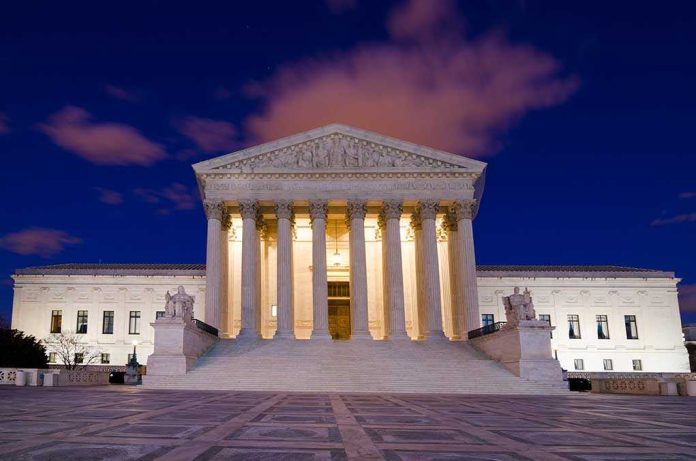
The Supreme Court just handed Bayer a major shield from Roundup cancer lawsuits, and it raises big questions about who really protects American families.
Story Snapshot
- Supreme Court ruled 7–2 that federal pesticide law blocks many state cancer warning lawsuits against Bayer.
- Environmental Protection Agency (EPA) says glyphosate in Roundup does not cause cancer and never required a warning label.
- World Health Organization calls glyphosate “probably carcinogenic,” and Bayer has already paid over $10 billion to settle cases.
- The ruling is a legal win for Bayer but leaves serious trust and health concerns for American families and farmers.
Supreme Court Gives Bayer a Big Legal Victory
The United States Supreme Court ruled 7–2 that federal pesticide law blocks many state lawsuits claiming Bayer failed to warn that Roundup could cause cancer.[2] Justice Brett Kavanaugh wrote the opinion, saying federal law on pesticides preempts, or overrides, state failure-to-warn claims when the Environmental Protection Agency has approved a label without a cancer warning.[2] The court overturned a $1.25 million Missouri jury verdict for John Durnell, who said years of Roundup use led to non-Hodgkin lymphoma.[1]
The case, Monsanto v. Durnell, turned on the Federal Insecticide, Fungicide and Rodenticide Act, the main federal pesticide law.[2] That law requires one national label and bars states from forcing extra or different warnings. Kavanaugh said Durnell’s claim would effectively require Monsanto to add a cancer warning even though federal law requires the EPA-approved label without one.[2] This logic now threatens thousands of similar cases in state courts, many brought by longtime users who believe Roundup contributed to their cancer.[1]
The Supreme Court ruled in favor of Bayer on Thursday in its fight against lawsuits accusing the company of not warning of the cancer risks of the weedkiller Roundup and its chemical glyphosate. https://t.co/7xc72waMxg
— The Washington Times (@WashTimes) June 25, 2026
EPA Says “No Cancer,” But Other Evidence Raises Doubts
Justice Kavanaugh leaned heavily on the Environmental Protection Agency’s long-standing position that glyphosate, Roundup’s active ingredient, does not cause cancer and does not need a cancer warning.[1] Bayer has repeated for years that the EPA has reviewed glyphosate many times and approved Roundup labels without any cancer notice.[2] This was central to Bayer’s argument that it simply followed federal science and law and should not be punished under different state rules.[2]
But many conservatives will see a problem here. The World Health Organization’s International Agency for Research on Cancer classified glyphosate as “probably carcinogenic to humans” back in 2015, based on peer-reviewed studies.[7] Bayer has already paid more than $10 billion to settle claims from people who believe Roundup led to non-Hodgkin lymphoma and other cancers.[1] Internal “Monsanto Papers” released in earlier lawsuits allegedly show the company ghostwrote scientific articles and worked with regulators during safety reviews, raising serious worries about regulatory capture and bad science.[4]
Dissent Warns About Overreach and Accountability
Two justices, Ketanji Brown Jackson and Neil Gorsuch, dissented from the ruling.[2] They argued that Durnell’s claim should not be wiped out because it did not really demand a label different from federal law but simply sought to hold the company accountable under equivalent duties.[2] Their dissent suggests the law on preemption is not perfectly clear and that courts still need room to hear real injury claims when evidence shows possible harm.
Legal scholars have noted that chemical companies have used federal preemption for decades to avoid state tort liability for pesticides, with mixed success across courts.[8] This ruling pushes the balance further toward industry, especially when federal agencies side with manufacturers. For many readers who value the Constitution, limited government, and honest science, the concern is simple: when Washington agencies make a mistake or get too cozy with big corporations, ordinary Americans lose their day in court.
Trump-Era EPA, Bayer, and the Trust Gap
Bayer’s win comes after years of heavy lobbying and close contact with regulators. EPA visitor logs and reporting show the agency’s leadership met with Bayer executives while litigation and labeling issues were on the table.[4] Emails cited in prior coverage suggest industry voices pushed back against state-level cancer warnings, especially in places like California, and thanked regulators when support for those warnings faded.[4] Even if the data review followed formal rules, these ties fuel doubts for families who already distrust “the swamp.”
The Trump administration has stood for cutting red tape, supporting farmers, and stopping abusive lawsuits, and many conservatives welcome clearer national rules.[10] At the same time, core conservative values demand that government serves the people, not global corporations. When a foreign company like Bayer gains a powerful liability shield through a mix of agency science and Supreme Court doctrine, many patriots will ask whether regular Americans still have a fair shot at justice if they are harmed.
What This Means for Farmers, Families, and the MAHA Push
This ruling will likely slash the number of Roundup cancer cases that can survive in state courts.[3] Bayer has said it hopes the decision will greatly reduce litigation after nearly ten years of battles.[4] Yet the company is still promoting a proposed $7.25 billion class-action settlement to cover many remaining claims, which shows it does not see the book as fully closed.[1] Markets cheered the news, but many families and farmers are left wondering whether health risks were simply moved off the courtroom stage.
Outside the courts, pressure keeps building. The Make America Healthy Again movement, led by Robert F. Kennedy Jr., is campaigning hard against glyphosate and other pesticides, pointing to rising cancer rates and metabolic problems.[6] Polls show broad support for reducing chemical use in food and farming.[6] Even with Bayer’s legal win, public opinion may keep shifting toward tighter rules, more transparency from the EPA, and independent studies on long-term exposure. For conservatives, the path forward is clear: defend real science, demand honest regulators, and make sure no corporation stands above accountability when American lives are on the line.
Sources:
[1] Web – Bayer wins in Roundup cancer case in the Supreme Court
[2] Web – Bayer wins in Roundup cancer case in the Supreme Court
[3] Web – US Supreme Court scales back Roundup cancer lawsuits in victory for …
[4] Web – Supreme Court to Hear Bayer Roundup Case on Cancer Warnings
[6] Web – Supreme Court will hear appeal by maker of popular Roundup weedkiller …
[7] Web – The War Over a Weedkiller Might Be Headed to the Supreme Court
[8] Web – US Supreme Court to hear Bayer’s bid to curb Roundup cases
[10] Web – Supreme Court agrees to hear longstanding fight over Roundup cancer …