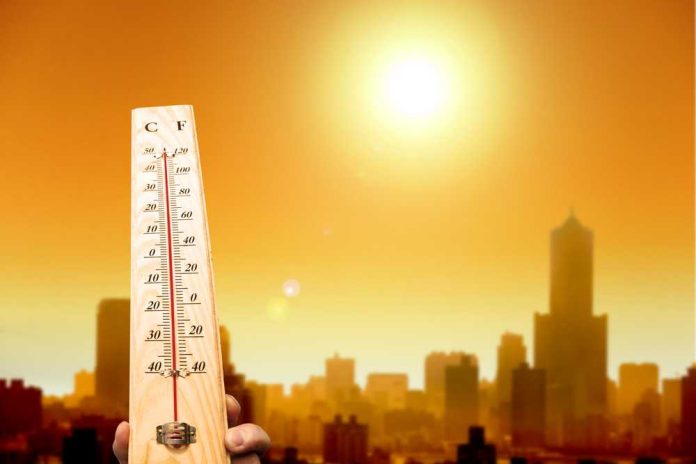
A rare “danger to life” red heat warning in the UK shows how fast unelected climate bureaucrats can shut down daily life while global elites shout “crisis” and demand more control.
Story Snapshot
- The Met Office has issued a rare red extreme heat warning, its highest “danger to life” alert level.
- United Kingdom Health Security Agency heat alerts now treat the whole population as at risk, not just the vulnerable.
- Media and global bodies rush to frame the heat as a climate “crisis,” pushing more regulation and spending.
- Transport, farming, and everyday life face disruption as warnings and policies expand well beyond basic safety.
What a Met Office Red Warning Really Means
A Met Office red warning is the top weather alert in the United Kingdom, used when extreme conditions are expected to cause real danger to life and major disruption. It is rarely issued and only when forecasters believe record or near-record temperatures will hit large areas and normal life could be seriously affected.[8] During this current heat event, the red warning covers parts of central and southern England and Wales as temperatures are forecast to push past 38 degrees Celsius, with the risk window stretching over key midweek days.[9]
Under a red warning, officials expect widespread impacts on health, transport, power networks, and day-to-day activity.[1] That includes a higher chance of people getting seriously ill or dying, even if they are normally healthy, not just those already classed as vulnerable.[2] Government guidance urges people to stay indoors during the hottest hours, keep homes shaded and cool, and look out for older neighbours, while also quietly preparing hospitals, ambulance services, and local councils for a spike in heat-related emergencies.[4]
A severe heatwave gripped much of Europe, with temperatures nearing 104 degrees Fahrenheit, prompting nationwide warnings, transport disruption and signs of strain on wildlife https://t.co/Si9EKOgXPH pic.twitter.com/vx81PTahUO
— Reuters (@Reuters) June 22, 2026
How Red Heat Alerts Tie Into Health, Travel, and the Economy
The Met Office red warning overlaps with separate “heat health alerts” from the United Kingdom Health Security Agency, which raised alerts to amber and above when hot conditions threaten the wider population.[2] These alerts push the health system to act as if the whole country is at higher risk, from care homes and hospitals to social workers doing checks on people living alone. Health models used by European experts estimate hundreds of extra deaths can occur over just a few very hot days, especially among older people and those with heart or lung problems.[10]
Extreme heat does not only strain hospitals. Past events in Europe show that heatwaves can buckle rail tracks, warp roads, disrupt power cables, and slow or cancel trains when operators impose speed limits to avoid accidents.[4] Aviation and road travel can also be hit if tarmac softens or visibility drops. Farmers face their own problems: flash drought, poor rainfall, and high temperatures can stress crops and livestock, force early irrigation, and drive up costs. Some analysts warn of potential agricultural losses in the hundreds of millions of pounds, though those figures often come from media or commentators rather than audited government accounts.[4]
Real Dangers from Heat – and the Media’s “Crisis” Chorus
Heatwaves are not just about feeling uncomfortable; they can kill. Reports from recent European heat events describe athletes collapsing, a runner dying during a ten-kilometre race in Paris, and multiple people rushed to hospital in critical condition.[9] Other deaths do not come from heatstroke itself but from risky choices people make to cool off. Several reports from European coverage describe drowning cases, including teenagers and older adults, after sudden “cold water shock” when jumping into rivers or lakes during hot spells.[10]
Alongside these real dangers, global organisations and many media outlets quickly label every major heatwave as proof of a sweeping climate “crisis.” United Nations climate officials have called recent European heat events a “brutal reminder” of climate change, blaming the burning of coal, oil, and gas and using the events to argue for more aggressive climate policies.[7] European climate agencies say extreme heat is now the leading cause of weather-related deaths on the continent and warn that current intervention plans may soon be “insufficient,” feeding calls for broader regulations on housing, transport, energy use, and even work rules.[19]
Why These Warnings Raise Bigger Questions About Power and Policy
For ordinary people, there is no doubt that 35 to 38 degrees Celsius in a country built for cool, damp weather can be dangerous, especially in crowded cities and poorly ventilated homes.[3] Simple, common-sense advice like staying hydrated, checking on vulnerable neighbours, and avoiding midday exertion saves lives and reflects basic personal responsibility.[1] But the way heat is framed also matters. When every hot spell is presented as proof of an endless crisis, many citizens start to feel alarm fatigue and distrust constant high-level alerts.[9]
There are also questions about how far unelected officials and agencies will take their new powers. Climate-focused departments, national weather services, and health agencies receive large public grants tied to climate and health programmes, which can create pressure to emphasise worst-case scenarios and justify new rules and spending.[21] At the same time, social media platforms often label or limit posts that challenge the dominant climate narrative, narrowing public debate and making it harder to ask basic questions about costs, trade-offs, and practical adaptation. The United Kingdom red warning system, like many European schemes, now sits at the crossroads of real public safety, expanding bureaucracy, and a global push for climate-driven policy change.[18]
Sources:
[1] Web – What is a Met Office red warning as rare heat alert issued for UK
[2] Web – Extreme Heat Warning extended as temperatures forecast to reach …
[3] Web – Heat-Health Alerts issued by UKHSA and the Met Office – GOV.UK
[4] Web – Amber extreme heat warning issued as 35C heatwave approaches
[7] Web – UK weather warnings – Met Office
[8] Web – extreme heat warning expanded as 37C heatwave approaches UK
[9] Web – Heat health alerts – UKHSA data dashboard
[10] Web – European Heatwave a ‘Brutal Reminder’ of Climate Crisis – Impakter
[18] Web – Climate scientist are saying that misleading claims on Europe’s …
[19] Web – Europe’s Heat Wave Has the ‘Fingerprints of Climate Change All …
[21] Web – Overview of Existing Heat-Health Warning Systems in Europe – PMC