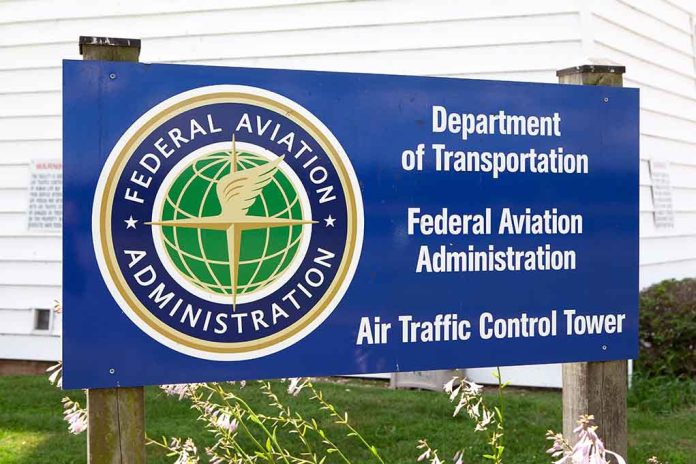
Newark Liberty International Airport has been deemed “unsafe” by an air traffic controller as staffing shortages, equipment failures, and deteriorating infrastructure threaten passenger safety and create travel chaos.
Key Takeaways
- Newark Airport has lost 20% of its air traffic controllers recently, forcing United Airlines to cancel 35 round-trip flights daily
- Air traffic control equipment failures have caused dangerous situations, including radar outages and communication losses with aircraft
- United Airlines CEO Scott Kirby warns there is “no way to resolve the near-term structural FAA staffing issues”
- The FAA is short approximately 3,000 air traffic controllers nationwide, with the problem particularly severe in New York City’s airspace
- Airport infrastructure is in poor condition with broken facilities and cleanliness issues, excluding United’s recently remodeled concourse
Crisis in the Control Tower
Newark Liberty International Airport has become ground zero for a perfect storm of airline industry problems. The facility is chronically understaffed, with Newark having lost a staggering 20% of its air traffic controllers in recent months. This critical shortage has forced United Airlines, which uses Newark as a major hub, to cancel 35 round-trip flights daily just to accommodate the reduced staff capacity. The situation has become so dire that Newark is now leading the nation in flight delays and cancellations, with a recent Monday seeing 42 flights (8% of departures) canceled before noon.
The staffing crisis extends far beyond Newark. The Federal Aviation Administration (FAA) is short approximately 3,000 air traffic controllers nationwide, with the problem particularly severe in New York City’s airspace. This shortage has led to required flight reductions across multiple airports, creating a ripple effect throughout the entire air travel system. Budget cuts at the FAA have only exacerbated these problems, with equipment maintenance suffering and technology failures becoming increasingly common.
I fly all the time. The system is safe.
But we must build an all new air traffic control system to make sure the system stays safe and prevent outages like Newark. pic.twitter.com/3rlER9nkMw
— Secretary Sean Duffy (@SecDuffy) May 6, 2025
Dangerous Equipment Failures
The staffing crisis is compounded by frightening equipment failures that have put passengers at risk. Recent incidents have included radar outages and complete loss of communication with aircraft, forcing controllers to use backup systems and causing numerous diversions and cancellations. These technological failures have transformed what should be routine flights into potentially dangerous situations, leaving both passengers and airline staff in jeopardy.
“There is no way to resolve the near-term structural FAA staffing issues,” he said in a letter to customers released Friday evening. said Scott Kirby United Airlines CEO
The technological infrastructure problems were dramatically demonstrated when air traffic control screens went dark at Newark, creating a chaotic situation for controllers trying to manage the complex airspace. These equipment failures have become so frequent that airlines have been forced to factor them into their operational planning, with United voluntarily reducing its schedule at Newark in an attempt to mitigate the disruptions caused by both staffing and equipment issues.
Deteriorating Infrastructure
Beyond the critical air traffic control issues, Newark’s passenger experience has become equally problematic. The airport infrastructure, with the sole exception of United’s recently remodeled concourse, is in poor condition. Travelers routinely encounter broken escalators and elevators, cleanliness issues, and a generally deteriorating facility. The surrounding area of the airport has been described as equally run-down, contributing to an overall negative impression for visitors to the New York metropolitan area.
“These challenges are not new to Newark. United has been urging the US government for *years* to use its authority to effectively limit the number of flights to what the airport can realistically handle,” Kirby said in his letter. “Past failure to make those changes had led to the circumstances that United and, most importantly, our customers now face. said Scott Kirby, United Airlines CEO
While the FAA has announced plans for new air traffic control equipment and is taking steps to improve the current technology infrastructure, these solutions are years away from implementation. In the meantime, travelers are advised to prepare for possible disruptions, book flights earlier in the day when possible, and explore rebooking options if needed. Unfortunately, compensation for delays or cancellations related to these issues may not be available, as they are often considered outside the airline’s control, leaving passengers to bear the financial burden of the government’s infrastructure failures.