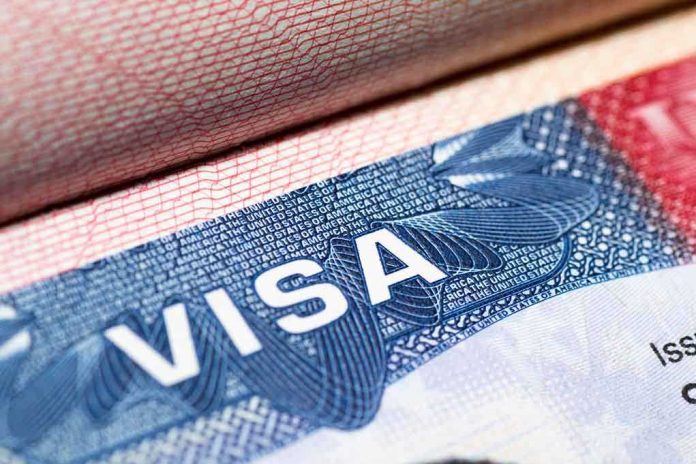
President Trump’s decision to welcome 600,000 Chinese students into the U.S. is stirring controversy among his core supporters, threatening to undermine the “America First” stance.
Story Highlights
- Trump’s policy reversal on Chinese student visas has sparked backlash from his “America First” supporters.
- U.S. universities, especially lower-tier ones, rely heavily on international tuition for financial stability.
- Howard Lutnick argues that without Chinese students, many American universities could face closure.
- The move is seen as a pragmatic economic decision, but raises concerns over national security and ideological consistency.
Economic Necessity vs. Nationalist Ideals
U.S. Secretary of Commerce Howard Lutnick publicly supported President Trump’s decision to admit 600,000 Chinese students into American universities. This move, justified on economic grounds, is designed to prevent the financial collapse of many lower-tier institutions that depend on international tuition revenue. Lutnick emphasized that without these students, approximately 15% of American universities could go out of business.
This policy reversal, however, has ignited a fierce backlash from Trump’s “America First” supporters who view it as a departure from previously strict visa policies targeting Chinese students, particularly in sensitive fields. The administration had earlier implemented stringent visa scrutiny to curb potential espionage risks and protect national security.
Political and Ideological Backlash
The decision to allow a large influx of Chinese students is a significant shift from the administration’s earlier hardline stance. This has led to criticism from conservative commentators and the MAGA base, who argue that the policy undermines the core principles of the “America First” agenda. These supporters are concerned that the decision prioritizes economic benefits over national security and ideological purity.
Fox News host Laura Ingraham has been particularly vocal, framing the move as a betrayal of Trump’s campaign promises to prioritize American interests. Meanwhile, Trump and his administration face the challenge of balancing economic needs with political optics, as they navigate the backlash from their core supporters.
Implications for U.S.-China Relations
This policy shift comes amid ongoing trade negotiations and a fragile truce between the U.S. and China. While the move may temporarily stabilize financial conditions for U.S. universities, it could also strain Trump’s relationship with his political base. The decision is seen as a pragmatic step to maintain economic stability and leverage in trade talks with China, but it raises questions about the long-term implications for U.S.-China relations and domestic policy.
Do we really need to allow 600,000 spies into the country to save our schools?
Lutnick: Without 600k Chinese Students, 15% of Schools Will ‘Go Out of Business‘ Since ‘Students Would Go Up to Better Schools‘ https://t.co/GWnX3A3nYh via @BreitbartNews
— John J (@lehmanjohnj) August 26, 2025
As the debate continues, stakeholders from both sides of the political spectrum weigh the potential benefits against the perceived risks, highlighting the complex dynamics of international education and national policy.