The Supreme Court’s decision to lift limits on federal immigration raids in Los Angeles reignites the battle over border security, federal power, and constitutional rights—delivering a major win for Trump’s enforcement-first agenda while raising alarms over the erosion of the Fourth Amendment.
Story Snapshot
- The Supreme Court allowed the Trump administration to resume broad immigration raids in Los Angeles, overriding prior restrictions.
- This move reverses earlier court findings that such enforcement likely violated constitutional protections against unreasonable searches.
- Liberal justices and civil rights groups argue the ruling could legitimize racial profiling and government overreach.
- The legal battle continues, with further hearings scheduled to determine the long-term future of these tactics.
Supreme Court’s Ruling Restores Trump-Era Immigration Raids in LA
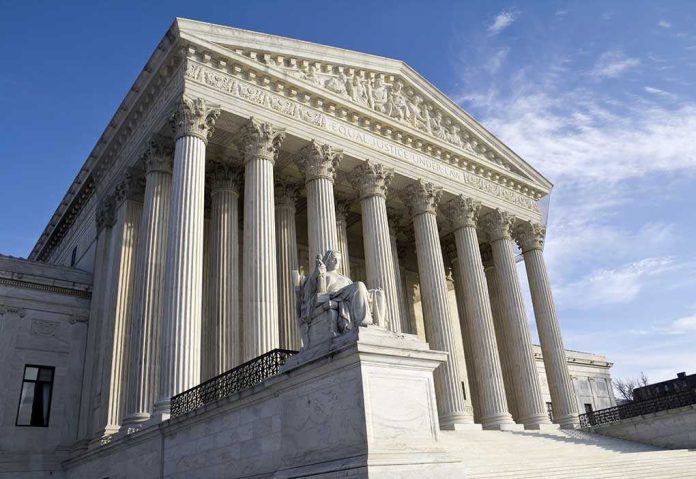
On September 8, 2025, the Supreme Court granted the Trump administration’s emergency request to stay a lower court’s order that had blocked federal immigration raids in Los Angeles and nearby counties. This unsigned order, which included no legal explanation, immediately enabled the Department of Homeland Security and Immigration and Customs Enforcement to resume aggressive enforcement actions that had been previously limited due to concerns about targeting individuals based solely on race, language, location, or occupation. The decision marks a pivotal moment for federal immigration policy and the administration’s ongoing pledge to restore law and order.
The original restraining order, issued by a district court in June 2025, came as a response to large-scale raids at locations such as car washes, farms, and public parks. Plaintiffs, represented by civil rights organizations, argued that these operations violated the Fourth Amendment by permitting stops and detentions without reasonable suspicion. The Supreme Court’s stay means these concerns will continue to play out in court, but for now, federal agents have the green light to resume tactics supporters say are vital for national security—and critics claim are unconstitutional and discriminatory.
Legal and Political Divide: Constitutional Rights Versus Federal Authority
The Supreme Court decision has sharply divided public officials and legal experts. While the conservative majority enabled federal enforcement to proceed, dissenting justices, including Sotomayor, Kagan, and Jackson, warned of grave constitutional violations and possible harm to both citizens and legal residents. Civil rights advocates argue that the ruling sets a precedent for broader use of racial profiling and diminishes hard-won protections against unreasonable searches and seizures. On the other hand, the Trump administration and its supporters view the ruling as a long-overdue correction to what they see as judicial activism and leftist obstruction that undermined the nation’s sovereignty and border security.
Justice Brett Kavanaugh, in a concurring opinion, acknowledged that ethnicity could be a “relevant factor” in law enforcement stops, though he conceded there is a risk of mistakenly detaining lawful residents and Americans. This rationale reflects the broader Trump-era philosophy that federal immigration authority must not be hamstrung by what they view as activist judges or local officials who refuse to cooperate with federal law. The ongoing legal fight, with another hearing scheduled for September 24, will determine whether these raids remain the norm or are once again curtailed by the courts.
Broader Impacts: Community, Economy, and National Debate
The immediate effect of the Supreme Court’s order is the resumption of immigration sweeps in one of America’s largest urban centers. For immigrant communities in Los Angeles, this has triggered renewed fear and uncertainty, while local businesses—especially in industries reliant on immigrant labor—face potential disruptions. Protests and outcry have surged, reflecting deep societal divisions over the balance between security and civil liberties. Conservatives see these raids as an essential step toward restoring the rule of law after years of lax enforcement and open-border chaos. Meanwhile, critics warn that unchecked federal power risks eroding the very constitutional principles that define American freedom.
Supreme Court Grants Trump Admin's Emergency Request, Lifts Biden Judge's Limits on ICE Patrols in LA via @WestJournalism https://t.co/lU2ziPKzOS
— meme (@mmemmepoppins) September 9, 2025
Looking ahead, the long-term implications go far beyond Los Angeles. If upheld, the Supreme Court’s decision could embolden future administrations to use similar tactics nationwide, potentially expanding law enforcement authority at the expense of individual rights. Legal scholars caution that the lack of a detailed legal rationale in the Court’s unsigned order raises troubling questions about transparency and accountability for such sweeping exercises of power. For Americans who value limited government, the separation of powers, and protection against arbitrary search and seizure, the outcome of this ongoing legal battle will shape the boundaries of federal authority for years to come.
Sources:
US Supreme Court Grants Stay in LA Raids Case
Supreme Court Order and Opinions in Vasquez Perdomo v. Noem
LA Immigration Sweeps: Supreme Court Ruling Explained
Supreme Court Allows Federal Officers to More Freely Make Immigration Stops in Los Angeles