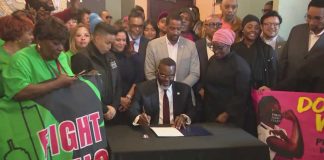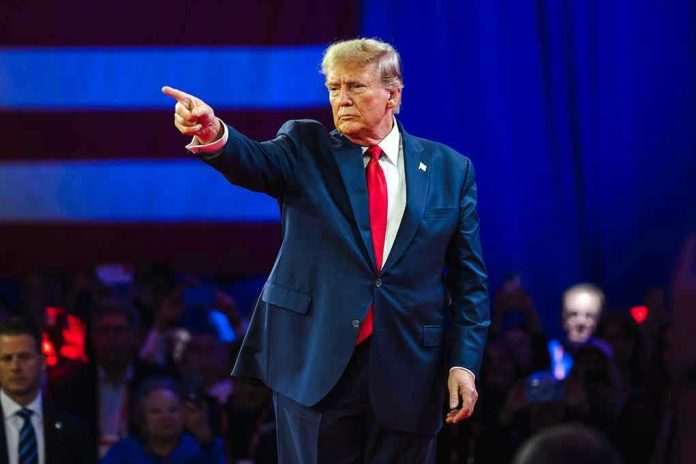
President Trump’s new executive orders strike at the heart of progressive bail reform, threatening to pull federal funding from cities that refuse to prioritize public safety over leftist criminal justice experiments.
Story Snapshot
- President Trump signed executive orders to eliminate cashless bail nationwide and declared a “crime emergency” in Washington, D.C.
- Jurisdictions with cashless bail policies risk losing federal funding if they do not comply with the new directives.
- Supporters argue the move restores public safety and curbs rising crime; opponents warn of legal challenges and civil rights concerns.
- The orders reignite the national debate over federal authority, local autonomy, and the future of criminal justice reform.
Trump’s Executive Orders Target Cashless Bail and Crime in D.C.
President Donald Trump signed two sweeping executive orders aimed at restoring law and order across the United States. The first order directs the Department of Justice to identify cities and states that have implemented cashless bail policies and threatens to revoke federal funding from those that refuse to reinstate cash bail for certain offenses. The second order specifically targets Washington, D.C., declaring a “crime emergency” and directing federal authorities to maximize pretrial detention for suspects considered threats to public safety.
This federal crackdown comes after years of rising frustration among conservatives and law enforcement who blame cashless bail for emboldening criminals and fueling spikes in violent crime. The Trump administration frames these actions as necessary to reverse the dangerous consequences of what it calls “woke” criminal justice experiments, positioning itself as the defender of American families and traditional values. The orders invoke the same funding leverage previously used against sanctuary cities, signaling a return to strong executive action to override local policies that are seen as undermining national security and order.
The Roots and Controversy of Cashless Bail
Cash bail has historically served as a mechanism to ensure defendants return for trial, but critics argued it unfairly punished low-income individuals who could not afford to pay. Progressive lawmakers in several states and cities eliminated or reduced cash bail requirements over the past decade to address perceived inequities. However, a series of high-profile crimes involving suspects released without bail ignited a nationwide backlash. Republicans, including President Trump, argue these reforms directly contributed to an erosion of public safety. Democrats and civil rights advocates counter that cashless bail is a necessary correction to a system that disproportionately detains the poor and minorities.
The executive orders arrive at a moment of heightened national debate. The administration’s threat to withhold federal funding has precedent in federal-state relations, but it also raises questions about constitutional limits on federal power. Local governments now face the difficult choice of maintaining progressive reforms at the risk of losing critical grants for public safety, infrastructure, and social services.
Key Stakeholders and Political Dynamics
President Trump and Attorney General Pam Bondi are leading the charge, directing the Department of Justice to enforce compliance nationwide. State and local officials in Democratic-led cities, many of whom championed cashless bail, are now under pressure to rethink their policies or face severe budgetary consequences. Advocacy groups, including civil liberties organizations and police unions, are lining up on opposing sides, with law enforcement broadly supporting stricter pretrial detention and civil rights groups warning of negative impacts on marginalized communities and potential constitutional violations.
Legal scholars anticipate swift court challenges, questioning the extent to which the federal government can dictate local criminal justice policy through funding threats. Some experts note the Supreme Court has historically placed limits on such federal leverage, suggesting the legal battle could reach the nation’s highest court. Meanwhile, law enforcement agencies and judicial systems in targeted jurisdictions must quickly adapt to new directives, creating uncertainty for communities and officials alike.
Consequences and the Road Ahead
In the short term, cities and states with cashless bail policies face immediate uncertainty and the prospect of losing federal funding if they do not comply. This could strain local budgets, impact public safety initiatives, and potentially increase jail populations as pretrial detention rates rise. The executive orders may prompt a rollback of bail reform in many areas, reigniting the debate over public safety versus criminal justice equity. Politically, the orders energize conservative voters and place pressure on progressive leaders ahead of the 2026 midterms and 2028 Olympics, where public safety is under the national microscope.
Trump Signs Order Aimed at Eliminating Cashless Bailhttps://t.co/F6pbp4UwWy
— Washington Free Beacon (@FreeBeacon) August 25, 2025
Long-term impacts include potential Supreme Court litigation that could redefine the boundaries between federal authority and state autonomy in criminal justice. While supporters celebrate the orders as restoring common sense and reinforcing traditional values, opponents warn of increased incarceration and civil rights challenges. The debate over cashless bail is now a central fault line in the struggle over America’s future direction on law, order, and constitutional governance.
Sources:
ABC News: Cashless bail — Trump executive orders
LA Times: Trump signs executive order targeting cashless bail